
The US Dollar Index (DXY) retreated below 103.00 on Thursday after reaching 103.08, its highest level in 19 months. The pullback followed a sharp two-session advance of approximately 1.20%, leaving the broader dollar uptrend intact. Investors have increased exposure to the Greenback as persistent US inflation strengthens expectations of further Federal Reserve tightening. However, with the index approaching a significant technical resistance zone, traders are assessing whether the latest decline represents a temporary pause or the beginning of a deeper correction.
Inflation Strengthens Fed Rate Expectations
The dollar’s recent rally reflects growing confidence that the Federal Reserve will raise borrowing costs at its December policy meeting. October’s US Consumer Price Index increased 0.4% month over month, exceeding economists’ 0.3% forecast. Core CPI , which excludes food and energy, advanced 0.3% for the third consecutive month, compared with expectations for a slower 0.2% increase.
The figures reinforced concerns that inflation remains persistent despite earlier signs of moderation. Federal Reserve Governor Christopher Waller said a 25-basis-point increase would be appropriate in December under his baseline outlook, while warning that a 50-basis-point move should be considered if core inflation remained elevated. Dallas Fed President Lorie Logan also indicated that policymakers might need to tighten more quickly.
Market pricing reflects those concerns. Recent estimates put the probability of a quarter-point December increase near 90%, while the chance of a larger 50-basis-point move remains considerably smaller. These are investor expectations, not a confirmed policy decision.
The prospect of higher US interest rates tends to support the dollar by making dollar-denominated assets more attractive relative to currencies offering lower returns. Treasury yields have also risen as investors reassess the likely path of monetary policy. Reuters’ coverage of the Fed debate highlights how inflation data and policymakers’ comments have shifted market expectations.
Equity Optimism Adds to Dollar Demand
The recent advance has also coincided with stronger US equity markets and renewed enthusiasm surrounding artificial intelligence and semiconductor companies. Analysts at Commerzbank identified improving sentiment toward technology shares as another factor supporting the dollar’s advance.
That relationship can appear counterintuitive because stronger equity markets often encourage demand for risk-sensitive currencies. However, US investment flows, the relative performance of American assets and expectations for domestic economic growth can also influence demand for the Greenback.
The DXY measures the dollar against six major currencies, including the euro, Japanese yen, British pound, Canadian dollar, Swedish krona and Swiss franc. Its direction therefore reflects both US economic developments and changing conditions among the currencies in its basket.
Investors are now watching:
- Further Federal Reserve speeches for clues about December policy.
- Treasury yields for changes in interest-rate expectations.
- Upcoming US economic releases for evidence of persistent inflation.
DXY Technical Outlook: 103.10 in Focus
On the four-hour chart, the DXY is undergoing a modest correction after failing to sustain gains near the 103.10 area. This level closely matches the 161.8% Fibonacci extension of the November 5–6 advance, making it an important near-term resistance zone.
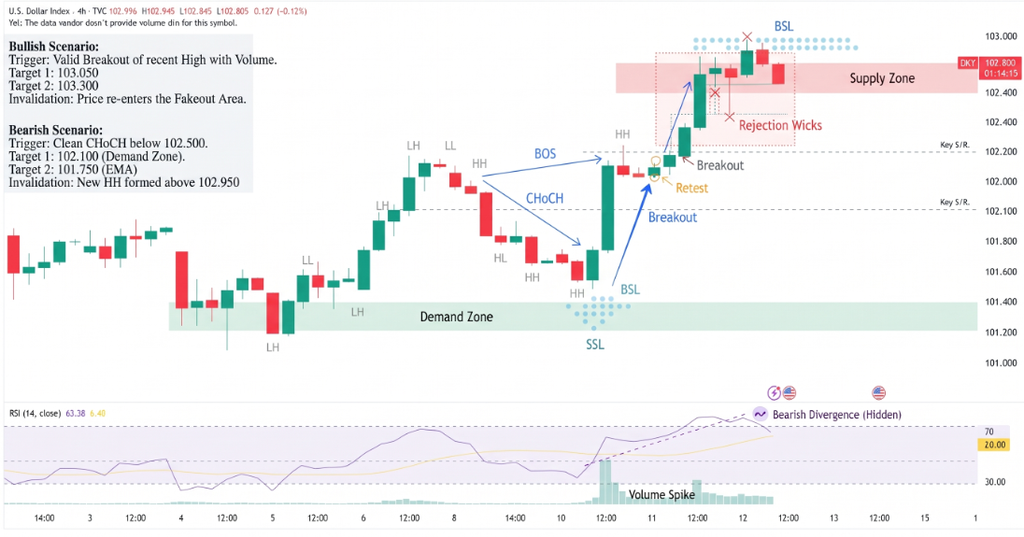
Momentum indicators continue to support the broader bullish structure. The four-hour Relative Strength Index (RSI) has moved below the conventional 70 overbought threshold, suggesting that upward momentum has cooled. Meanwhile, the Moving Average Convergence Divergence (MACD) remains in positive territory, indicating that bullish momentum has not yet disappeared.
The immediate technical levels are:
- Initial support: 102.80.
- Next support zone: 102.40–102.50, around late-October and early-November highs.
- Immediate resistance: 103.10.
- Higher resistance: 103.50, near the April 8, 2025 high.
A sustained move below 102.80 could expose the 102.40–102.50 support region. Conversely, a decisive break above 103.10 would strengthen the case for another advance toward 103.50.
Conclusion
The dollar’s retreat below 103.00 does not yet signal a confirmed reversal. Persistent inflation, rising rate expectations and positive MACD momentum continue to support the broader bullish outlook. However, the 103.10 resistance level remains a critical hurdle. A breakout could open the way toward 103.50, while a sustained decline below 102.80 would put the 102.40–102.50 support zone back in focus. The next direction will depend largely on incoming US economic data and whether Federal Reserve officials maintain their hawkish stance.
Sources & Methodology
Primary-source standard: Market-moving facts should link to original data releases, regulator notices, company filings or official project announcements whenever available. Secondary reporting is used for additional context, not as a substitute for original evidence.
Page last reviewed: