
The Australian Dollar is struggling to regain the 0.7000 level after reaching about 0.6975 before turning lower. AUD/USD is hovering near 0.6964 as a firm US Dollar and elevated Treasury yields continue to limit the pair’s recovery. The latest official data show the Aussie has already fallen from 0.7034 on September 24 to 0.6953 on October 2, highlighting the loss of upside momentum.
The immediate question for traders is whether AUD/USD can reclaim 0.7000 or whether another decline will push the pair toward fresh lows.
Dollar Strength Keeps AUD/USD Under Pressure
The US Dollar Index (DXY) remains elevated, supporting the downside pressure on AUD/USD. U.S. yields are also providing a strong backdrop for the greenback. The 10-year Treasury yield was around 5.28% on October 5, while the two-year yield stood near 4.83%, maintaining a substantial yield advantage for dollar-denominated assets.
The Federal Reserve remains central to the currency outlook. Policymakers lowered the federal funds target range by 25 basis points at the September meeting to 3.75%-4.00%, while the latest projections still show considerable uncertainty around the future rate path. Fed projections put 2026 PCE inflation at 3.7%, well above the central bank’s 2% longer-run objective.
That inflation backdrop gives investors less reason to aggressively price additional easing, particularly while long-term Treasury yields remain high.
Investors are also focused on the FOMC minutes for additional clues about the debate surrounding future rate decisions. Recent market pricing has nevertheless reduced expectations for an October hike following weaker U.S. economic data.
AUD/USD Faces 0.7035 Technical Barrier
From a technical perspective, AUD/USD remains below its 20-day exponential moving average (EMA), positioned around 0.7035. The indicator has become an important dynamic resistance level because repeated failures beneath it would reinforce the short-term bearish structure.
The Relative Strength Index (RSI) is around 34. That places momentum close to oversold territory but does not yet provide a confirmed reversal signal. For traders, the reading means selling pressure remains significant, although the risk of a short-term bounce is increasing.
The technical map is relatively straightforward:
- 0.7035: 20-day EMA and key recovery barrier.
- 0.7000: Psychological resistance and first bullish hurdle.
- 0.6975: Recent intraday recovery high.
- 0.6962: Current area and immediate downside reference.
A daily close above 0.7035 would weaken the bearish setup and give buyers room to target higher levels. Until that happens, rallies remain vulnerable to renewed selling.
0.6962 Break Could Extend Losses
The most important downside signal would be a sustained break below 0.6962. With limited measured support immediately underneath, such a move could expose AUD/USD to another leg lower as momentum traders increase short positions.
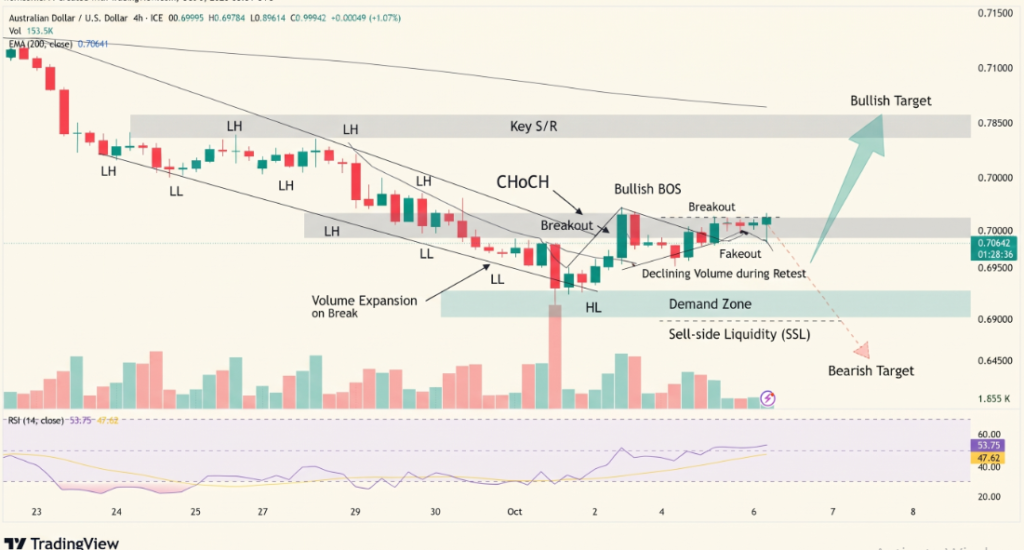
Conversely, a rebound above 0.7000 would give buyers an opportunity to challenge the 20-day EMA. The 0.7035 level is therefore more significant than 0.7000 because a sustained break above the EMA would indicate that the recent bearish momentum is losing control.
The Australian currency also remains sensitive to changes in global risk appetite, commodity prices and relative interest-rate expectations. Those factors can quickly alter the balance between the higher-yielding Australian Dollar and the US Dollar.
Conclusion
AUD/USD remains under pressure near 0.6964 as elevated U.S. yields and a firm dollar weigh on the Australian currency. The pair needs to reclaim 0.7000 and, more importantly, close above the 0.7035 20-day EMA to establish a stronger recovery. Meanwhile, a break below 0.6962 would reinforce the bearish technical structure and leave the pair exposed to deeper losses.
Sources & Methodology
Primary-source standard: Market-moving facts should link to original data releases, regulator notices, company filings or official project announcements whenever available. Secondary reporting is used for additional context, not as a substitute for original evidence.
Page last reviewed: