
The EUR/USD outlook has shifted lower as the U.S. Dollar maintains strength and the euro struggles to recover above recent technical levels. Societe Generale strategist Kit Juckes said consensus forecasts that once called for EUR/USD to reach 1.20 have since fallen to 1.16, while the bank’s forecast now stands at 1.15.
The latest market backdrop has added pressure to the pair. On Sept. 28, EUR/USD was around $1.1386, near a two-month low, while the Dollar remained close to a two-month high as higher oil prices and Treasury yields supported demand for the greenback.
Dollar Strength Reshapes EUR/USD Forecasts
Juckes said discussions with clients indicate that market positioning is more Dollar-positive than the published consensus forecasts suggest. He pointed to elevated oil and commodity prices, resilient U.S. economic data and a more risk-averse global environment as factors that have weakened bearish Dollar expectations.
That backdrop has become more important because energy prices can feed into inflation expectations and influence central-bank policy. Reuters reported Monday that the U.S. Dollar was holding near a two-month high as the U.S.-Iran standoff pushed oil prices and Treasury yields higher, while investors prepared for a busy week of U.S. economic releases.
Societe Generale’s separate Dollar analysis also described the short-term outlook as constructive, while noting longer-term headwinds linked to U.S. fiscal policy and global savings patterns.
- Earlier consensus target: 1.20
- Current consensus: 1.16
- Societe Generale forecast: 1.15
- Sept. 28 market area: Around 1.1386
Inflation Could Test the Euro
The next major driver is the U.S. inflation and growth data calendar. Societe Generale said stronger inflation combined with resilient real-economy activity could lift the Dollar Index toward a 2026 high or push EUR/USD to a fresh low. The bank estimates the Dollar Index is only 0.7% from that potential high, while EUR/USD is about 0.5% from its cited potential new low.
The data calendar includes JOLTS, ADP employment, personal income and spending, trade figures, ISM surveys and labor-market data. Societe Generale also highlighted the possibility that the August core PCE inflation measure could reach 3.4%, which would keep inflation in focus for the Federal Reserve.
EUR/USD has already encountered important technical pressure. Societe Generale noted on Sept. 25 that the pair had traded between 1.1359 and 1.1387, with the 100-week moving average at 1.1356 providing a nearby technical reference. The bank identified 1.1270 as support and 1.1450 as resistance.
Key EUR/USD Levels to Watch
The euro’s ability to stabilize near the 1.1350 area will remain important for the short-term technical structure. A sustained move above 1.1450 would put the pair back above the resistance level identified by Societe Generale, while continued weakness could expose 1.1270.
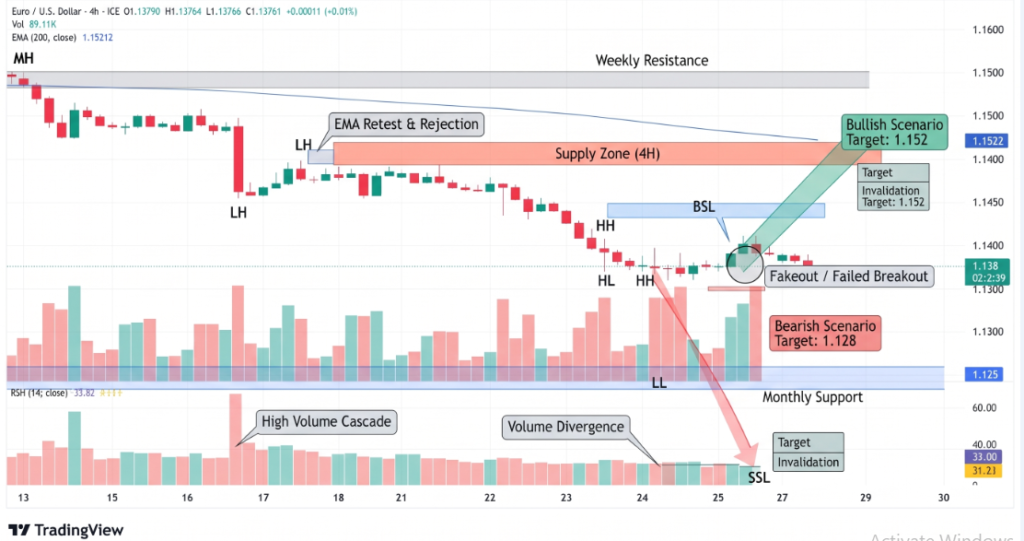
Other market analysts have also highlighted 1.15 as an important area. Scotiabank recently described 1.15 as critical support and placed resistance above 1.16 around the 200-day moving average.
- Immediate technical area: 1.1350-1.1400
- Support: 1.1270
- Resistance: 1.1450
- Higher resistance: Above 1.16
- Societe Generale forecast: 1.15
Conclusion
EUR/USD is facing a stronger Dollar backdrop as markets reassess the outlook for U.S. inflation, economic growth and Federal Reserve policy. Societe Generale has reduced its forecast to 1.15, compared with an earlier consensus target of 1.20, while current trading near 1.1386 keeps the pair close to the technical levels highlighted by the bank.
The immediate focus is on the 1.1350-1.1400 region, followed by 1.1270 on the downside and 1.1450 on the upside. The next U.S. inflation and economic releases could determine whether the Dollar’s recent resilience persists or EUR/USD begins to stabilize.
Sources & Methodology
Primary-source standard: Market-moving facts should link to original data releases, regulator notices, company filings or official project announcements whenever available. Secondary reporting is used for additional context, not as a substitute for original evidence.
Page last reviewed: