
USD/JPY remains sensitive to Japanese intervention warnings even as the U.S. Dollar broadly holds firm. Brown Brothers Harriman (BBH) strategist Elias Haddad says the threat of official action is helping keep the Japanese Yen supported. BBH expects the pair to remain within a 155.00-160.00 range in the near term.
The latest warning came from Japan’s top currency diplomat, Atsushi Mimura, who said markets should take the “very clear” message from Tokyo and Washington regarding yen weakness at face value. Mimura also said he remained neither satisfied nor reassured by recent yen moves, keeping intervention concerns firmly in focus.
Yen Intervention Risk Caps USD/JPY
Japanese officials have intensified their verbal warnings as the yen remains weak. Mimura declined to say whether Japan would intervene again, but his comments indicate that authorities remain closely focused on excessive currency moves. Finance Minister Satsuki Katayama and U.S. Treasury Secretary Scott Bessent also discussed the yen’s valuation in a recent phone call, according to Reuters.
The intervention issue is important because Japan has previously used foreign-exchange operations to support the yen. In September, Mimura had already said authorities were on heightened alert over currency-market developments.
For USD/JPY, intervention risk creates a potential constraint on moves higher even when the Dollar receives support from the interest-rate differential between the United States and Japan.
- BBH near-term range: 155.00-160.00
- Key technical reference: 158.47
- Upper range: 160.00
- Lower range: 155.00
Rate Gap Keeps Dollar Supported
The interest-rate differential remains another important factor for the currency pair. BBH notes that the U.S. federal-funds target range stands at 3.75%-4.00%, compared with the Bank of Japan’s policy rate of 1.25%. The gap continues to influence demand for the Dollar against the Yen.
The BoJ has nevertheless been moving away from its earlier ultra-loose monetary-policy settings. A Reuters poll earlier in September showed economists expected the Japanese central bank to raise rates to 1.25% and potentially reach 1.75% by the second quarter of 2027, reflecting increased attention to inflation and yen weakness.
Higher Japanese rates can narrow the yield advantage of Dollar assets and potentially alter demand for USD/JPY. At the same time, U.S. Treasury yields and expectations for future Federal Reserve policy remain important drivers of the pair.
155 and 160 Define the Range
BBH’s 155.00-160.00 range provides a framework for the near-term outlook. The pair recently moved below its 200-day moving average at 158.47 after political comments concerning yen weakness, according to BBH. A sustained move back above that average would place greater focus on the upper part of the range.
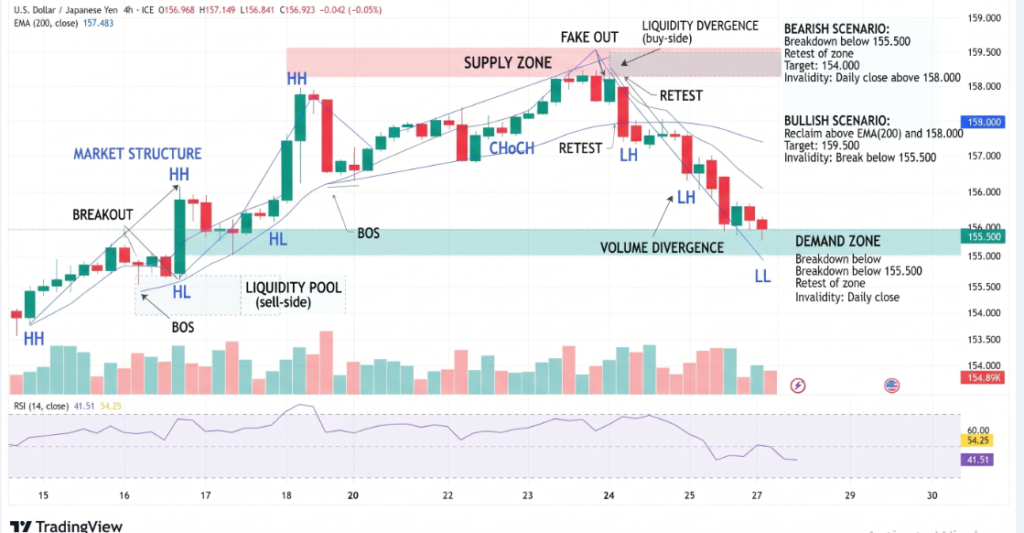
A move toward 160.00 would also be closely watched because Japanese officials have repeatedly signaled concern about excessive yen depreciation. Conversely, a decline toward 155.00 would bring the lower boundary of BBH’s projected range into focus.
The technical and policy signals therefore remain closely connected: interest-rate differentials support the Dollar, while intervention warnings and a gradual BoJ tightening cycle provide counterweights.
- Support zone: 155.00
- Key moving average: 158.47
- Upper range: 160.00
- Policy risk: Japanese FX intervention
Conclusion
USD/JPY is being pulled between a wide U.S.-Japan interest-rate differential and rising official concern over yen weakness. BBH expects the pair to remain within 155.00-160.00 in the near term, while the 158.47 200-day moving average provides an additional technical reference.
Japan’s latest warnings have not confirmed that intervention will occur, but officials have made clear that excessive yen weakness remains under close observation. The next moves in U.S. yields, Federal Reserve expectations and Bank of Japan policy will therefore remain important alongside the 155.00 and 160.00 boundaries.
Sources & Methodology
Primary-source standard: Market-moving facts should link to original data releases, regulator notices, company filings or official project announcements whenever available. Secondary reporting is used for additional context, not as a substitute for original evidence.
Page last reviewed: