
The GBP/JPY pair has fallen below 208.00 after another rejection near 209.00, extending its decline toward the 207.70 area. The pair has lost more than 1% over the past two trading days in the latest market setup, while four-hour momentum indicators are approaching oversold territory.
The decline comes as traders assess contrasting monetary-policy signals from the Bank of Japan and Bank of England. The BoJ released minutes from its July 30-31 meeting on Sept. 28, with several policymakers arguing that inflation risks could justify faster rate increases.
GBP/JPY Tests 207.80 Support
The technical structure has weakened after GBP/JPY failed to hold above 209.00. The pair is now testing the 207.80 area, corresponding to the Sept. 17 and Sept. 25 lows, while the next major support is the 207.10 trough from Sept. 8.
The four-hour chart remains under pressure. The Relative Strength Index (RSI) is just above oversold territory, while the Moving Average Convergence Divergence (MACD) histogram is printing wider red bars. Together, these readings show persistent downside momentum, although neither indicator by itself confirms that the decline will continue.
A trendline drawn from the early-September lows has also been breached around 208.10, turning that area into an important reference point for any attempted recovery.
- Current reference: Around 208.00
- Immediate support: 207.80
- Major support: 207.10
- First resistance: 209.00
BoJ Minutes Add Yen-Side Focus
The Bank of Japan minutes showed that policymakers were increasingly focused on upside inflation risks. One member said the pace of rate increases could be faster than markets had expected, while another argued that policy should respond nimbly to rising price risks.
The BoJ subsequently raised its policy rate to around 1.25% at its September meeting. The central bank’s current guideline calls for the uncollateralized overnight call rate to remain around 1.25%, according to its latest official information.
In the UK, the Bank of England maintained Bank Rate at 3.75% in September, although three of nine Monetary Policy Committee members voted for a 25-basis-point increase to 4%. UK CPI inflation reached 3.1% in August, according to the BoE’s September policy statement.
This divergence in policy expectations remains relevant to GBP/JPY because the pair reflects the relative value of the Pound against the Yen.
209.00 Resistance Caps Recovery
On the upside, 209.00 remains the first major barrier after rejecting buyers during the latest Asian session. A sustained move above that level would bring 210.10 into focus, followed by the Sept. 22 high around 210.90.
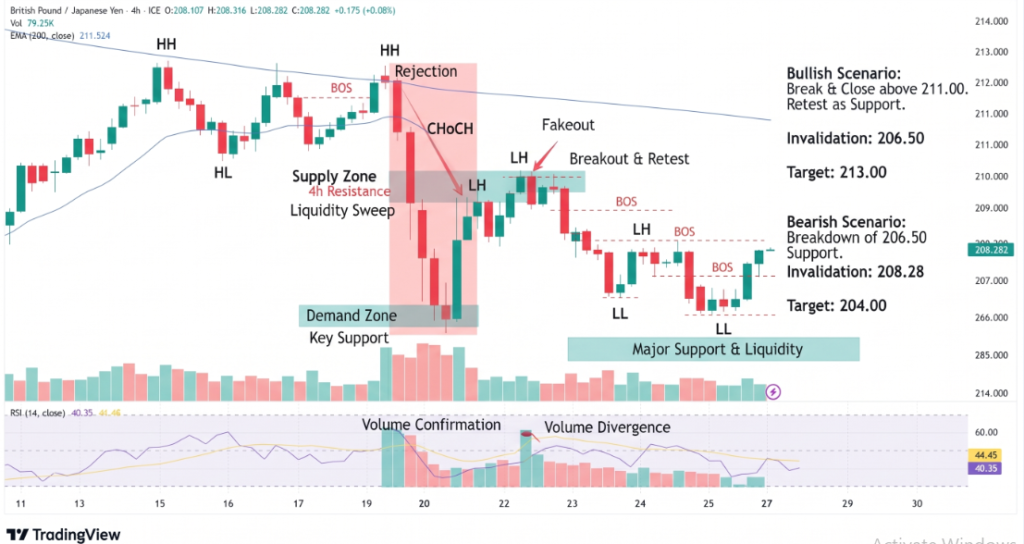
On the downside, a decisive break below 207.80 would put the Sept. 8 low at 207.10 back in focus. The technical structure therefore remains concentrated between the immediate support and resistance levels.
The upcoming UK fiscal calendar could also influence Sterling volatility. HSBC analysts cited by FXStreet highlighted the period leading into the Oct. 28 budget update as a potential source of pressure because of elevated gilt yields and difficult fiscal decisions.
- Support: 207.80 and 207.10
- Resistance: 209.00, 210.10 and 210.90
- Momentum: RSI near oversold; MACD remains bearish
- Policy focus: BoJ rate expectations and UK inflation
Conclusion
GBP/JPY remains below 208.00 after failing to clear 209.00, leaving 207.80 and 207.10 as the key downside levels in the current technical structure. A break below 207.10 would mark a further deterioration in the chart, while a sustained recovery above 209.00 would shift attention toward 210.10 and 210.90. Meanwhile, the BoJ’s latest minutes and its 1.25% policy rate, alongside the BoE’s 3.75% Bank Rate, keep monetary-policy expectations central to the pair’s next moves.
Sources & Methodology
Primary-source standard: Market-moving facts should link to original data releases, regulator notices, company filings or official project announcements whenever available. Secondary reporting is used for additional context, not as a substitute for original evidence.
Page last reviewed: