Knowing how to open a trading account means verifying the provider, selecting the right account type and understanding its terms before sending money. Complete the application accurately, use an authenticated channel and review the permissions granted. Approval does not mean you should immediately trade.
This general multi-asset guide complements the AAFX.IO broker-selection pillar. Product-specific steps still matter, whether the account offers securities, currencies, funds, crypto assets or derivatives.
Risk warning: Trading can lose money, borrowing can create additional obligations and provider or operational problems can restrict access. Verification and account security do not guarantee returns or individual suitability.
Affiliate disclosure: AAFX.IO may earn a commission through links on this page. This does not change our editorial conclusions.
How do I open a trading account?
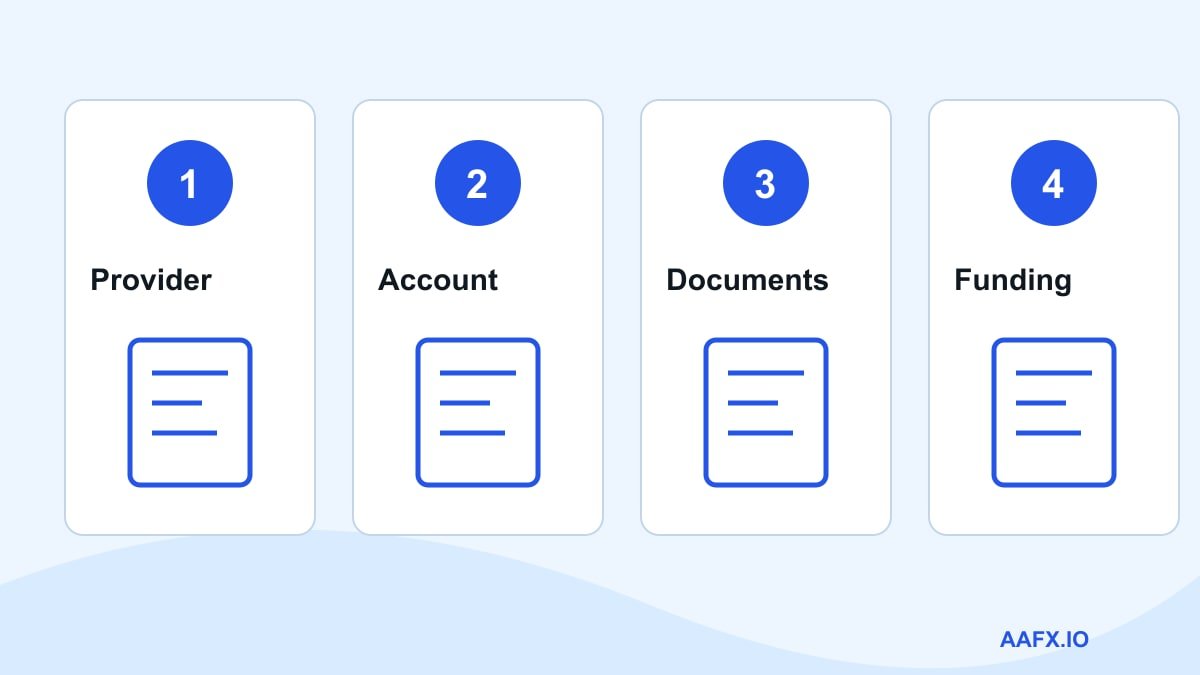
Choose the product and provider first, verify the contracting entity, and read the account agreement and fee schedule. Complete the application accurately through an authenticated channel, supply the requested verification information and review the approval terms. Before funding or trading, check security, deposit and withdrawal arrangements, account currency and the permissions actually enabled on the account.
Does account approval mean I should start trading?
No. Approval establishes that the provider has accepted an application under its process, not that every available product suits you or will make money. Review the account type, enabled permissions and costs independently. You can leave an approved account unfunded while resolving questions, and you do not need to place a trade simply because access is available.
Opening a Trading Account: Overview
- How to open a trading account: start with the product
- Verify the legal entity and reach the genuine application
- Choose the account type and read permissions deliberately
- Prepare accurate information and protect the submission
- Review funding, withdrawals and a hypothetical account ledger
- Set up account security and understand the first order
- When to pause the application or leave the account unused
- AAFX.IO: opening an account is the start of a decision process
How to open a trading account: start with the product
The question is not only how to create a login. Decide what the account is intended to do: hold fully paid assets, support occasional transactions or provide access to more complex contracts. Those purposes can require different agreements and permissions. A convenient app does not remove the need to understand the account relationship behind it.
This is the general multi-asset account-opening workflow. A forex account also requires currency-pair, contract-size and financing checks, while a securities account raises ownership and settlement questions. Keep the market-specific investigation separate from the common application process. The broker-role guide explains services a provider may perform.
Identify whether you will make your own decisions or obtain an advice service. Do not assume a helpful support conversation gives the provider authority to trade for you, or that a brokerage account includes personalised advice. The agreement should describe who can make decisions and what authorisation would be needed to change that arrangement.
Write a short account-purpose note before comparing providers. Include the products you understand, how often you expect to transact and which services are essential. Leave aspirations such as learning options separate from permissions you are ready to use. Our trading-versus-investing guide helps distinguish a transaction workflow from a longer ownership horizon.
Make the purpose test concrete. If the aim is a fully paid share purchase, check that the selected service provides the ownership arrangement you expect. If the aim is a currency or commodity contract, identify the price reference and obligations instead. The account comparison should answer the stated purpose, rather than accumulating features simply because they appear in a menu.
Verify the legal entity and reach the genuine application
Record the legal entity named in the proposed agreement, its jurisdiction and the relevant service. Check its status and permissions through the appropriate official source. Then match the website and contact details independently. A real licence number copied onto a different domain does not establish that the application belongs to the genuine firm.
The FCA clone-firm guidance explains why identity and contact checks matter. Its process is specific to its remit; use the relevant authority for the service and jurisdiction you are investigating. Do not treat a brand’s licence in one country as proof about every entity using the same name.
Reach the application through the authenticated provider channel. A link in an unsolicited message, a search advertisement or a screenshot should not replace independent verification. If documents name different entities, record and resolve the difference before uploading sensitive information. The broker-selection pillar develops the wider checks on service and terms.
Do not send a test deposit to establish whether a suspicious contact is genuine. Payment success would answer a different question. A contact who creates urgency, asks for remote access or changes the recipient late in the process needs independent investigation. You can stop the application without proving that an offer is fraudulent.
Keep the verification record linked to the application you actually use. An official entry for one company and a document from another company are not a completed match. Record the exact entity, domain and date, plus the question that remains unanswered. This helps distinguish a missing piece of evidence from a negative conclusion about the genuine firm whose identity may have been copied.
Choose the account type and read permissions deliberately
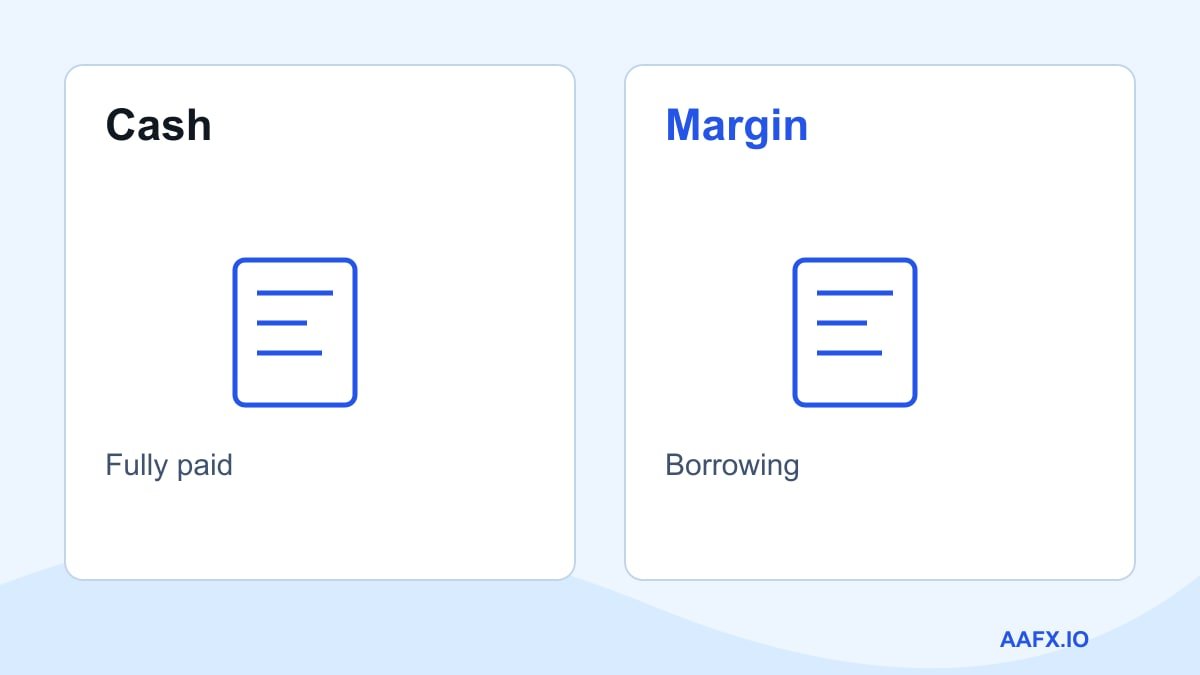
For securities, distinguish cash from margin. A cash account requires full payment under its rules; margin can involve borrowing with assets used as collateral. The SEC margin bulletin explains interest, collateral and forced-sale risks. These mechanics differ from merely holding cash and shares in the same account.
FINRA’s account-opening decisions guide also discusses cash management and decision-making authority. Read the choice presented in your actual application. A default setting, attractive buying-power figure or short tick-box description is not enough to establish the consequences of enabling borrowing or another complex feature.
A multi-asset platform can combine different products behind one login. A company name might represent an actual share or a derivative; a crypto label might represent a withdrawable asset or a price-linked contract. Check the relevant disclosure and account entity for each service. Our CFD-versus-stock comparison explains one common distinction.
Keep permissions proportionate to what you understand. An application can ask about experience or financial circumstances, but completing it accurately is different from selecting answers to unlock access. Broader permissions do not guarantee better outcomes. Save the selected account type and enabled features so they can be compared with the final approval notice.
| Decision | Question to resolve | Evidence to keep |
|---|---|---|
| Product and account type | What will I own or owe? | Account and product agreements |
| Borrowing and permissions | Which features are enabled? | Selected settings and approval terms |
| Cash management | How is unused cash treated? | Relevant disclosures and choices |
| Decision-making authority | Who can submit instructions? | Agreed authority and access records |
Prepare accurate information and protect the submission
The SEC account-opening bulletin describes personal, financial and tax information that US brokers may request. Requirements differ elsewhere and between products. Use the actual provider checklist rather than assuming every account requires the same document format or that one previous approval determines another application.
Prepare accurate information and check the intended recipient before submitting it. Read what a question asks and obtain clarification where the meaning is unclear. Do not alter financial circumstances or experience to satisfy an access test. A general guide cannot promise that a particular document set will be accepted or that an application will be approved.
Use the verified upload channel and retain the relevant application and disclosure records securely. Avoid circulating identity documents through unauthenticated messages merely because a contact says it will accelerate onboarding. Record unresolved requests so an incomplete check does not become an assumed success. The KYC and AML guide provides further identity-check context.
If review is delayed or declined, use official support to establish whether accurate additional information is needed. Avoid repeated applications with inconsistent answers or offers to bypass the process. Approval is a provider decision under its rules, not an outcome that justifies misrepresentation. You can reassess the account choice while questions remain unresolved.
Review funding, withdrawals and a hypothetical account ledger
Before sending money, establish the supported funding route, recipient details, account currency and relevant charges. Check whether funds must come from an account in your own name, how a withdrawal is requested and which conditions affect availability. These details depend on the provider, payment method and account agreement; no universal processing time should be assumed.
Separate account opening from funding and trading. You can decide that the terms are unsuitable after reading them, even if a login has been created. Compare the broker-fee guide with the actual schedule. A minimum deposit is an access condition, not an appropriate trading budget or a measure of provider safety.
Consider an entirely hypothetical cash-share ledger in dollars. A $1,000 transfer incurs an assumed $5 transfer charge, leaving $995 credited. Buying five shares at an invented $100 each uses $500, and an assumed $2 dealing charge leaves $493 cash. At an unchanged share price, the account contains $500 of shares and $493 cash, or $993 in total.
The $7 difference comes from assumed charges, not a share-price move. The example excludes tax, settlement timing and currency conversion and does not quote a provider. It shows why the deposit, available cash and total account value answer different questions. If the shares later fall to $90, their value becomes $450 and the combined value becomes $943, assuming unchanged cash.
| Step | Cash | Shares at the assumed price | Total value |
|---|---|---|---|
| $1,000 sent less $5 assumed transfer charge | $995 | $0 | $995 |
| Five shares at $100 plus $2 dealing charge | $493 | $500 | $993 |
| Hypothetical decline to $90 per share | $493 | $450 | $943 |
The ledger can also be checked backward: $493 cash plus $500 of shares equals $993, and the original $1,000 transfer less $7 assumed charges gives the same result. If the platform balance differs, investigate the definition and pending items before placing another order. Do not assume a discrepancy means either a profit or a missing payment until the records are reconciled.
Set up account security and understand the first order
The SEC online-account security bulletin recommends additional authentication and account alerts where available. Use a strong unique credential, understand recovery arrangements and review authorised access. Never share a password or one-time code with an unsolicited contact claiming to help with an application or withdrawal.
Security and investment risk are separate. A well-protected login does not make a product suitable or prevent its price falling. Likewise, a correct market view does not resolve a provider-identity discrepancy. Keep these checks in their own records so a success in one area does not hide an unresolved issue in another.
Before a first order, establish the instrument, quantity, order type, session and costs. A platform demonstration is not a promise of live execution. A stop-loss is a trigger, not a guaranteed fill, as the SEC stop-order bulletin explains. An accepted instruction may remain unfilled or fill differently from a displayed quote.
Check the actual execution confirmation afterward, including price, quantity, charges and any remaining order. Keep a record of the account value and outstanding obligations. The position-sizing guide explains planned loss calculations. Creating a login and passing verification do not replace that separate decision about whether to hold a position.
When to pause the application or leave the account unused
Pause if you cannot authenticate the entity, explain the product or understand the payment instructions. Also pause when the agreement grants permissions or decision-making authority you did not intend. A bonus deadline or salesperson’s urgency does not change the evidence needed. There is no need to continue simply because time has already been spent completing forms.
Approval does not oblige you to fund or trade, although inactivity and closure terms may affect an unused account. Read those conditions and ask official support about any uncertainty. A provider may also change its services or request updated information. Keep the account purpose and settings under review rather than assuming the original application remains the whole relationship. Ask about statement access and account-closure procedures before committing.
Check what changes if you move country, change account classification or are offered a new contracting entity. Those events can require another review of terms, permissions and protection. Do not infer the consequences from a shared brand or familiar interface. The relevant agreement is the one associated with the account actually being offered.
A useful final checklist is factual: entity verified, documents read, information accurate, permissions understood, funding route authenticated and unresolved questions listed. It should not force a positive decision. Choosing a different provider or choosing not to open an account can be a reasonable outcome of the same careful process.
A fictional application review can finish with no account opened. Suppose the provider is authenticated but the proposed account includes borrowing that the applicant did not intend. The useful next step is to resolve the account choice through official support. It is not to accept the setting and hope that avoiding a particular button will remove the contractual feature or its consequences.
AAFX.IO: opening an account is the start of a decision process
A complete account-opening process connects the provider, agreement, permissions, verification and funding arrangements. It also leaves room to stop. The hypothetical ledger shows why account labels and balances need interpretation before a first trade. None of these steps guarantees that a particular product fits your circumstances or will produce a favourable return.
Return to the AAFX.IO broker-selection pillar and the linked guides on account mechanics and risk. Educational videos are available on TikTok and Instagram. Review this guide annually and when material onboarding or regulatory guidance changes.
Affiliate disclosure: Commercial links may generate compensation for AAFX.IO. This workflow does not certify a provider, promise approval or recommend every product available in an account.
Educational disclaimer: General information only, not personal investment, tax or legal advice. Verify the rules and account terms relevant to your circumstances.
Written and reviewed by Arslan Ali Butt
MPhil Behavioural Finance, MBA Finance, 10+ years in forex dealing and analysis.
Last reviewed: 29 October 2026.
How we reviewed this guide: We checked SEC account-opening, margin, security and stop-order guidance, FINRA account decisions and FCA clone-firm guidance on 28-29 October 2026. Requirements are described as provider- and jurisdiction-dependent. The cash-share ledger and charges are hypothetical; no provider-account test is claimed.
Frequently Asked Questions
Is a trading account the same as a bank account?
No. The rights, services and treatment of cash depend on the provider and agreement. A trading account can hold investments or support contracts without being an ordinary bank deposit. Read the custody and cash-management terms and verify any claimed protection through the relevant official scheme. Do not infer deposit insurance merely from the presence of a cash balance on a platform.
Which documents will I need to apply?
Requirements vary by provider, jurisdiction, account type and circumstances. Identity, contact, tax, employment or financial information may be requested, with supporting evidence where needed. Use the verified application channel and follow the actual checklist. A general guide cannot promise one universal document list or approval outcome. Do not alter information to fit an application or send documents to an unauthenticated contact.
Can I open an account without funding it immediately?
That depends on the provider terms, including any minimum-funding, inactivity or closure conditions. Check those terms before applying or leaving an account unused. Approval does not create an obligation to place a trade merely because a platform is accessible. Resolve questions about products, costs and withdrawals before sending money, and do not treat an advertised deadline as a substitute for verification.
What is the difference between cash and margin accounts?
In a securities cash account, purchases must be fully paid under the applicable payment and settlement rules. A margin account permits borrowing against account collateral under its agreement. Borrowing adds interest and liquidation risks, and can create losses beyond the original cash committed. Confirm the type actually selected rather than assuming that a default application choice reflects the account you intended.
Does a multi-asset account give identical rights in every market?
No. One interface can contain actual shares, fund interests, currency contracts or other derivatives with different terms. Permissions, custody and the contracting entity can also vary. Read each relevant product disclosure and account agreement. A shared login or familiar ticker does not establish that ownership, protection, funding arrangements or complaint rights are identical across everything shown in the platform menu.
Should I accept every available trading permission?
Only request access after understanding the relevant product and its obligations. Options, margin, short selling and other features can introduce risks beyond a fully paid asset purchase. Application approval is not a recommendation to enable them all. Read the terms of each permission and ask questions through verified support when anything is unclear rather than treating broader access as a benefit by itself.
Why can available cash differ from buying power?
These labels can describe different things, including settled cash, pending transfers, collateral or borrowing capacity. Their meaning depends on the account and platform. Read the definitions and check pending transactions before submitting an order. Do not treat a large buying-power figure as money you own free of obligations, or assume every displayed balance is immediately available to withdraw from the account.
Does a small successful withdrawal prove the provider is safe?
No. It establishes only that a particular transaction occurred under those circumstances. It does not authenticate every future payment instruction, verify regulatory permission or guarantee treatment of a larger balance. Provider identity and product checks must be independent. Never send a test deposit or personal documents simply to investigate an already suspicious contact whose relationship to the genuine firm remains unresolved.
How can I secure an online trading account?
Use the provider channel you independently authenticated, a strong unique credential and additional authentication where available. Review account alerts, authorised devices and the recovery process. Never share passwords or one-time codes with an unsolicited contact. Security settings reduce some access risks but do not prevent market losses or establish that the provider and products are suitable for your circumstances.
What if the application is rejected or delayed?
Use the official support route to ask what remains unresolved and whether further accurate information is needed. Do not submit false answers, borrow someone else’s identity or follow a contact promising to bypass checks. A provider may decline an application under its process. You can stop and reassess the account choice rather than treating approval as an outcome that must be obtained.
Sources & Methodology
Primary-source standard: Market-moving facts should link to original data releases, regulator notices, company filings or official project announcements whenever available. Secondary reporting is used for additional context, not as a substitute for original evidence.
Page last reviewed: