Trading commodities means choosing a specific way to take exposure to raw materials such as gold, oil, metals or agricultural products. Physical assets, commodity funds, futures and CFDs have different rights and risks. Start with the product, its units and its exit obligations before comparing price views.
This is an educational guide to mechanics rather than a live commodity-price page. Start with AAFX.IO trading foundations if you are new to accounts, exposure and order execution.
Risk warning: Commodity prices can move sharply, leverage can magnify losses, and contracts can involve expiry or delivery obligations. A planned exit is not a guarantee of the price you receive. Examples use invented prices and charges.
Affiliate disclosure: AAFX.IO may earn a commission through links on this page. This does not change our editorial conclusions.
What does trading commodities mean?
Trading commodities means taking exposure to raw materials such as gold, crude oil or agricultural products. The route matters: physical ownership, a fund share, a futures contract and a CFD create different rights, costs and obligations. Identify the instrument and its units before calculating the effect of a price change or deciding whether it suits your circumstances.
Can beginners trade gold and oil safely?
No product makes commodity trading automatically safe. Beginners need to understand exposure, costs, custody or counterparty arrangements, and any expiry or delivery obligations. Gold and oil are different markets, while leverage can magnify the effect of either price moving against you. Start with product understanding and a loss scenario rather than a promise of easy access or guaranteed returns.
Commodity Trading: Overview
- Trading commodities starts with the product, not the ticker
- Separate the market thesis from the instrument mechanics
- Read units, multipliers and account currency before sizing
- Hypothetical gold and oil examples: calculate both directions
- Check expiry, delivery and the cost of maintaining exposure
- Compare total costs and the provider relationship
- Who should pause, and what to review before placing an order
- AAFX.IO: understand the exposure before choosing a commodity
Trading commodities starts with the product, not the ticker
Gold, crude oil, natural gas, copper and wheat are commodities, but a market name is not an account contract. A platform can display a familiar price while offering a very different legal instrument. Begin by asking what you would own, what obligation you would enter and how the position would eventually be closed.
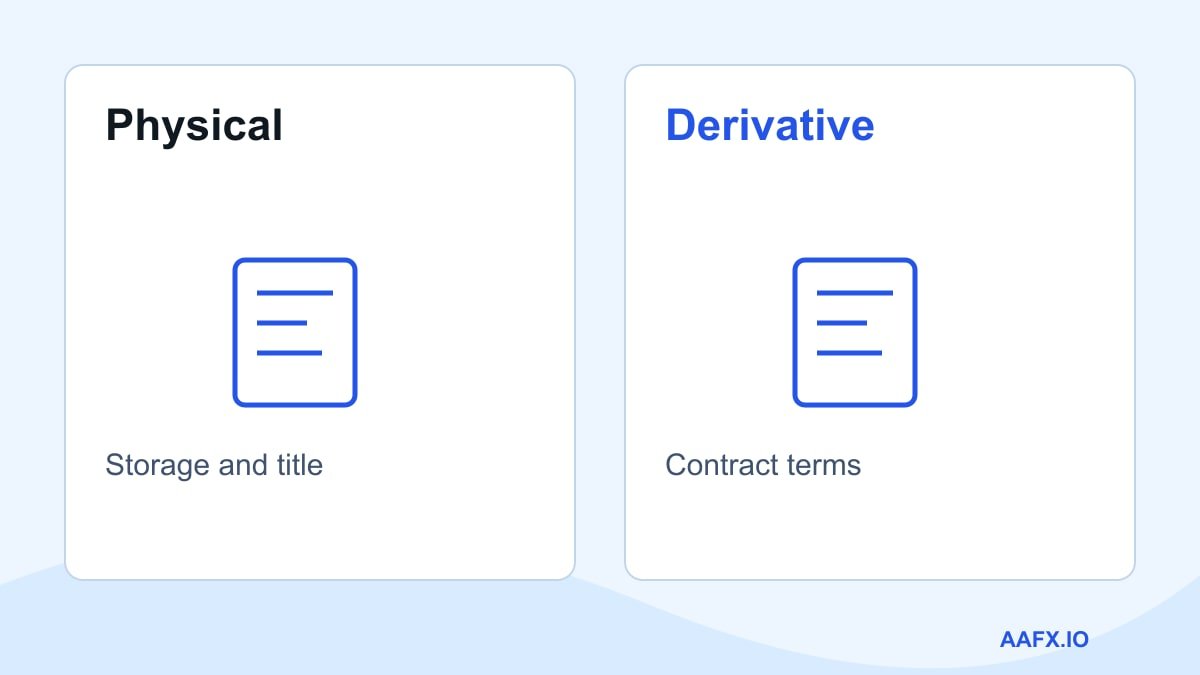
Physical ownership concerns the asset itself and the arrangements for storing or transferring it. A fund share gives rights under the fund structure. A futures contract has defined terms and an expiry. A CFD is a price-linked agreement with its issuer. These routes can reference the same commodity without delivering the same result.
The SEC commodity overview introduces commodity futures. For the broader distinction between asset ownership and price-linked exposure, use the spot-versus-futures guide and the CFD explanation. Product availability and account terms vary by provider and customer location.
| Route | What to establish | Ongoing questions |
|---|---|---|
| Physical asset | Ownership, quality and custody records | Storage, insurance, transfer and sale costs |
| Commodity fund or ETP | Structure, holdings and stated objective | Expenses, tracking, redemption and any roll policy |
| Futures | Quantity, month, settlement and margin rules | Expiry, delivery deadlines and changing collateral needs |
| CFD | Issuer contract, pricing and unit size | Financing, margin, closure and counterparty terms |
A practical comparison begins with documents rather than brand names. Record the product identifier, who owes the customer an obligation and what evidence describes the holding. If one route allows a transfer of an asset and another only pays a price difference, that distinction belongs in the comparison even when their charts look similar. Do not infer identical rights from identical marketing language.
Separate the market thesis from the instrument mechanics
A gold thesis and an oil thesis should begin with different research questions. A headline about economic uncertainty does not explain every commodity move. Write down the proposed driver, the evidence supporting it and the information that would challenge it. Then ask whether the instrument you selected actually expresses that view over your intended holding period.
The EIA crude-oil framework covers supply, demand, inventories and financial influences. For oil, distinguish an announced production decision from actual supply, and a change in demand expectations from a measured change in consumption. An inventory headline also needs its reporting period and context.
For gold, avoid treating a single label such as safe haven as an unconditional forecast. An investment thesis still needs a price, time horizon and loss scenario. The same is true of an industrial metal or an agricultural commodity. A persuasive story does not establish the size or timing of a future price move.
Keep the evidence record concise. Record what was released, when it was published and what you previously expected. Separate an observation from an interpretation. This prevents a later price move from being used to rewrite the original reason for the position. Our market-analysis guide introduces ways to combine evidence while recognising uncertainty.
An expected event can also be partly reflected in the price before it occurs. Write down what would count as a surprise rather than assuming that a favourable headline must create a profitable trade. A supply concern and a change in the valuation of the account currency can interact. The research note should explain the uncertainty instead of assigning every movement to one cause.
Read units, multipliers and account currency before sizing
A price is meaningful only alongside its unit. An ounce, a barrel and a bushel are not interchangeable, and one contract can represent many units. Write down the quoted currency, quantity per contract, number of contracts and value of a minimum price movement. Do not copy a lot size from another market or another provider.
Position value and margin answer different questions. Position value measures the economic exposure at the quoted price; margin is collateral required under the account rules. The amount shown as available cash does not by itself describe how sensitive the account is to a move in the underlying commodity.
Use the leverage and margin guide before comparing deposits. A small margin requirement can support a large quantity. If the contract is priced in dollars and the account is measured in another currency, translation and conversion costs can also affect the account result. Keep the calculation in a consistent currency.
A useful pre-trade note contains the instrument identifier, unit size, entry assumption, intended exit, adverse execution scenario and relevant charges. Leave any missing specification unresolved rather than substituting the terms of a similar-looking contract. The position-sizing guide develops that calculation.
The unit calculation can be checked independently of the market thesis. In the hypothetical gold example below, ten ounces means a one-dollar change per ounce creates ten dollars of gross price change. A hundred-barrel exposure changes by one hundred dollars for a one-dollar move per barrel. These are arithmetic relationships for the assumed quantities, not descriptions of a particular exchange contract.
Hypothetical gold and oil examples: calculate both directions
The following prices, quantities and charges are invented to show arithmetic. They are not current market quotations, forecasts, actual futures specifications or a suggested trade. Assume dollar-denominated linear exposure and no currency conversion. A real contract must be checked separately for its units, settlement, margin and other terms.
First assume gold exposure of 10 ounces at $2,000 per ounce. The notional value is 10 multiplied by $2,000, or $20,000. A rise to $2,020 creates a $200 gross gain. A decline to $1,980 creates a $200 gross loss. If total assumed transaction charges are $8, the outcomes become a $192 gain or a $208 loss before tax.
Now assume oil exposure of 100 barrels at $70 per barrel. The entry notional is $7,000. A move to $72 produces a $200 gross gain, while a move to $68 produces a $200 gross loss. The dollar results match the gold example despite different unit prices, quantities and percentage moves.
If the hypothetical oil position required $700 collateral, the $200 gross adverse move would equal about 28.6% of that collateral. That calculation excludes charges and liquidation. The relevant lesson is exposure sensitivity, not an implied margin offer. A planned exit at $68 would also not prevent a gap from producing a different execution price.
| Example | Entry exposure | Adverse move | Gross price loss |
|---|---|---|---|
| Gold, 10 ounces | $20,000 at $2,000 per ounce | $2,000 to $1,980 | $200 |
| Oil, 100 barrels | $7,000 at $70 per barrel | $70 to $68 | $200 |
Costs make the two directions asymmetric even when the underlying moves are equal. The hypothetical gold gain falls from $200 to $192 after the assumed $8 charge, while the loss rises from $200 to $208. Repeating the same trade would repeat relevant charges as well. A journal that records only the price difference would therefore overstate the outcome of both winning and losing positions.
Check expiry, delivery and the cost of maintaining exposure
A futures contract does not continue indefinitely. The CME expiration and settlement lesson explains that contracts expire and settlement arrangements depend on the product. Some involve physical delivery and others cash settlement. Read the actual specification and any earlier broker handling deadline.
Closing a position and rolling a position are different decisions. Rolling usually closes one contract month and opens another. The prices can differ, and execution costs still apply. Do not treat a new contract month as the same position with its calendar simply extended. Record what changed and why ongoing exposure is wanted.
Contango describes later-dated futures priced above nearer-dated futures; backwardation describes the opposite ordering. Neither term is an unconditional spot-price forecast. The curve and its changes can affect strategies that repeatedly replace expiring exposure. The impact depends on positions, roll timing, subsequent market changes and costs.
The CFTC commodity-ETP advisory explains why a futures-based vehicle may not follow the underlying commodity over time. Inspect the holdings, objective, fees and roll policy. Buying a fund linked to oil is not the same calculation as buying an indefinitely held barrel at a spot quotation.
Compare total costs and the provider relationship
Match the cost estimate to the route and holding period. Physical ownership may involve storage, insurance and dealing costs. A fund has its own expense and tracking arrangements. A derivative can involve spread, commission, financing or other contract-specific charges. A displayed minimum spread cannot summarise all of these.
For a CFD, inspect the issuer, reference price, financing method, margin close-out rules and treatment of any underlying contract change. ASIC Moneysmart explains the risks of leveraged CFDs and direct dependence on the issuer. Its jurisdiction-specific protections should not be assumed to apply to every account worldwide.
Our broker-fee guide explains common charges, while the broker-selection pillar develops provider checks. Identify the contracting entity and applicable permissions independently. A familiar platform, brand logo or successful small transaction does not establish the full account relationship.
Keep estimated and realised charges separate in the journal. A difference may arise from holding period, execution or another account term. Understanding that difference is more useful than assuming every shortfall came from a bad price forecast. Read updates to the fee schedule when the provider gives notice of a change.
For a simple hypothetical comparison, a $20 fixed charge is 2% of a $1,000 transaction value but only 0.2% of a $10,000 value. That does not justify increasing size to make the percentage look smaller: the larger exposure also changes the loss scenario. Compare cost and risk together, using the actual schedule, rather than allowing one low percentage to dominate the decision.
Who should pause, and what to review before placing an order
Pause if you cannot explain what the product represents or how it closes. Unclear units, unresolved provider identity and unknown delivery obligations are reasons to investigate further. So is a position whose plausible loss would interfere with essential spending. There is no need to submit a live order to prove interest in a commodity.
Check the timing demands as well. A market thesis can require monitoring economic releases, supply events or contract deadlines when you are unavailable. The trading-styles guide explains why a holding period should fit the monitoring process. More frequent access does not guarantee better decisions or lower costs.
Before submission, review the instrument, direction, quantity, account, order type and session eligibility. A stop-loss is a trigger, not a guaranteed fill, as explained in the SEC stop-order bulletin. Check the provider rules and model the consequences of an execution beyond the planned exit.
Afterward, confirm the actual fill, fees, open quantity and any remaining orders. Record the next review date and relevant expiry or funding deadline. Distinguish an accepted instruction from a completed trade. A useful journal records uncertainty and mistakes as well as favourable outcomes, so the next review can assess the process honestly.
Separate the review of an open position from the decision to enter another one. A missed move does not require an immediate replacement trade, and a favourable exit does not establish that the process was sound. Check whether the recorded thesis, size and execution matched the plan. The review is useful when it can identify a specific change in behaviour or understanding.
AAFX.IO: understand the exposure before choosing a commodity
Gold and oil can be useful examples for learning, but neither removes the need to understand the account contract. Product rights, unit size, costs and settlement explain what the position actually does. Use the hypothetical examples to check the arithmetic, then replace every invented input with verified terms before evaluating a real instrument.
Return to the AAFX.IO trading foundations pillar and the linked guides on product structure and risk. Educational videos are available on TikTok and Instagram. Review this guide annually and when a material product or regulatory change affects its explanations.
Affiliate disclosure: Commercial links may generate compensation for AAFX.IO. No product or provider mentioned is automatically suitable, and no result is guaranteed.
Educational disclaimer: General information only, not personal investment or legal advice. Verify the current rules and terms relevant to your circumstances.
Written and reviewed by Arslan Ali Butt
MPhil Behavioural Finance, MBA Finance, 10+ years in forex dealing and analysis.
Last reviewed: 29 October 2026.
How we reviewed this guide: We checked SEC commodity and stop-order explanations, CME expiration guidance, CFTC commodity-ETP guidance, ASIC Moneysmart CFD guidance and the EIA oil-price framework. Source checks span 28-29 October 2026. Prices, quantities and charges are hypothetical and are not live contract specifications. No provider-account test is claimed.
Frequently Asked Questions
Does a gold CFD mean I own physical gold?
No. A gold CFD is a price-linked contract with an issuer rather than ownership of a particular bar. Read its pricing, financing, margin and closure terms. Physical gold involves different questions, including ownership records, storage, insurance and sale arrangements. A gold label on an app does not establish which route is being offered or what happens if a provider fails.
Are oil funds the same as holding barrels of crude?
Do not assume so. A commodity fund may hold futures or other instruments rather than physical oil. Its objectives, expenses and trading approach can affect how its share value behaves. Read the disclosure document and identify the holdings and roll policy. A product linked to oil does not necessarily match the change in a quoted spot price over your holding period.
What is a futures expiry date?
It is the specified point at which a futures contract reaches the end of its trading life under its rules. Settlement arrangements depend on the contract and may involve cash or physical delivery. Brokers can impose earlier handling deadlines. Establish those dates and obligations before opening a position rather than assuming a contract can be held indefinitely like an ordinary share.
What does rolling a commodity futures position involve?
Rolling generally involves closing exposure in one contract month and opening exposure in another. The two prices may differ, and commissions and spreads may also apply. It is not simply extending the same contract without a cost or change in terms. Read the strategy and settlement rules, and distinguish a futures roll from a provider-specific cash adjustment on another product.
Does contango mean a commodity price must fall?
No. Contango describes a futures curve in which later-dated prices are higher than nearer-dated prices, rather than a guaranteed future direction for spot prices. Backwardation describes the opposite ordering. The effect on a strategy depends on its positions, roll timing, subsequent price changes and costs. Do not turn the shape of the curve into an unconditional trading forecast or return promise.
Is the margin deposit the full commodity exposure?
Usually a margin deposit is collateral supporting a larger position, so it should not be treated as the full economic exposure. Read the contract units and multiplier, calculate the position value, and model an adverse price change. Margin requirements and liquidation rules also matter. A small deposit does not make the underlying quantity small or limit loss to a planned stop.
Does a stop-loss guarantee an exit price?
No. A standard stop order changes to a market order after its trigger and can execute at a different price. Gaps and limited liquidity may make the difference material. A stop-limit order adds a price boundary but may leave the position open. Check the actual provider rules and include an adverse execution scenario in the position-sizing decision before entering a trade.
Will gold always rise when oil falls?
No. Gold and oil have different supply, demand and financial influences, but their price relationship is not fixed. They can move together or in opposite directions across different conditions. Assess the actual positions and how their losses could combine rather than assuming that two commodity labels provide diversification. A historical relationship does not guarantee the same response to the next event.
What costs should I compare before trading?
Depending on the route, costs can include spreads, commission, storage, insurance, fund expenses, financing, currency conversion and the effects of rolling futures exposure. Not every charge applies to every product. Use the schedule and disclosure for the exact instrument and holding period. Compare an illustrative round trip and ongoing holding costs rather than relying on a headline spread or margin amount.
When should I avoid a commodity position?
Pause if you cannot identify the product, units, costs, provider or settlement obligations. Also reconsider if a plausible loss would interfere with essential spending or if you cannot monitor the relevant events and deadlines. A familiar commodity name does not solve these gaps. You can learn the mechanics without submitting a live order, and choosing not to trade remains a valid decision.
Sources & Methodology
Primary-source standard: Market-moving facts should link to original data releases, regulator notices, company filings or official project announcements whenever available. Secondary reporting is used for additional context, not as a substitute for original evidence.
Page last reviewed: