
Gold prices declined on Tuesday as a stronger US dollar and rising expectations that the Federal Reserve could keep monetary policy tighter for longer reduced demand for the precious metal ahead of this week’s policy meeting.
Investing.com reported that spot gold fell 0.7% to $4,048.40 per ounce, while US gold futures for August delivery also declined 0.7% to $4,049.10 in early trading. The retreat followed two consecutive sessions of gains as investors shifted their attention to Wednesday’s Federal Reserve interest-rate decision.
Stronger US Dollar and Higher Rate Expectations Weigh on Gold
Pressure on bullion increased as the US Dollar Index hovered near its highest level in almost a month, making dollar-denominated gold more expensive for overseas buyers.
Meanwhile, CME FedWatch data showed traders are pricing roughly a 40% probability of a 25-basis-point interest-rate increase at this week’s Federal Open Market Committee meeting, while the probability of another hike in September has climbed to around 80%.
Higher interest rates generally reduce the appeal of non-yielding assets such as gold because investors can earn stronger returns from interest-bearing securities, including US Treasury bonds. Elevated Treasury yields also continued to support the dollar, adding further pressure to bullion prices.
US GDP and PCE Inflation Data Could Shape the Fed’s Next Move
Beyond the Fed meeting, investors are preparing for several key US economic releases that could reshape expectations for monetary policy.
A Wall Street Journal survey showed economists expect the advance estimate of second-quarter US GDP to expand at an annualised 1.8%, slowing from 2.1% in the previous quarter.
Markets will also receive the June Personal Consumption Expenditures (PCE) Price Index, the Federal Reserve’s preferred inflation gauge. Economists expect headline PCE to decline 0.1% month-on-month after rising 0.4% previously, while annual inflation is forecast to ease to 3.7% from 4.1%. Core PCE, which excludes food and energy, is projected to rise 0.2% on the month, with the annual rate edging lower to 3.3% from 3.4%.
Investing.com reported that analysts believe gold remains trapped in a broad trading range until the Federal Reserve provides clearer guidance on the outlook for interest rates. Stronger-than-expected GDP growth or inflation would likely reinforce expectations for additional policy tightening, a scenario that typically weighs on gold by lifting Treasury yields and the US dollar.
Trump’s Iran Comments Ease Safe-Haven Demand for Gold
Geopolitical developments also reduced demand for traditional safe-haven assets.
Investing.com reported that US President Donald Trump said Washington was having “good talks” with Iran and that a diplomatic agreement remained possible, although he warned military strikes could resume if negotiations fail.
The comments extended optimism following last week’s pause in hostilities, helping keep oil prices under pressure and reducing concerns that higher energy costs could reignite inflation. Lower crude prices have also eased inflation expectations, removing one of the key drivers that had supported gold during the recent Middle East conflict.
Silver, Platinum and Copper Extend Broad Metals Sell-Off
Weakness extended across the wider metals complex as investors reduced exposure ahead of the Federal Reserve meeting.
Investing.com reported that silver fell 1.8% to $57.39 per ounce, platinum declined 0.9% to $1,611.60, LME copper futures dropped 0.6% to $13,677.33 per tonne, while US copper futures slipped 0.5% to $6.364 per pound.
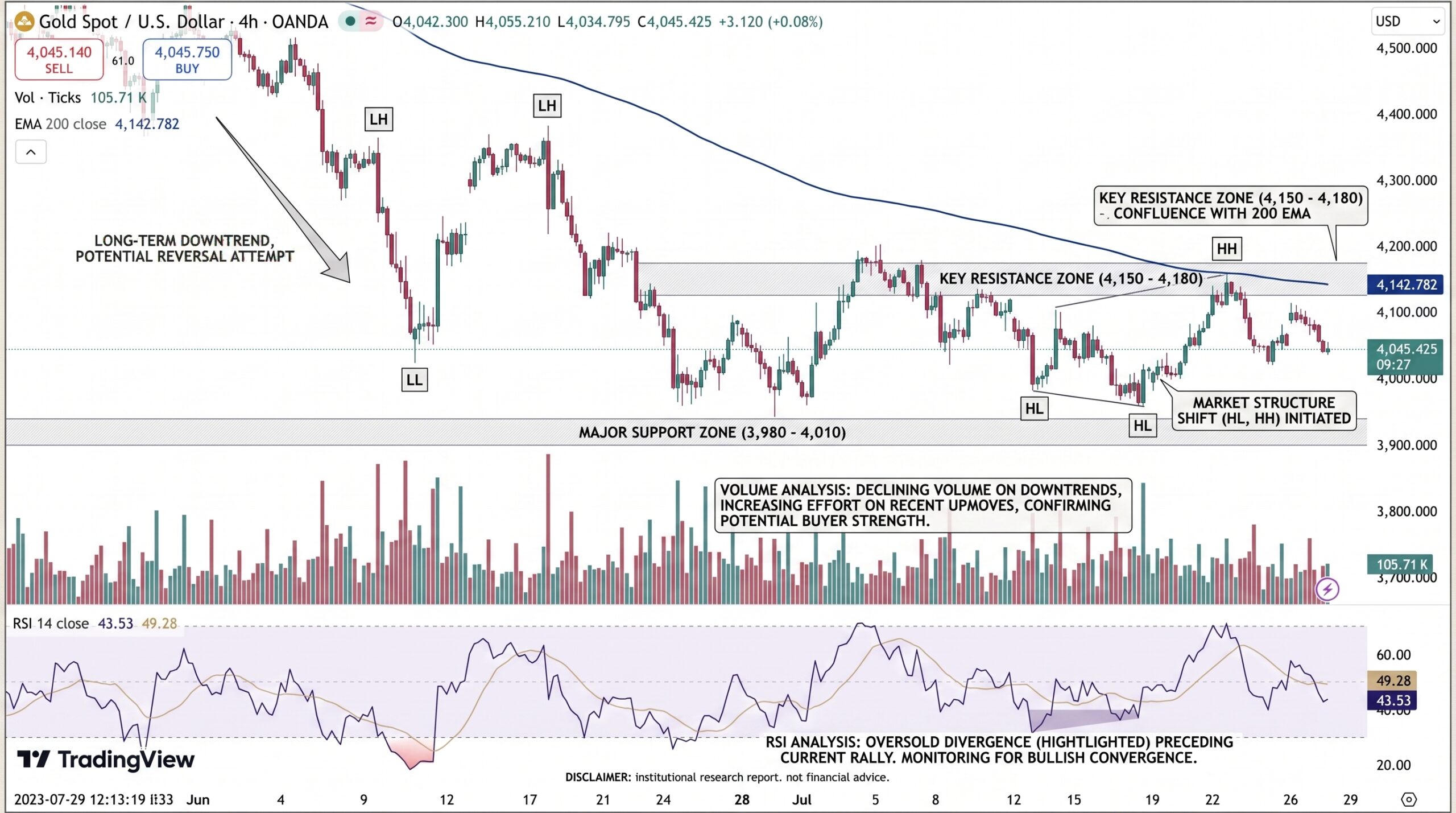
The broad-based decline suggests traders are positioning cautiously ahead of several major macroeconomic events rather than reacting to metal-specific fundamentals.
Fed Decision and Inflation Data Become Gold’s Next Major Catalyst
Attention now turns to one of the most important weeks for financial markets this quarter. Investors will closely monitor the Federal Reserve’s policy statement on Wednesday, followed by Fed Chair Kevin Warsh’s press conference for clues on the outlook for interest rates through the remainder of 2026.
Markets will then focus on the second-quarter GDP report, June PCE inflation data and upcoming US labour-market figures, all of which could reshape expectations for future Federal Reserve policy.
For gold, the next major move is likely to depend on whether incoming economic data support the market’s expectation that the Fed will keep policy restrictive for longer. A stronger dollar, firmer Treasury yields and persistent inflation could continue to pressure bullion, while softer economic data may revive expectations for future policy easing and renewed demand for safe-haven assets.
Sources & Methodology
Primary-source standard: Market-moving facts should link to original data releases, regulator notices, company filings or official project announcements whenever available. Secondary reporting is used for additional context, not as a substitute for original evidence.
Page last reviewed: