
XRP briefly fell below $1.50 on Monday as traders locked in gains following its recent advance. The decline came despite approximately $18.04 million entering U.S. spot XRP exchange-traded funds, showing that ETF demand was too small to absorb wider selling. XRP traded near $1.51 at the latest check, down about 1.9% for the session, after moving between $1.47 and $1.54. The pullback places the $1.50 level at the center of the token’s short-term outlook.
Selling Overwhelms ETF Demand
XRP has surrendered part of the advance that lifted it toward $1.60 last week. The token recently recorded an 8% decline to around $1.50 as profit-taking and spot-market selling outweighed demand from regulated investment products.
U.S. spot XRP ETFs attracted an estimated $18.04 million during the measured session. That inflow represented only about 0.44% of XRP’s reported $4.1 billion in 24-hour spot trading volume. However, the figures cover different reporting periods and should not be treated as a direct comparison.
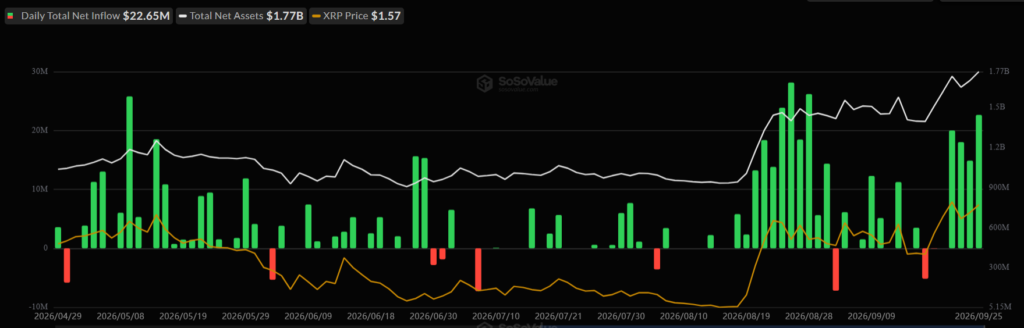
The imbalance explains why positive ETF flows do not guarantee an immediate price increase. ETF purchases account for only one part of the market, while cryptocurrency exchanges operate continuously and process sales from retail traders, large holders and leveraged investors.
The current market signals include:
- XRP traded as low as $1.47 during Monday’s session.
- The token later recovered toward $1.51.
- ETF demand remained positive but modest.
- September weekly inflows ranged from $10 million to $19 million.
- August recorded more than $150 million in XRP ETF inflows.
The slower September pace has reduced the funds’ ability to counter heavier selling across the wider market.
Why XRP Fell Below $1.50
Profit-taking increased after XRP’s recent rally. Investors who bought at lower prices used the move toward $1.60 to close positions, adding supply to the spot market.
Exchange balances also indicate that more tokens may be available for sale. Binance held approximately 2.68 billion XRP after its reserves reportedly increased by nearly 3% from the beginning of September. Deposits to an exchange do not confirm that every holder intends to sell, but rising reserves can increase available liquidity and potential selling pressure.
It is also important to distinguish Ripple, the financial-technology company, from XRP, the digital asset operating on the XRP Ledger. Corporate announcements involving Ripple do not automatically generate buying demand for the token.
ETF inflows show that investors are seeking regulated XRP exposure without holding the cryptocurrency directly. They do not prove that institutional purchases are large enough to control short-term market prices.
Technical Levels Define Next Move
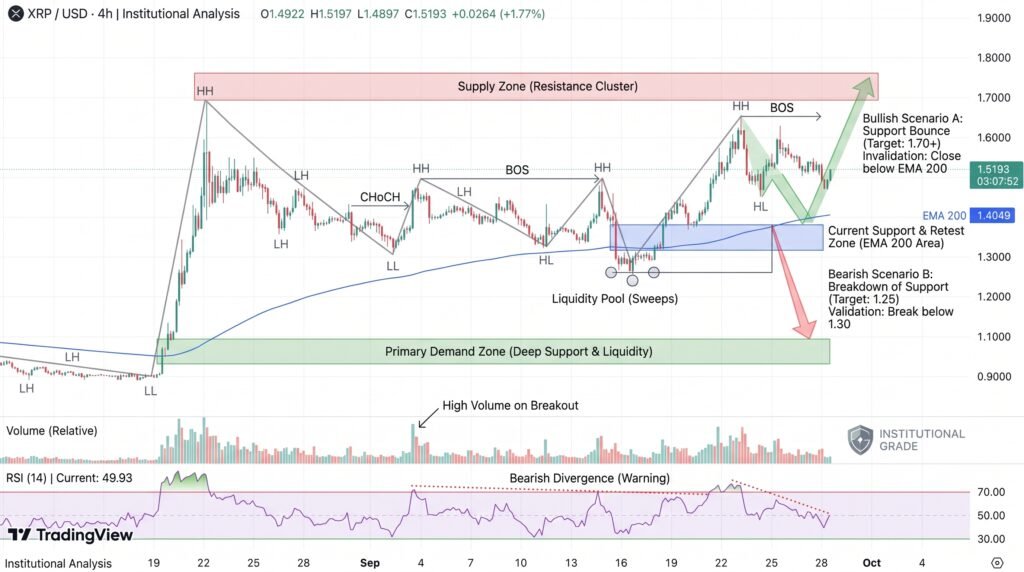
The $1.50 area is the immediate price pivot. A sustained recovery above that level could allow buyers to challenge resistance near $1.57 and $1.60. Failure to reclaim it would leave XRP exposed to additional selling.
Initial support sits near the session low of $1.47, followed by the $1.40 region. Broader moving-average support has recently been concentrated between approximately $1.28 and $1.36.
Key levels for traders include:
- Immediate resistance: $1.50
- Secondary resistance: $1.57 to $1.60
- Initial support: $1.47
- Stronger support: approximately $1.40
- Long-term support zone: $1.28 to $1.36
These figures are analytical reference points based on recent price behavior. They are not guaranteed targets or investment recommendations.
Conclusion
XRP’s move below $1.50 shows that positive ETF inflows alone cannot overcome stronger selling in the spot market. The token has recovered slightly, but buyers must establish sustained demand above $1.50 before the short-term outlook improves. Until that happens, trading volume, exchange reserves and ETF flows will provide more useful evidence than speculative forecasts.
Sources & Methodology
Primary-source standard: Market-moving facts should link to original data releases, regulator notices, company filings or official project announcements whenever available. Secondary reporting is used for additional context, not as a substitute for original evidence.
Page last reviewed: