
The Australian Dollar traded near 0.6925 against the US Dollar on Tuesday, November 10, as investors positioned ahead of the October US Consumer Price Index (CPI) report. The currency pair remains under pressure, with a key technical support area close to 0.6914 and a stronger US Dollar limiting recovery attempts. The inflation figures could influence expectations for the Federal Reserve’s next interest-rate decision, while Australian inflation expectations data later this week may shape the outlook for the Reserve Bank of Australia (RBA).
US Inflation Data Puts Fed in Focus
The October US CPI report is scheduled for release at 13:30 GMT on Tuesday. Economists expect annual headline inflation to rise to 3.9%, from 3.7% previously, while core inflation is forecast to increase to 2.8%, compared with 2.6%. Core CPI excludes food and energy prices to provide a clearer view of underlying inflation pressures.
A reading significantly above forecasts could strengthen the US Dollar by reinforcing expectations that the Federal Reserve will maintain a restrictive policy stance. A softer result, however, could weaken the case for further tightening.
According to the CME FedWatch tool, markets assign an 84.2% probability to a 25-basis-point rate increase in December, up from 77.4% a week earlier. That would lift the federal funds target range to 4.00%-4.25%.
Expectations shifted after October’s US employment report showed that employers added 165,000 jobs, exceeding the 65,000 forecast and the previous reading of 60,000. Strong employment can give policymakers more room to keep interest rates elevated while addressing inflation.
Australian Inflation Adds Another Risk
In Australia, attention is turning to November’s Consumer Inflation Expectations survey, due Thursday. The figures could influence market expectations for the RBA, particularly as policymakers remain concerned that inflation is still too high.
Deputy Governor Andrew Hauser recently warned that inflation remained elevated across different measures. His comments underline the central bank’s concern that domestic price pressures could persist, potentially limiting its flexibility to reduce interest rates.
The next catalysts for AUD/USD include:
- US CPI: A higher-than-expected reading could support the US Dollar.
- Australian inflation expectations: Stronger expectations could reinforce the case for a restrictive RBA policy.
- Fed rate pricing: Changes in December hike expectations may drive short-term currency volatility.
AUD/USD Forecast: 0.6914 Support Matters
On the daily chart, AUD/USD trades around 0.6926, holding just above former rising trend-line support near 0.6914. However, the pair remains below its 20-day Exponential Moving Average (EMA) at 0.6977, keeping the near-term technical outlook tilted lower.
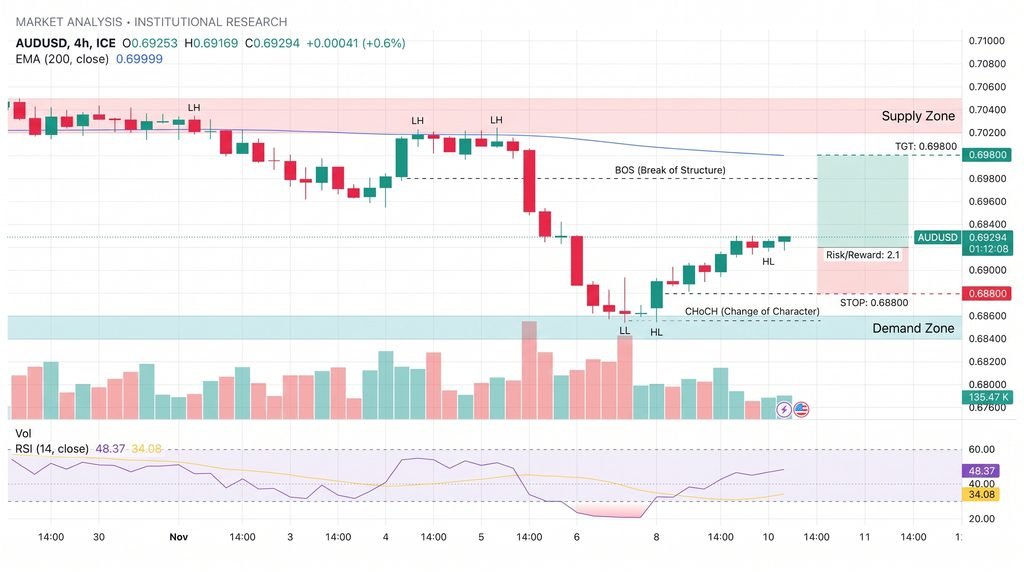
The Relative Strength Index (RSI) is in the low-40s, indicating subdued momentum without yet reaching oversold territory. This suggests buyers have not established a convincing recovery.
The key technical levels are:
- Immediate support: 0.6914, near the former trend line.
- Initial resistance: 0.6977, around the 20-day EMA.
- Bearish signal: A decisive daily close below 0.6914.
- Recovery signal: A daily close above 0.6977.
Conclusion
AUD/USD is approaching an important technical decision point. A sustained break below 0.6914 would strengthen the bearish outlook and expose the pair to further losses. Conversely, a move above 0.6977 could ease immediate selling pressure. Until either level gives way, US inflation data and Australian price expectations are likely to keep the pair sensitive to shifting central-bank expectations.
Sources & Methodology
Primary-source standard: Market-moving facts should link to original data releases, regulator notices, company filings or official project announcements whenever available. Secondary reporting is used for additional context, not as a substitute for original evidence.
Page last reviewed: