
Bitcoin traded below $75,000 on Tuesday as investors weighed persistent withdrawals from US spot exchange-traded funds (ETFs), political uncertainty surrounding crypto regulation and an approaching US inflation report. The largest cryptocurrency edged 0.3% higher to $74,358.10 at 05:19 ET, but its recovery remained fragile after a sharp decline following the November midterm elections. Weak institutional fund flows and uncertainty over the Federal Reserve’s next interest-rate decision continued to limit demand for digital assets.
Bitcoin ETF Outflows Weigh on Recovery
Investor withdrawals from US spot Bitcoin ETFs have become a major obstacle to a sustained price recovery. The funds recorded approximately $1.28 billion in net outflows between November 2 and November 6, their largest weekly withdrawal since late June, according to SoSoValue data. BlackRock’s iShares Bitcoin Trust accounted for roughly $1.21 billion of those withdrawals.
Selling pressure continued into the new week. US spot Bitcoin ETFs registered another $201.08 million in net outflows on Monday, November 9, extending the withdrawal streak to three consecutive trading sessions.
Spot Bitcoin ETFs allow investors to gain exposure to the cryptocurrency through traditional brokerage accounts. Their daily flows are closely monitored because they provide an indication of institutional demand. Persistent withdrawals can weaken market sentiment, although they do not necessarily mean that every investor is selling Bitcoin directly.
The latest figures show that:
- Last week’s withdrawals: Approximately $1.28 billion.
- Monday’s ETF outflows: About $201.08 million.
- Largest contributor: BlackRock’s IBIT, with roughly $1.21 billion in weekly withdrawals.
US Politics Raises Crypto Regulation Risks
The US political outlook has added another source of uncertainty. Democrats secured control of the Senate in the November midterm elections and are expected to take over the chamber in January 2027. Investors are assessing how the change could affect legislation covering digital assets, market oversight and investor protection.
Senator Elizabeth Warren, a prominent critic of the cryptocurrency industry, is currently the ranking Democrat on the Senate Banking Committee. Her influence could increase when Democrats assume the Senate majority, although she has not yet formally become the committee’s chair.
The prospect of closer congressional scrutiny has unsettled some crypto investors, particularly those awaiting clearer rules for exchanges, stablecoins and digital-asset markets. However, the election outcome does not automatically establish a new regulatory framework; proposed legislation would still need to pass through the required congressional process.
US CPI Could Shape Bitcoin’s Next Move
Attention is also turning to the October Consumer Price Index, scheduled for release at 13:30 GMT on Tuesday. Economists expect headline inflation to increase 0.3% month over month, down from September’s 0.6%. Core CPI, which excludes food and energy, is forecast to rise 0.2%, compared with 0.3% previously.
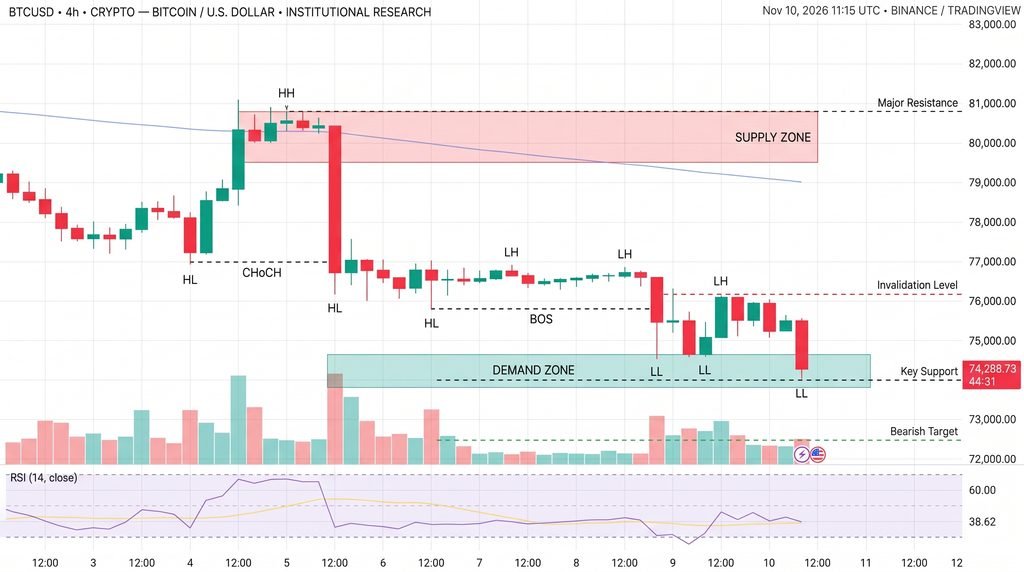
A stronger-than-expected reading could reinforce expectations of another Federal Reserve rate increase in December. Higher interest rates generally make speculative investments less attractive by increasing the appeal of interest-bearing assets.
Other major cryptocurrencies also traded unevenly:
- Ether fell 0.7% to $2,093.42.
- XRP declined 0.5%, while Solana lost 1%.
- Cardano gained 1.2%, and BNB advanced 1.1%.
- Dogecoin rose 1%, while the TRUMP token slipped 1.2%.
Conclusion
Bitcoin’s attempt to recover above $75,000 faces pressure from institutional withdrawals, regulatory uncertainty and interest-rate concerns. ETF flows and the October inflation report are likely to shape near-term sentiment. A sustained improvement in fund demand and a softer inflation reading could support a recovery, while renewed outflows and stronger price pressures would leave Bitcoin vulnerable to further losses.
Sources & Methodology
Primary-source standard: Market-moving facts should link to original data releases, regulator notices, company filings or official project announcements whenever available. Secondary reporting is used for additional context, not as a substitute for original evidence.
Page last reviewed: