CFD trading costs reduce the gross market result through execution, financing and other contract charges, so compare the full trade rather than one advertised fee. This guide provides a repeatable worksheet with hypothetical calculations and a process for checking the statement.
Use our trading education hub for the foundations. The examples below are invented and do not quote current broker rates or recommend an account.
Risk warning: CFDs are complex leveraged products. Losses can be substantial and may exceed your deposit where negative balance protection does not apply. Lower costs do not remove market, execution or provider risk.
Affiliate disclosure: AAFX.IO may earn a commission through qualifying links on the site. Commercial relationships do not determine this analysis. No new broker offer is included here.
What costs should you include when trading CFDs?
CFD trading costs can include the spread, commission, overnight financing, currency conversion and product-specific charges or adjustments. Their effect depends on position size, direction, holding period and the exact contract. Build one all-in estimate for the proposed trade, then compare it with the gross price objective and a delayed-exit scenario.
How do you calculate the total cost of a CFD trade?
Identify the contract units and account currency, estimate each applicable charge over the intended holding period, and combine them without counting the spread twice. Keep financing assumptions and conversion separate. Reconcile the estimate with executed prices and the account statement afterwards. No generic calculator can replace the current fee schedule for your provider and product.
CFD trading costs: overview
- Map the contract before comparing CFD trading costs
- Spread and commission: use one consistent price basis
- Holding costs depend on the rate, basis and calendar
- Conversion and product adjustments need their own lines
- A complete hypothetical net-result worksheet
- Compare equivalent trades, not advertising headlines
- Manage avoidable costs without increasing the market risk
- Reconcile the statement and keep an exceptions log
- AAFX.IO: judge the net result with a complete worksheet
- Frequently asked questions
Map the contract before comparing CFD trading costs
A useful cost estimate begins with the product you are actually trading. Record the provider entity, contract name, symbol, unit size, quote currency and account currency. Then identify whether the instrument is a cash CFD, a futures-referencing CFD or another contract structure. Similar chart names do not ensure identical terms or charging methods.
Keep three inputs separate: exposure, initial margin and money deposited in the account. Exposure measures the market value represented by the position. Margin is the security required to support it. The deposit funds the account. A financing formula based on exposure cannot be estimated by multiplying a rate by the deposit instead.
Our CFD introduction explains the product mechanics, while the leverage guide distinguishes exposure from margin. This article focuses on a different question: how much of the gross market result might remain after the contract charges and execution effects are accounted for.
Write each charge as a formula with units. For example, dollars per contract per side differs from a percentage of trade value per side. An annual percentage differs from a daily one. A quoted minimum commission can dominate a small order even where the advertised percentage looks low. Do not compare rates until their bases are consistent.
Create a dated copy of the fee schedule or retain the relevant product document. Note any input that remains unknown. A blank financing rate is an unresolved calculation, not a zero charge. Ask the provider to clarify the missing term before relying on the estimate for a trade decision.
Spread and commission: use one consistent price basis
The spread is the difference between the buying and selling quotes at a particular time. Suppose a hypothetical unchanged market displays a bid of $99.95 and an ask of $100.05. Buying and immediately selling 100 equivalent units at those executable prices creates a $10 price loss before any separate commission. The calculation uses the $0.10 difference once.
If you later calculate profit using your actual opening buy price and actual closing sell price, the buying and selling quote effects are already within that result. Subtracting an additional notional spread allowance would count part of the same economic effect twice. This is a common worksheet error when an estimate and a statement use different price conventions.
A midpoint-based planning calculation works differently. It starts from a reference price between the quotes and separately estimates the execution cost of crossing the spread on entry and exit. State that convention clearly. Spreads can change, so an estimate based on a quiet period is not a promise about the quote when you close.
Commission may apply on opening, closing or both sides, depending on the schedule. Calculate it for the actual contract volume and check any minimum. A $3 minimum per side means a round-trip commission of $6 in a hypothetical account even if a percentage calculation would give a smaller amount. This is arithmetic, not a quoted market fee.
Read our broker revenue and fee guide for the broader charging models. Here the practical objective is a consistent worksheet: reference-price result minus separately modelled execution costs, or actual-fill result minus only charges not already included. Do not combine both approaches accidentally.
Holding costs depend on the rate, basis and calendar
For an open position, establish the financing rate, calculation base, day-count convention and time at which charges are applied. A simple illustrative formula is exposure multiplied by an annual rate multiplied by chargeable days, divided by the stated year basis. Real provider calculations can use changing inputs or separate components, so verify the actual method.
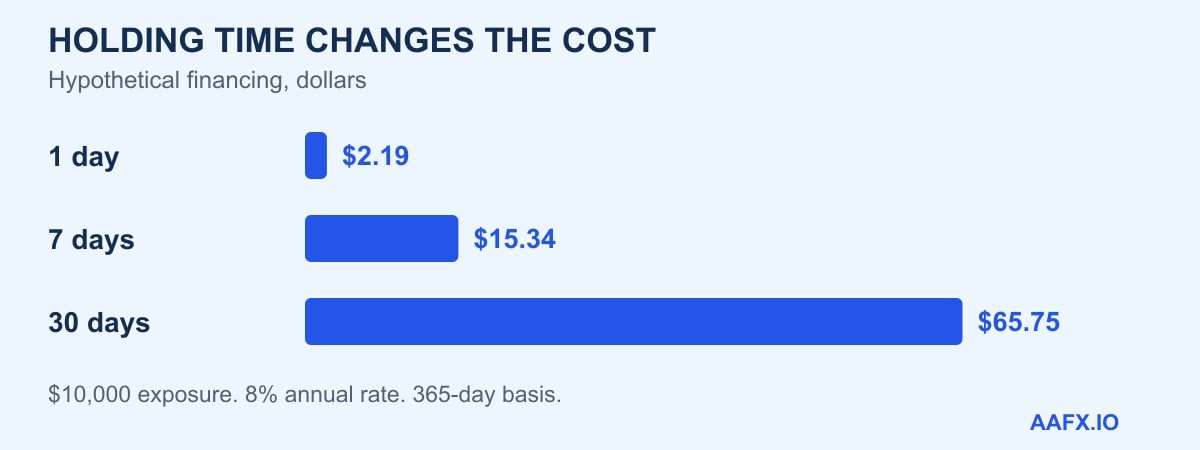
For example, assume $10,000 constant exposure, a hypothetical 8% annual financing charge and a 365-day basis. One chargeable day is approximately $2.19: $10,000 multiplied by 0.08, divided by 365. Seven chargeable days cost approximately $15.34, and 30 cost approximately $65.75. These invented rates illustrate the method; they do not describe a current broker.
A small initial margin does not change that exposure-based calculation. If the hypothetical margin were $1,000, the seven-day charge would still be about $15.34 under these assumptions. Expressing it as a percentage of margin can show its account significance, but does not change the amount owed. Longer holding periods make this distinction more visible.
The FCA review of CFD charges highlights concerns about overnight funding and how firms explain it, including matched opposite positions. Checked on 7 November 2026, this is UK regulatory context rather than a fee quote for your account. A provider’s price and fair-value obligations do not give a universal financing formula.
Read buy and sell schedules separately. A short position does not automatically earn a financing credit, and a hedged pair of open trades does not automatically become cost-free. Also check how weekends and holidays are charged. Record chargeable days according to the contract instead of assuming that one calendar date always produces one identical adjustment.
| Illustrative period | $10,000 at 8% annually | Assumptions |
|---|---|---|
| 1 chargeable day | $2.19 | 365-day basis; constant exposure/rate |
| 7 chargeable days | $15.34 | Rounded after calculation |
| 30 chargeable days | $65.75 | Not a provider fee quote |
Conversion and product adjustments need their own lines
When the contract result and account use different currencies, record how the result is converted and whether a conversion fee applies. Determine when the conversion occurs and whether the provider converts each cash flow separately. A percentage conversion charge needs both a rate and a cash amount to which it applies.
Keep economic currency exposure distinct from an explicit conversion fee. An exchange-rate movement changes the value of a foreign-currency amount; a fee is a separate charge under the agreement. The statement may show these effects differently. A worksheet that labels every difference as commission loses the information needed to investigate the result.
A share-related dividend adjustment is also not the same as owning a dividend-paying share. Its sign, timing and amount follow the CFD contract. A futures-referencing product can have maturity or rollover adjustments. Examine the full price and cash-flow treatment together before classifying an adjustment as a fee, a gain or a neutral mechanical change.
Check other relevant terms, such as a guaranteed-stop premium, market-data subscription, share-borrow charge, inactivity fee or withdrawal charge. Some depend on the product or account activity rather than each trade. Allocate recurring account expenses consistently if comparing strategies, while keeping personal tax treatment separate and checking it with a qualified local adviser where needed.
Singapore’s MoneySense CFD explanation provides product context for charges and adjustments. Use the provider’s own dated terms for the final worksheet. There is no reason to assume that the same brand applies identical pricing across its entities, account types and client categories.
A complete hypothetical net-result worksheet
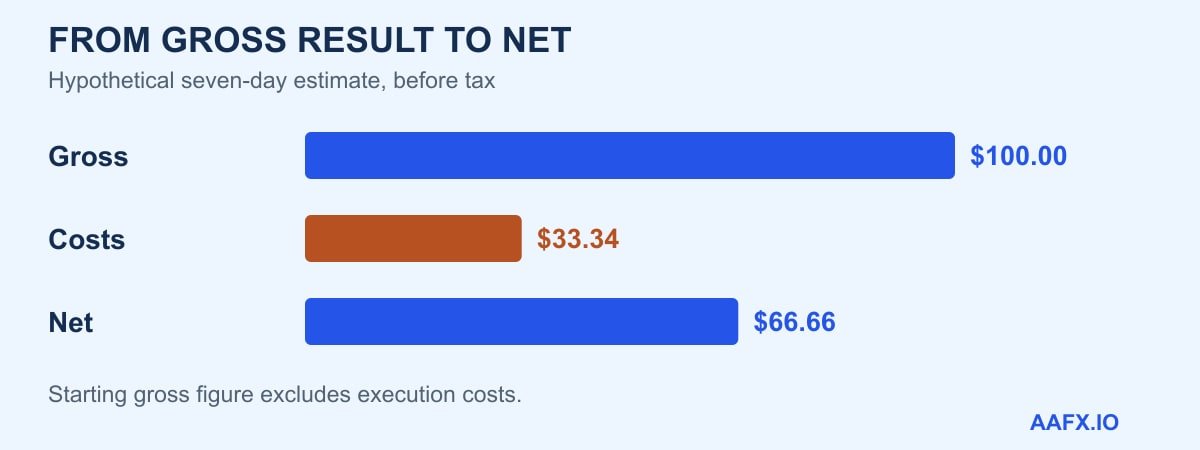
Assume a hypothetical trade has a $100 favourable price result measured against a reference-price benchmark before estimated execution costs. For this example only, allocate $10 to the round-trip spread effect, $6 to total commission, $15.34 to seven chargeable days of financing and $2 to a separate conversion charge. The cost estimate totals $33.34.
Subtracting $33.34 from $100 leaves an estimated $66.66 net result before tax and any other excluded item. If the reference-price result were only $20, the same cost estimate would instead produce a $13.34 net loss. Directional accuracy is therefore insufficient to assess the economic outcome. The size of the move and the cost of obtaining it both matter.
The $10 spread allowance belongs in this example because the starting result excludes execution effects. If your platform statement already calculates the price result from actual buy and sell fills, do not subtract that $10 again. Instead reconcile its actual commission, financing and conversion separately. Keep the planning convention beside the calculation to prevent accidental reuse.
A delayed exit also changes the estimate. Holding the same hypothetical exposure for 30 chargeable days increases financing to approximately $65.75. Keeping the other assumed charges unchanged produces total costs of $83.75 and leaves $16.25 from the same $100 reference-price gain. A longer holding period can materially change the trade economics without changing that gross gain.
None of these numbers predicts an attainable return, suitable holding period or worst loss. The exposure, rate and charges are invented, and a real market move can be adverse. Use the arithmetic to identify required inputs, then test an unfavourable price scenario and a worse execution scenario as separate parts of the risk review.
| Hypothetical item | Seven-day estimate | Thirty-day estimate |
|---|---|---|
| Reference-price gain before execution costs | $100.00 | $100.00 |
| Spread allowance | $10.00 | $10.00 |
| Total commission | $6.00 | $6.00 |
| Financing | $15.34 | $65.75 |
| Conversion charge | $2.00 | $2.00 |
| Total estimated costs | $33.34 | $83.75 |
| Estimated net before tax | $66.66 | $16.25 |
Compare equivalent trades, not advertising headlines
Choose one comparison scenario before collecting broker prices. Fix the instrument, economic exposure, direction, account currency, intended opening time and holding period. If those inputs differ, a lower number may reflect a different trade rather than a cheaper service. Compare a delayed holding period as well, because a narrow spread can coexist with expensive financing.
Record each provider quote with a date and the account entity. Distinguish an observed spread from an advertised minimum or an average measured over another period. If a fee cannot be verified, show it as unknown. Do not rank an incomplete estimate as the cheapest merely because an unresolved component is missing from the arithmetic.
Review execution and protection separately from cost. A favourable estimate cannot compensate for an unverified company, unclear permissions or unsuitable terms. Our broker-selection checklist covers those checks. A detailed cost table is one input into the decision, rather than an endorsement of the firm that appears cheapest in a selected scenario.
Likewise, compare cash and futures-referencing CFDs on equivalent economic dates. A different maturity structure or price basis can move costs between the quote and the cash adjustments. Ask for a worked provider example if the comparison is unclear. Avoid assuming that no separately labelled overnight fee means no economic carrying cost.
Manage avoidable costs without increasing the market risk
The first response to a cost problem is better information. Confirm that the account and product match the intended use, identify minimum charges and understand the financing cut-off. An incorrect contract size can create a much larger cost than the difference between two advertised spreads. Resolve calculation errors before looking for a new strategy.
Trading less frequently can reduce repeated transaction charges, but holding longer can increase financing and market exposure. Neither approach is automatically cheaper overall. Compare both under the actual proposed plan. Do not turn a short trade into an open-ended position solely to avoid recognising a loss or paying another closing commission.
Order choice also involves a trade-off. A limit can constrain price if it fills, but may remain unexecuted; an ordinary stop is a trigger rather than a guaranteed fill. The SEC investor bulletin explains these principles for securities orders. Check the CFD execution policy separately. Fees and adverse price changes still matter whichever instruction is used.
Avoid increasing size to make a fixed fee look smaller as a percentage of the trade. That changes the market loss exposure, which can outweigh the saving. Similarly, do not keep two opposite positions open solely because their directional exposure appears offset. Check charges on each contract and whether closing the positions is operationally appropriate.
If the projected cost consumes most of the price objective, consider declining the trade. A smaller target is not improved by ignoring financing or assuming a perfect fill. For the broader loss framework, use CFD risk guide and record why the opportunity was accepted or rejected alongside the cost assumptions.
Reconcile the statement and keep an exceptions log
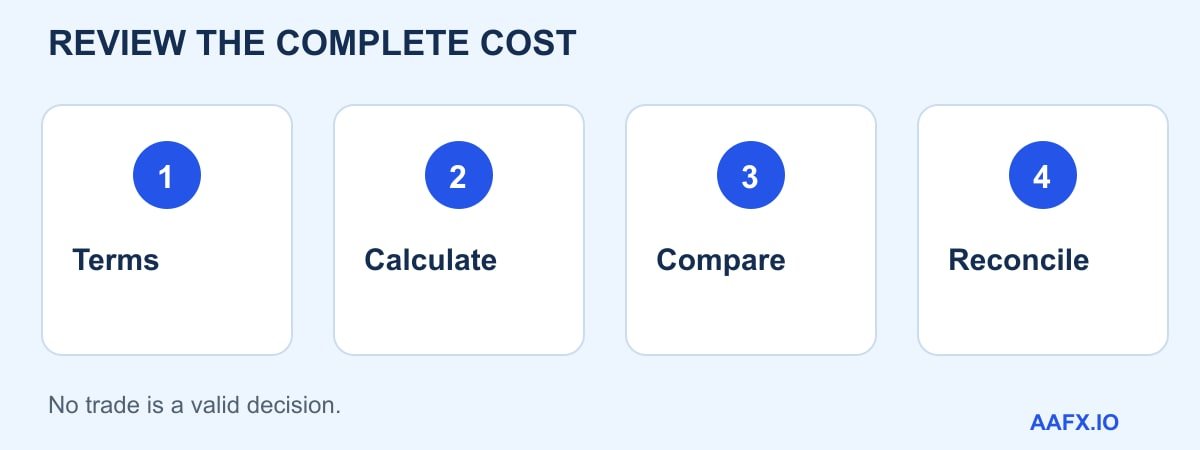
After closing, compare the executed-price result with the cash movements in the statement. Separate the market result from commission, financing, conversion and other adjustments. Retain the transaction identifiers and relevant contract terms. This makes a discrepancy actionable rather than a vague impression that the platform result looks too low.
For a financing difference, check each input in order: notional amount, rate, direction, number of chargeable days, year basis and conversion. For commission, check the contract units, per-side convention and minimum. Rounding can explain small differences, but do not use rounding as a blanket explanation for an amount you cannot reconstruct.
Create a brief exception entry when the statement differs from the estimate. Record the expected amount, actual amount, likely cause and provider explanation. Do not silently overwrite the original estimate, because doing so removes the evidence of what was knowable before entry. Correct the worksheet for future trades after resolving the issue.
Review a sample of these records periodically. Repeated delayed exits, conversion surprises or wider spreads may reveal that the intended holding style and the selected product do not fit. The purpose is to improve the decision process, not to infer future profitability from a few completed trades or a favourable short-term result.
AAFX.IO: judge the net result with a complete worksheet
The cheapest-looking fee is not necessarily the cheapest complete trade. Use a consistent price basis, model the holding period, include applicable adjustments and compare the result with the account statement. Keep unknown inputs visible. A cost estimate is useful when its assumptions can be checked and revised.
Continue with the CFD introduction, order-type guide and broker licence checklist linked throughout this article. For educational videos, follow @arslaninsights on TikTok and AAFX.IO on Instagram. No video or calculator replaces the terms of the entity actually providing the contract, and no fee reduction guarantees a profitable trade.
Affiliate disclosure: Verify providers independently. An affiliate relationship does not establish suitability, regulatory protection or a competitive cost.
Educational information only, not personalised investment, legal or tax advice. Figures and graphics are hypothetical examples, not tested performance, market forecasts or broker quotations.
Written and reviewed by Arslan Ali Butt, MPhil Behavioural Finance, MBA Finance, with more than 10 years in forex dealing and market analysis. Last reviewed: 7 November 2026.
How we reviewed this guide: Checked the linked FCA review of CFD charges, MoneySense CFD guidance and SEC order bulletin on 7 November 2026. The arithmetic is original and uses invented constant exposures and rates with explicit assumptions. It does not rank brokers or represent first-hand account testing. Intended for annual editorial review, with earlier updates after material developments; actual account fee inputs need checking before use.
Frequently Asked Questions
Is commission-free CFD trading free?
No. A provider can charge through the spread, financing, conversion or other terms even when no separate dealing commission applies. Compare the complete cost for the specific instrument, size and holding period. A commission-free label describes one part of the charging model; it does not establish that the product is inexpensive, suitable or likely to produce a positive net result.
Do I pay the spread once or twice?
The economic effect depends on the prices used in your calculation. An immediate buy and sell at an unchanged quote loses the bid-ask difference. If your profit calculation already uses actual buying and selling execution prices, that effect is already embedded. Do not subtract the same spread again. A separate midpoint-based estimate needs an explicitly defined spread allowance for the round trip.
Is overnight financing calculated on the deposit?
Do not assume that it is. Check the provider formula, which may use the full notional exposure rather than the initial margin. You also need the applicable rate, direction, day-count convention and charging schedule. A small margin deposit can therefore support a position with substantial holding charges. Use the product terms, not the account deposit, as the starting point.
Will a short CFD position always receive financing income?
No. Whether a short position receives or pays a financing adjustment depends on the contract, reference rate, provider markup and other terms. Borrowing costs may also apply to particular share positions. Read the buy and sell schedules separately. A credit shown for one product or date should not be carried over to another position without checking its actual specification.
Why can the overnight charge change from day to day?
Rates, notional exposure, exchange rates and the number of days charged can change under the contract. Weekends, holidays or the provider schedule may also affect when adjustments appear. Compare the statement with the published formula and relevant date. Ask the provider to explain an unexpected amount in writing rather than assuming that every difference is either an error or unavoidable.
Does hedging two opposite CFDs remove the costs?
Not necessarily. Opposite positions can offset some directional exposure while leaving two contracts open. Spread, commission and holding charges may still apply under the terms for each leg. Compare the combined statement result and financing method. Do not confuse a smaller net market position with the absence of gross exposure, operational complexity or charges on the positions that remain open.
Are futures-based CFDs cheaper than cash CFDs?
There is no universal answer. A futures-based CFD may use a different spread, maturity structure or pricing adjustment instead of the cash product financing method. Compare equivalent exposure and dates, including expiry or rollover arrangements and any explicit charges. Avoid treating the absence of one labelled fee as proof that the overall economic cost is lower for your intended trade.
How should I compare two broker fee schedules?
Use the same instrument, contract exposure, direction, account currency and holding period. Include both opening and closing commission where relevant, the expected spread, financing and conversion. Keep unverified fees marked as unknown instead of treating them as zero. Then check entity, permissions and execution terms separately, because a lower estimated charge does not establish that an account is suitable or safe.
Can a limit order eliminate CFD trading costs?
No. A limit instruction can constrain the execution price if filled, but it does not cancel applicable commission, financing or conversion. It can also remain unfilled. Compare the instruction with the trading objective and contract terms rather than treating it as a free execution method. The actual result must still be reconciled using executed prices and the full statement of charges.
How often should I update a CFD cost worksheet?
Check the current schedule before opening a position and after material changes to rates, exposure, holding plans or account terms. Reconcile charges while positions remain open and after closure. This evergreen guide is intended for annual editorial review, but individual fee inputs need much more frequent checking. An old worksheet is a record of assumptions, not confirmation of the cost today.
Sources & Methodology
Primary-source standard: Market-moving facts should link to original data releases, regulator notices, company filings or official project announcements whenever available. Secondary reporting is used for additional context, not as a substitute for original evidence.
Page last reviewed: