CFD trading risks arise from the market exposure, the execution process and the provider agreement, not just the deposit used to open a position. This guide explains how to calculate losses, examine account protections and decide when to stay out.
Start with our education hub if the contract mechanics are unfamiliar. This article is a risk framework, not a current trade recommendation or broker ranking.
Risk warning: CFDs are complex leveraged products. You can lose substantial funds; losses can exceed your deposit where applicable negative balance protection does not apply. No stop instruction or checklist guarantees a safe result.
Affiliate disclosure: AAFX.IO may earn a commission through qualifying links on the site. This does not change the analysis. No broker offer is added to this guide.
What are the main CFD trading risks?
CFD trading risks include losses on the full market exposure, forced position closure, gaps, slippage, ongoing charges and provider failure. A small margin deposit does not make the position small. Before trading, identify the contract, calculate a stressed loss, check the legal entity and understand which protections actually apply to your account.
Can you lose more than your CFD deposit?
You can lose the margin allocated to a position and other available account funds. Whether you can owe additional money depends on applicable rules, client classification and the contract. Negative balance protection is not universal. Even where it applies, it does not protect your trading capital from ordinary market losses or guarantee a particular exit price.
CFD trading risks: overview
- CFD trading risks begin with exposure, not the deposit
- A worked loss example, including a gap
- Stops, gaps and forced closure solve different problems
- Costs and currency conversion change the account result
- Provider and legal-entity risk require separate checks
- Several trades can share one underlying risk
- A practical pre-trade risk review
- Who should skip CFDs or pause trading?
- AAFX.IO: understand the contract before taking the exposure
- Frequently asked questions
CFD trading risks begin with exposure, not the deposit
A contract for difference is an agreement with a provider to settle changes in a referenced price under specified terms. It is not the same as owning the underlying share, currency or commodity. The first risk question is therefore about the contract: what does one unit represent, and how does a price change affect the account?
Separate three amounts on a worksheet. Notional exposure is the market value represented by the contract. Required margin is the security the provider requires for that exposure. Account equity is the account value after open profits, losses and applicable charges. These amounts answer different questions, so substituting margin for exposure creates a misleading risk estimate.
The Australian regulator’s Moneysmart CFD guide identifies leverage, pricing and counterparty risks. Its Australian rules should not be assumed to apply everywhere. The practical lesson is broader: understand both the market sensitivity and the agreement supporting it. Our CFD introduction explains the basic product before this risk-focused checklist.
Write the value of a one-unit price movement in the account currency. Check whether the platform volume is measured in shares, lots, contracts or another unit. A familiar chart symbol does not establish a familiar contract size. Two products referencing the same asset can have different minimum sizes, price conventions and financing arrangements.
For example, a small deposit supporting a large position can make an ordinary market fluctuation material to the account. Increasing available leverage does not improve the underlying forecast. It changes the relationship between funds committed and exposure controlled. Read our leverage and margin guide before using a platform’s largest permitted trade size.
A worked loss example, including a gap
Consider a hypothetical long share CFD representing 100 shares at an executed opening price of $100 each. The exposure is $10,000. Assume a 10% initial margin requirement solely for illustration, making required margin $1,000. The example assumes $5,000 account equity before the trade. These are invented contract terms and prices, not a broker offer or recommendation.
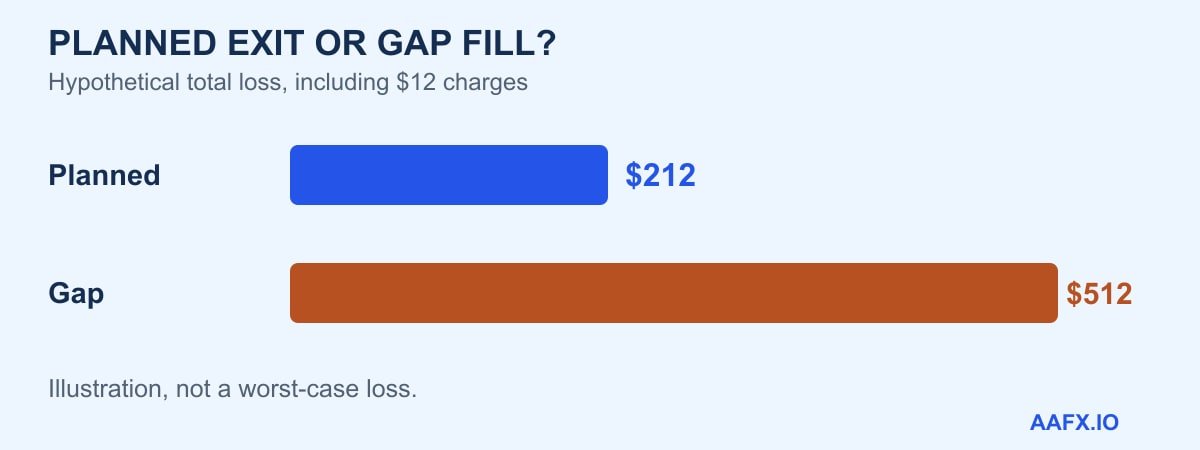
If the executed closing price is $98, the gross price loss is 100 multiplied by $2, or $200. Assume $12 total additional commission and financing charges. The total illustrated loss is $212. That equals 21.2% of the initial position margin and 4.24% of starting account equity. Both percentages describe the same dollar loss using different denominators.
Now suppose the planned $98 exit cannot execute and the position instead closes at $95 after a gap. The gross loss becomes $500, and the illustrated total becomes $512 after the same assumed charges. That is 51.2% of initial margin and 10.24% of starting account equity. The plan and realised outcome have diverged substantially.
Because these calculations start with executed opening and closing prices, spread effects embedded in those prices must not be charged a second time. Real financing, conversion, tax and contract adjustments can differ. Recalculate with the actual specifications. A provider may also close positions earlier under its margin rules, so this arithmetic does not predict a liquidation sequence.
The useful comparison is between a planned scenario and a plausible adverse scenario. Neither figure is a guaranteed worst case. Test larger moves and changed costs as well, then consider the effect on the whole account rather than looking at one trade in isolation.
| Hypothetical close | Gross price loss | Loss including $12 charges | Starting equity impact |
|---|---|---|---|
| $98 planned fill | $200 | $212 | 4.24% of $5,000 |
| $95 gap fill | $500 | $512 | 10.24% of $5,000 |
Stops, gaps and forced closure solve different problems
An ordinary stop is an instruction, not insurance against every market condition. Read which price triggers it, whether that is a bid, ask or another reference, and what happens after the trigger. The chart you watch and the price used for execution need not be identical. Spreads can also change while a position is open.
The SEC’s stop-order investor bulletin explains the trade-off for stock orders: a stop can execute away from its trigger, while a stop-limit can remain unfilled. That source describes securities orders, not your CFD provider’s contract. Check the CFD execution policy separately. Our order-type guide compares these instructions.
A guaranteed stop, where offered, is a different contractual feature. It can involve a charge, minimum distance or restrictions on particular products and circumstances. Verify whether the guarantee actually applies to the proposed trade. A marketing heading or a familiar button is insufficient evidence of the obligations that the provider accepts.
Margin close-out serves a different purpose again. It allows or requires positions to be reduced under the provider and applicable regulatory rules when account resources become insufficient. Do not build a plan around receiving a warning and then having time to transfer money. Connectivity, funding delays and rapidly moving prices can make that response unavailable.
Before holding through a market closure, note when pricing resumes and which events can occur while trading is unavailable. An announcement during a closure can cause the first available quote to differ sharply from the last one. Decide in advance whether the exposure is acceptable through that period.
Costs and currency conversion change the account result
A position can move in the expected direction and still disappoint after costs. The spread is the difference between quoted buying and selling prices. Commission is an explicit transaction charge where applicable. Financing and other holding adjustments depend on the contract and time held. None should be inferred from a headline claim of low spreads.
Singapore’s MoneySense CFD explanation discusses leverage, margin and ongoing costs in its jurisdiction. Use the actual provider schedule for a calculation. In particular, establish whether a quoted holding rate is annualised, when it is applied and the exposure on which it is calculated. A rate without its basis and period cannot support a reliable estimate.
If the contract result is in a currency different from the account currency, conversion can alter the reported amount. Identify the conversion rate source, any conversion charge and when conversion occurs. A stable underlying position does not necessarily mean a stable account-currency value when another currency relationship is involved.
For a proposed multi-day trade, calculate the expected holding cost across the intended period and a longer period if the exit is delayed. Then compare that cost with both the price objective and the loss scenario. A small target can leave little room for a wider spread, additional financing or an imperfect fill.
Do not respond to unexpectedly high costs by increasing position size to recover them. That raises exposure while leaving the original economic problem unresolved. Our broker charges guide explains revenue sources; this checklist focuses on what those charges mean for a risk decision.
Provider and legal-entity risk require separate checks
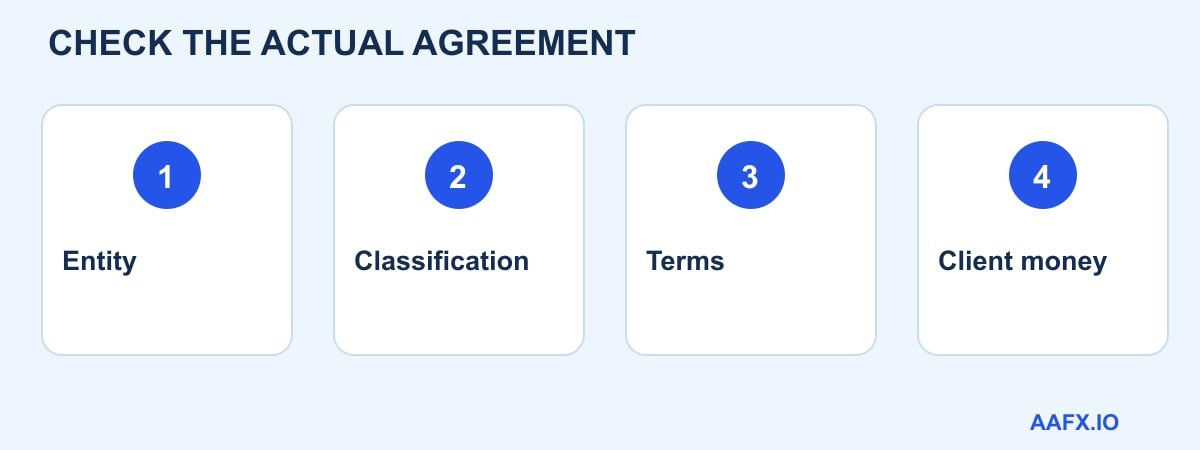
The trading interface is only one part of the arrangement. Identify the legal company named in the agreement, the entity receiving client money and the provider responsible for the contract. A group can operate through several companies. A licence displayed for one company does not automatically cover every customer relationship associated with the brand.
Check relevant permissions directly and compare the registered details with the agreement and website. Our broker licence checklist provides the verification workflow. If details conflict, resolve the discrepancy before funding. Do not treat a support representative’s reassurance as a substitute for an identifiable entity and verifiable permission.
Retail protections depend on the jurisdiction and account classification. The FCA describes negative balance protection and margin close-out requirements for relevant UK retail CFD business. This is a specific regulatory framework, not a worldwide promise. Avoid selecting a professional or offshore arrangement solely because it advertises higher leverage without understanding which protections change.
The FCA CFD information page is the primary reference for that UK context, checked on 7 November 2026. Do not interpret this explanation as confirmation that a particular account qualifies. Ask for the applicable terms in writing and check the exact company rather than transferring another entity’s protections to it.
Separately, determine how money is held, what happens if the provider fails and which complaint routes may be available. Regulation cannot guarantee investment success or eliminate insolvency risk. Our client-funds guide distinguishes custody, contractual claims and protection limits without presenting them as interchangeable safeguards.
| Check | Evidence to retain | What it does not establish |
|---|---|---|
| Entity and permissions | Agreement plus official register record | That a trade will be profitable |
| Client classification | Written retail or professional status | That another entity provides identical rights |
| Execution and costs | Contract specification and dated schedules | That a stop must fill at its trigger |
| Money and complaints | Client-money terms and eligible complaint routes | That all losses are compensated |
Several trades can share one underlying risk
A list of different instruments can conceal a single concentrated view. A long equity index position and several long shares in its largest sector may all rely on the same earnings and financing backdrop. A currency position can add exposure to that same backdrop instead of offsetting it. Names alone do not establish diversification.
Construct a common stress scenario before evaluating trades independently. Ask what happens if the dollar strengthens, relevant interest-rate expectations change or risk appetite weakens. Then estimate how each position could respond under explicit assumptions. The estimates are scenarios, not measured probabilities, and correlations can change during stress.
For illustration, three trades each planned to lose $100 can create a $300 combined planned loss if all fail together, before any additional slippage or charges. On $5,000 starting equity that is 6%, even though each individual worksheet shows 2%. The calculation does not require the instruments to move by identical percentages.
Margin demands can also interact across an account. Reducing one position can change available margin and exposure elsewhere, while financing continues on remaining positions. Review the account after every material change. Our long and short position guide explains direction; the portfolio question is how those directions combine under shared drivers.
Maintain one account-level record alongside the individual trade plans. Include notional exposure, planned exits, gap scenarios, expected charges and common events. A process that approves each trade without considering the existing book can accumulate more risk than the trader intended.
A practical pre-trade risk review
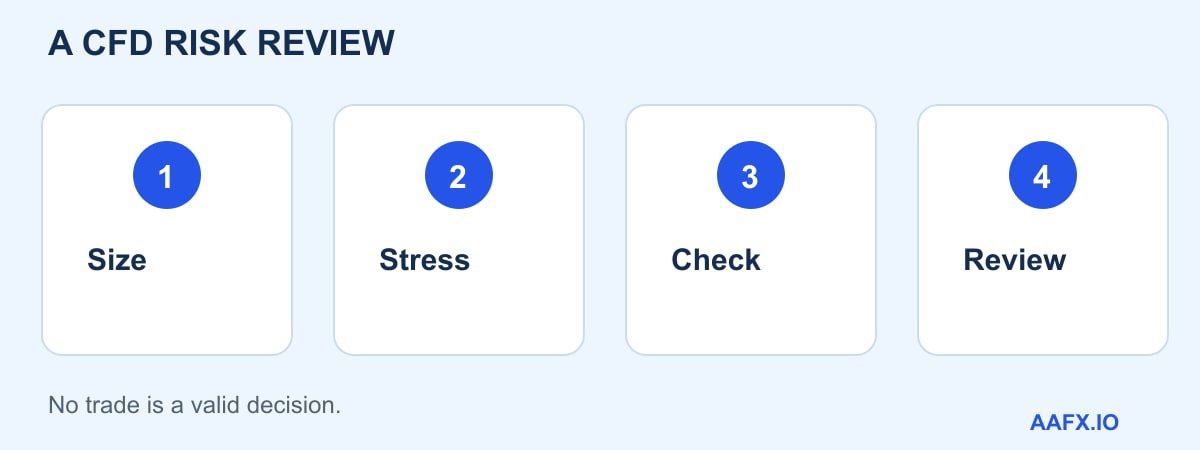
Start by writing the trade idea in plain language. Identify the price behaviour that would support it and the evidence that would invalidate it. Then calculate contract units, exposure, account-currency sensitivity and required margin. Keep these calculations separate from the platform button that opens the order, so a display misunderstanding is easier to catch.
Next, compare the planned exit with a worse-fill scenario and a period when the market is unavailable. Estimate charges for the intended holding period and a delayed exit. Review scheduled events that can affect the instrument, while recognising that unscheduled events remain possible. If the combined scenario is unaffordable, reduce exposure or decline the trade.
Test the operational sequence in a demo environment: place and amend an order, cancel it, close a partial position and locate the account history. Record what the test can and cannot establish. Demo familiarity is useful preparation, but it does not reproduce every live liquidity condition or the pressure of a real loss.
Finally, record the decision, including a decision not to trade. After closing, compare the actual fill, charges and account result with the worksheet. Investigate differences before repeating the process. A written review is useful when it identifies a sizing error or an unexpected conversion charge, even if the market prediction happened to be correct.
| Before entry | Question | Reason to pause |
|---|---|---|
| Exposure | Can I calculate a one-unit move? | Unclear contract multiplier |
| Exit | What if the next fill is worse? | Gap outcome unaffordable |
| Account | What if existing positions also lose? | Concentrated combined exposure |
| Operations | Can I close and verify the result? | Unresolved platform or connectivity problem |
Who should skip CFDs or pause trading?
CFDs are a poor fit for money required for rent, bills, debt payments or a near-term essential expense. If a loss would interfere with those commitments, the problem cannot be solved merely by choosing a more exciting market or a broker offering a smaller deposit. Access to a product is not evidence that the exposure is affordable.
Pause if you cannot explain how the contract is priced, what one unit represents or how the provider can close positions. The same applies if you cannot identify the company responsible for the account. Missing information is a reason to stop the process, rather than an invitation to discover the terms through a live loss.
A repeated urge to increase size after losses or to keep opening trades to recover costs also warrants a break. A different indicator cannot fix an uncontrolled decision process. Review the records and consider whether unleveraged alternatives, longer-term investing or remaining in cash better match the underlying financial objective. None is free of its own risks.
Experienced traders also need an exclusion list. An unfamiliar contract, a technical outage, an imminent event or changed account terms can justify avoiding a trade that would normally fit the strategy. A disciplined process includes conditions for declining participation, without treating inactivity as failure.
AAFX.IO: understand the contract before taking the exposure
The central risk distinction is between the price idea and the account consequences. A view can be coherent while the position is too large, the exit uncertain or the costs disproportionate. Review those dimensions separately. Acceptance of an order by a broker does not confirm that the exposure fits your circumstances.
Continue with the trading basics guide, revisit provider selection and use the worked arithmetic above as a template with your own contract details. For educational videos, follow @arslaninsights on TikTok and AAFX.IO on Instagram. Videos supplement the written terms; they do not replace them.
Affiliate disclosure: Commercial relationships do not determine editorial conclusions. Verify any provider separately before opening an account.
Educational information only, not personalised investment, legal or tax advice. Hypothetical examples are not forecasts or evidence of trading performance.
Written and reviewed by Arslan Ali Butt, MPhil Behavioural Finance, MBA Finance, with more than 10 years in forex dealing and market analysis. Last reviewed: 7 November 2026.
How we reviewed this guide: Checked the linked FCA, ASIC Moneysmart, Singapore MoneySense and SEC investor-education material on 7 November 2026. Examples and illustrations are original hypothetical calculations, not live quotes, account tests or broker fee comparisons. Jurisdictional protections must be checked against the actual entity and client classification. Intended for annual editorial review, with earlier changes after material rule or product developments.
Frequently Asked Questions
Are CFDs suitable for beginners?
CFDs are complex leveraged products, so being able to open an account does not establish suitability. A beginner should first understand the contract, calculate exposure and costs, and practise order handling without committing essential money. If the provider terms or a gap scenario remain unclear, avoiding the trade is a reasonable decision. A demonstration account cannot remove the risks of live execution.
Is CFD margin the most I can lose?
No. Initial margin is the amount required to support an exposure under the provider rules. It is not automatically a contractual loss ceiling. Losses may consume other funds in the account, while charges also reduce equity. Whether a negative account balance can create a debt depends on the legal protections and terms applying to the particular client and provider entity.
Does a stop-loss guarantee my planned exit?
An ordinary stop usually triggers an instruction once its condition is met; it does not promise the execution price. A gap or thin market can produce a worse fill. A guaranteed stop is a separate provider feature with specific eligibility, pricing and conditions. Check those terms explicitly instead of assuming that every order labelled stop has a guaranteed outcome.
What is the difference between margin close-out and a stop-loss?
A stop-loss is an instruction linked to a position or trading plan. Margin close-out is a provider risk process triggered under the account margin rules. The provider may close positions without waiting for your preferred exit or a personal response. Read how equity, required margin and multiple positions interact, because closing one trade can alter the remaining account exposure.
Does negative balance protection prevent losses?
No. Where applicable, negative balance protection addresses liability for a negative account balance under its governing rules. It does not reimburse an unsuccessful trade or preserve the original deposit. Scope varies by jurisdiction, entity and client classification. Confirm eligibility in the actual agreement and avoid relying on a protection described for another company within the same international broker group.
Why can a winning CFD trade lose money after costs?
A favourable price move produces a gross trading result, but the account result also includes applicable charges and adjustments. Spreads, commission, financing and currency conversion can absorb or exceed that gross gain. The size of the effect depends on exposure, holding period and provider terms. Calculate the expected net result with the actual schedule before deciding that a small price target is worthwhile.
Do several CFD positions provide diversification?
Not necessarily. Positions with different names can depend on the same underlying driver, such as the US dollar, technology earnings or global risk appetite. Their losses may arrive together during stress. Evaluate the combined account impact under a shared scenario, including costs and margin changes. Holding several contracts is a count of positions, not proof that economic risks are independent.
Does regulation make a CFD provider risk-free?
No. Authorisation and applicable conduct rules are important checks, but they cannot remove market losses or guarantee that a provider will never fail. Confirm the exact entity, its relevant permissions, your client category and available complaint routes. A genuine licence held by a different company does not establish that the entity accepting your deposit is authorised to provide that service.
Can a demo account prove that a strategy will work live?
No. A demonstration account can help test calculations, platform navigation and order workflows, but it does not establish future profitability. Simulated fills, available liquidity, financing treatment and emotional pressure may differ from live conditions. Keep a written record of those limitations and evaluate errors and costs, rather than treating a short sequence of profitable simulated trades as a reliable performance estimate.
How often should I review CFD risk?
Review account exposure and relevant events before placing a trade and whenever positions or conditions change. Recheck contract specifications, charges and provider notices when holding positions. Revisit legal protections after a change of entity, residence or client category. This guide is designed for annual editorial review, but that timetable does not make an individual trade safe to leave unmonitored.
Sources & Methodology
Primary-source standard: Market-moving facts should link to original data releases, regulator notices, company filings or official project announcements whenever available. Secondary reporting is used for additional context, not as a substitute for original evidence.
Page last reviewed: