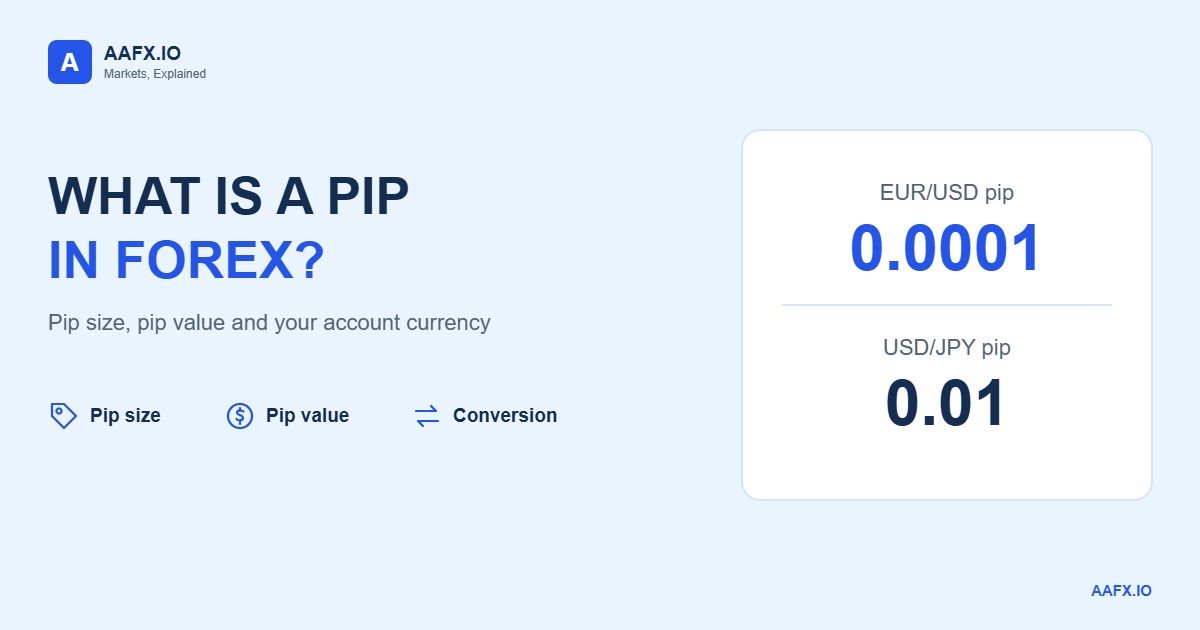
What is a pip? In forex, a pip is the standard unit for measuring a price move: 0.0001 of the quoted rate for pairs such as EUR/USD and 0.01 for yen pairs such as USD/JPY. If EUR/USD rises from 1.1000 to 1.1010, it has moved ten pips. That number tells you how far the price travelled, not how much money you made or lost.
To turn pips into money you also need the trade direction, the number of units you traded and the currency your account is held in. This guide works through each step with hypothetical numbers you can check on paper. It sits in our forex basics section, and if you are brand new to currency pairs, start with our forex trading guide for beginners.
Risk warning: A small exchange-rate move can produce a large cash loss on a big position, and leveraged forex trading can lose money quickly. All rates in this guide are hypothetical and exclude charges unless stated.
AAFX.IO may earn a commission through links on this page. This does not change our ratings or the calculations we explain.
How many pips is a move from 1.1000 to 1.1010?
Ten pips on EUR/USD. Subtract 1.1000 from 1.1010 to get 0.0010, then divide that difference by the pip size of 0.0001. The result measures a rise in the euro against the dollar. Someone holding a long EUR/USD position benefits from that rise before costs, while a short position loses value by the same distance.
Is one pip always worth $10?
No. One pip is worth $10 on 100,000 units of EUR/USD because each euro changes in value by $0.0001. A 10,000-unit trade on the same pair changes by $1 per pip. A different quote currency or account currency can change the cash figure again, even when the trade contains exactly the same number of units.
What is a pip in forex: overview
- What is a pip on a four- or five-decimal quote?
- Count the pips between two prices
- Turn one pip into money using position units
- Convert pip value into your account currency
- Check the result with the pip value calculator
- Separate the bid-ask spread from the market move
- Use pips to plan risk, not to cap it
- When to skip the standard forex pip formula
- AAFX.IO: what to record in your trade journal
- Frequently Asked Questions
What is a pip on a four- or five-decimal quote?
Every forex price is a ratio. EUR/USD tells you how many US dollars one euro buys. The euro is the base currency, the first one named, and the dollar is the quote currency, the one the price is counted in. When EUR/USD moves from 1.1000 to 1.1001, one euro gains $0.0001. That single step in the fourth decimal place is one conventional pip.
Yen pairs are the main exception. USD/JPY is quoted with two decimals in the traditional format, such as 150.00, so one pip is 0.01 yen per dollar. The Bank for International Settlements glossary sets out both conventions: 0.0001 for most pairs quoted to four decimals and 0.01 for pairs such as USD/JPY.
Most trading platforms now add one more decimal. On a five-decimal EUR/USD quote, 0.00001 is a tenth of a pip, often called a pipette or a fractional pip. On a three-decimal USD/JPY quote, 0.001 plays the same role. This is where many beginners go wrong. They count the last digit on screen and report a 5-pip move as 50 pips.
Check the instrument specification before you enter a distance in points. If one displayed point equals 0.00001, then 25 points on EUR/USD are 2.5 pips, not 25.
| Pair | Starting quote | Ending quote | Move (pips) |
|---|---|---|---|
| EUR/USD | 1.10000 | 1.10010 | +1.0 |
| EUR/USD | 1.10000 | 1.10001 | +0.1 |
| USD/JPY | 150.000 | 150.010 | +1.0 |
| USD/JPY | 150.000 | 149.995 | -0.5 |
Hypothetical quotes. Pip counts checked 27 November 2026.
Charts often round the last digit or show mid prices, so use the confirmed fill prices on your trade history when you count pips on a real trade. Our guide to reading trading charts explains why a chart and an order record can show slightly different numbers.
Count the pips between two prices
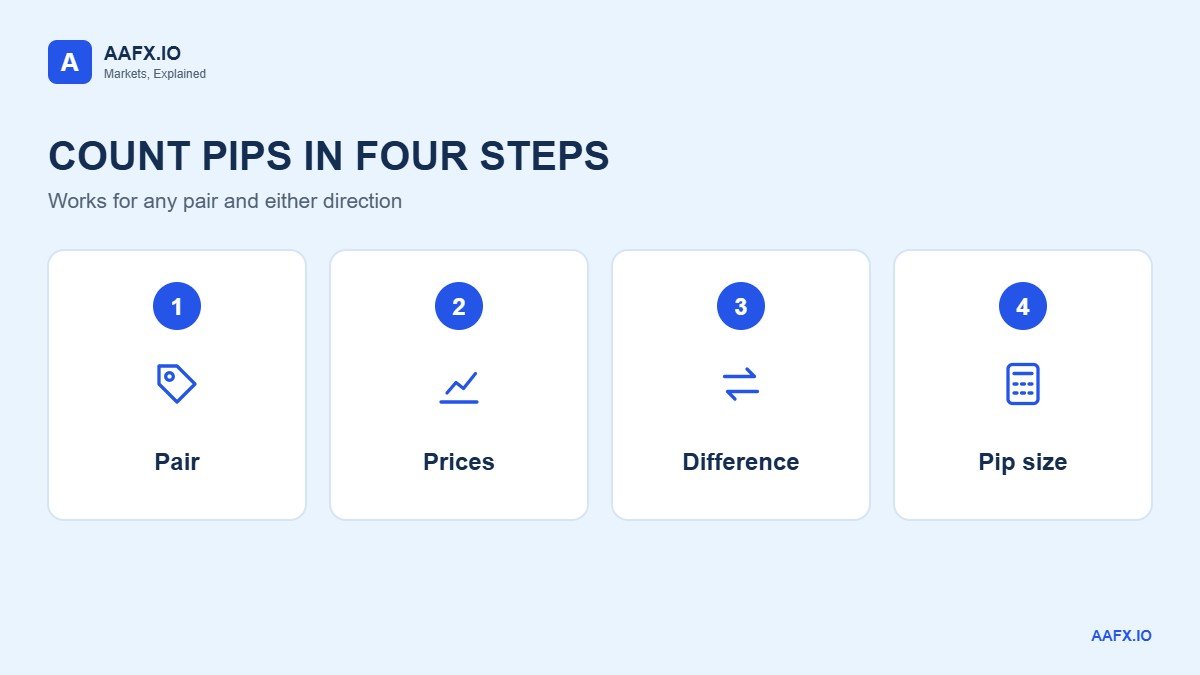
The method is the same for every pair. Subtract the entry price from the exit price, then divide the difference by the pair’s pip size. A positive result means the rate rose and a negative result means it fell. Whether that helped or hurt you depends on your side of the trade, which is why you should note the direction before you note the number.
Take EUR/USD rising from 1.08365 to 1.08510. The difference is 0.00145. Divide by 0.0001 and you get 14.5 pips. Keep the half pip; round only once the calculation is finished, so small errors do not build up across many trades.
Now take USD/JPY falling from 150.24 to 150.09. The difference is minus 0.15. Divide by 0.01 and the move is minus 15 pips. A trader who was short USD/JPY, meaning they sold dollars against yen, gains on that fall before costs. A trader who was long loses the same 15 pips.
A simple habit prevents most counting errors: write the pip size beside the pair before you subtract. For any pair with JPY as the quote currency, write 0.01. For almost everything else, write 0.0001. If a platform shows an unfamiliar instrument, such as an exotic pair with large numbers, read its contract specification rather than guessing.
Turn one pip into money using position units
Pip value is what one pip is worth in cash at your position size. The formula is short: units of the base currency multiplied by the pip size gives the value per pip in the quote currency. For a 10,000-unit EUR/USD trade, 10,000 multiplied by $0.0001 equals $1 per pip.
Platforms usually describe size in lots rather than units. A standard lot is commonly 100,000 units of the base currency, a mini lot 10,000 and a micro lot 1,000. The table below assumes those sizes. Contract sizes can differ between providers and instruments, so confirm the figure on your deal ticket before you rely on the lot column.
| EUR/USD size (lots) | Base units (EUR) | Value per pip ($) | Value of 12 pips ($) |
|---|---|---|---|
| 0.01 | 1,000 | 0.10 | 1.20 |
| 0.10 | 10,000 | 1.00 | 12.00 |
| 1.00 | 100,000 | 10.00 | 120.00 |
Hypothetical examples assume 100,000 EUR per standard lot. Arithmetic checked 27 November 2026.
Notice what is missing from the formula: leverage. For a fixed number of units, changing the margin requirement changes how much collateral you post. It does not change the value of each pip. Leverage only affects pip value indirectly, by letting you open a larger position, and a larger position moves more per pip.
So at 10,000 EUR/USD, a 12-pip move against you costs $12 before charges, whatever leverage the account offers. Our guide to leverage and margin shows how collateral and exposure relate.
Convert pip value into your account currency
The formula above gives an answer in the quote currency. If your account is held in that same currency, you are done. EUR/USD pip values come out in dollars, so a US dollar account needs no conversion. Anything else needs one more step, and the safest habit is to label the currency of every figure before you convert it.
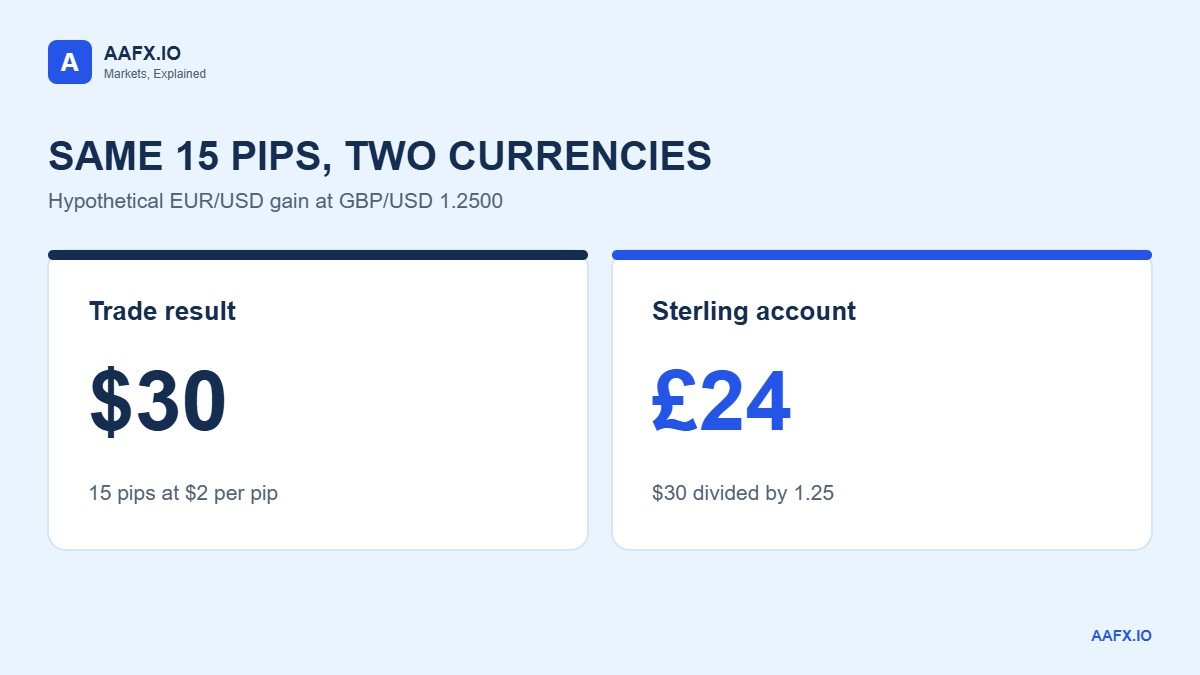
Suppose your account is in pounds and GBP/USD is 1.2500. One pound buys $1.25, so you divide a dollar figure by 1.25 to express it in pounds.
Hypothetical worked example. You buy 20,000 EUR/USD at 1.1000 and sell at 1.1015. The move is 15 pips. Pip value is 20,000 multiplied by $0.0001, or $2. The gain is 15 multiplied by $2, which is $30. Converted at $1.25 per pound, that is £24 before charges.
Yen pairs work the same way. For 10,000 USD/JPY, one pip is 10,000 multiplied by 0.01, or ¥100. If the trade gains 15 pips, that is ¥1,500. At a fixed conversion rate of ¥150 per dollar, ¥1,500 equals $10 for a US dollar account.
For an actual fill, use the conversion rate shown on your statement rather than a rate you looked up later, because exchange rates keep moving. Reference sources such as the European Central Bank euro reference rates are published for information only and quote every currency against the euro.
Check the result with the pip value calculator
Once you can do the arithmetic by hand, a calculator saves time and catches typing errors. In the AAFX.IO pip value calculator, choose EUR/USD, a US dollar account, 0.10 lot and 10 pips. With 100,000 units per lot, the check values are $1 per pip and $10 in total. If your result differs, look first at the lot size and the account currency.
Be careful with cross conversions. A EUR/USD rate alone cannot convert dollars into pounds. If the calculator does not show which exchange rate it used to reach your account currency, convert the dollar result separately with GBP/USD and compare. Our position size calculator runs the same logic in reverse, starting from the amount you plan to risk.
Separate the bid-ask spread from the market move
Every forex quote has two prices. The bid is roughly where you can sell and the ask is where you can buy. The gap between them is the spread, and it is usually measured in pips. The SEC’s Investor.gov glossary defines the bid and ask in the same way for shares.
At a 1.10000 bid and a 1.10012 ask, the EUR/USD spread is 0.00012 divided by 0.0001, or 1.2 pips. If you buy at the ask and the quote does not move, you can only sell at the lower bid. That gap is a cost you pay before the market moves at all.
| Hypothetical action | Execution rate (USD per EUR) | Effect on 10,000 EUR |
|---|---|---|
| Buy at the ask | 1.10012 | Pay $11,001.20 |
| Immediately sell at the unchanged bid | 1.10000 | Receive $11,000.00 |
| Round-trip difference | -0.00012 | Lose $1.20 before other fees |
Illustrative unchanged quote with no separate commission. Checked 27 November 2026.
Do not deduct the spread twice. If you buy at 1.10012 and later sell at 1.10042, the gain on 10,000 euros is $3 before other fees. Both fill prices already include their side of the quote, so the spread is built into that $3.
A midpoint chart can differ from your executable price, which is why your statement and your chart may disagree by a fraction of a pip. Compare the actual confirmations, and read our guide to trading order types to see which side of the quote each order fills on.
Use pips to plan risk, not to cap it
Pips are the bridge between a chart and a position size. Suppose a hypothetical $5,000 account plans to risk 1%, or $50, on a EUR/USD trade with a stop-loss 25 pips from entry. Divide $50 by 25 pips and you need a pip value of $2. At $0.0001 per euro, that is 20,000 units, or 0.20 lot.
That $50 is planned risk, not a guaranteed maximum. A stop-loss is a trigger, not a guaranteed fill. Once the stop price is reached, the order typically becomes a market order, and in a fast market or a weekend gap it can fill well beyond the level you chose. The SEC bulletin on stop and stop-limit orders explains why the execution price can differ from the stop price.
The same distance also means different things on different pairs. Twenty-five pips is a small move on a volatile pair and a larger one on a quiet pair, so set the stop where the trade idea is proven wrong, then size the position to it, rather than choosing a round number of pips first.
When to skip the standard forex pip formula
The pip convention belongs to spot forex and forex CFDs. Other instruments measure movement in ticks or points, with their own multipliers. For an index future or a gold contract, check the tick size, the contract multiplier and the quantity. A forex lot convention cannot tell you their tick values.
Currency futures have their own specifications too. The CME Group guide to FX futures gives contract-specific examples. Check the quote direction as well as the contract size, because some futures quote the currency the other way round from the spot pair you are used to.
Skip the standard formula as well if your platform quotes a pair in an unusual way or labels a different decimal as one point. In every one of these cases, the instrument specification wins over a rule of thumb.
AAFX.IO: what to record in your trade journal
Record the pair, side, units, entry, exit, pip count and account currency for every trade. Keep the conversion rate next to the result, because that is the number you will need if a statement ever looks wrong. A journal kept this way lets you separate three things that beginners often mix up: how far price moved, what the move was worth and what it cost to trade.
For the bigger picture, go back to our forex trading guide for beginners. Use the trade profit calculator to compare entry and exit prices, and read our guide to trading costs to spot charges recorded outside the fill price. More lessons sit in the AAFX.IO learning hub. For short explainers, follow @arslaninsights on TikTok and AAFX.IO on Instagram.
Affiliate disclosure: AAFX.IO may earn a commission if you open an account through some links on our site. Commercial relationships do not affect our examples, calculations or analysis. Always verify a provider independently before depositing.
Educational information only, not personalised investment advice. Leveraged forex and CFD trading carries a high risk of loss. All examples are hypothetical and do not represent live quotes.
Written and reviewed by Arslan Ali Butt, MPhil Behavioural Finance, MBA Finance, with more than 10 years in forex dealing and market analysis. Last reviewed: 27 November 2026.
How we reviewed this guide: Every pip count, pip value, conversion and spread example was recalculated by hand from the figures shown, and quoting conventions were checked against BIS, CME Group, ECB and SEC Investor.gov material on 27 November 2026.
Frequently Asked Questions
How many pipettes make one pip?
Ten pipettes make one pip when the dealer quotes in tenths of a conventional pip. On EUR/USD, a change of 0.00001 is one pipette and a change of 0.00010 is one pip. On a three-decimal USD/JPY screen, the matching increments are 0.001 and 0.010 yen per dollar. Read the instrument and the decimal place together before you count.
Does a 20-pip fall always mean I lost money?
No. A pip count describes the direction of the exchange rate, not your result. If you sold the base currency and bought it back 20 pips lower, the move was in your favour. The money result depends on the number of units, the currency conversion and any charges. Record your side of the trade before putting a plus or minus sign beside the cash figure.
Does moving from a USD account to a GBP account change the pip count?
No. Identical entry and exit prices on the same pair produce the same pip count in either account. Only the currency used to report the money result changes. For example, a $10 gain converted at $1.25 per pound is £8 before conversion costs. Use the actual conversion rate on your statement if you are reconciling two statements issued at different times.
Can a spread be less than one pip?
Yes. A bid of 1.10002 and an ask of 1.10009 on EUR/USD are 0.00007 apart, a spread of 0.7 pip. Five-decimal pricing lets platforms show that fraction directly. A separate commission may still apply on top. When comparing accounts, convert both the spread and any stated commission into the same currency at the same trade size before deciding which is cheaper.
Does doubling leverage double the value of a pip?
No. If you keep the same pair and the same number of base units, doubling the available leverage leaves the value per pip unchanged. It only reduces the margin you post. Higher leverage may let you open a larger trade, and if you then double the units, the pip value doubles because the position is larger. Check which input changed on the deal ticket.
Can I add the pips on two different pairs to calculate profit?
No. A simple sum of pip counts cannot give account profit when position sizes, quote currencies or pip conventions differ. Work out each position’s cash result in its quote currency, convert it into the account currency and then add the amounts. Keep the pip counts separately if you want to compare how far each exchange rate moved during the trades.
Is a 50-pip move the same as a 0.5% move?
No. A pip measures an absolute price step, while a percentage measures the change relative to the starting price. On EUR/USD, 50 pips is 0.0050. From 1.0000 that rise is 0.5%, but from 1.2500 it is 0.4%. The same pip distance therefore represents different percentage moves at different starting rates, even on the same currency pair.
How do I work out the result when an order fills in two parts?
Calculate the quote-currency result for each filled quantity and add the amounts, or use a quantity-weighted average entry if both parts share one exit. A simple average of the two prices only gives the correct entry when both fills are the same size. Check commission entries separately, because a provider may record them for each fill rather than for the whole order.
Should I round the pip value before multiplying by the distance?
No. Keep extra precision during the calculation and round only the final account-currency amount to the precision used on your statement. Rounding a conversion to two decimals first can create a visible difference across a large pip count. Keep the original quote-currency result as well, so you can tell a rounding difference apart from a different conversion rate.
Can I use pip distance as the most I could lose on a trade?
No. The distance between your entry and a planned exit gives you a scenario to calculate, not a ceiling. A stop-loss is a trigger, not a guaranteed fill. If the market gaps or liquidity thins, the actual exit can be further away. Use the confirmed entry and exit prices, plus recorded charges, to establish what the trade really cost.
Sources & Methodology
Primary-source standard: Market-moving facts should link to original data releases, regulator notices, company filings or official project announcements whenever available. Secondary reporting is used for additional context, not as a substitute for original evidence.
Page last reviewed: