Quick Answer
People trade forex, stocks or crypto for different reasons. Forex offers the deepest market in the world, near round-the-clock trading on weekdays and prices driven by interest rates and economic data. Stocks let you own or trade a share of real businesses, with company earnings and growth as the main drivers. Crypto offers 24/7 markets, high volatility and exposure to a young, fast-changing asset class. The right market for you depends on your time, temperament, capital and how much risk you can genuinely tolerate, not on which market promises the biggest returns.
I get asked “which market should I start with?” more than almost any other question. My honest answer is that the market matters less than the match. A trader with a day job and an interest in economics might suit forex. Someone who enjoys reading company reports might suit stocks. Someone comfortable with sharp swings and new technology might suit crypto. The mistake is choosing based on social media screenshots of big wins.
This guide looks at the reasons to trade each market, their differences in hours, costs, volatility and regulation, and how to pick a starting point. It is part of our guide on what trading is.
Why Trade Forex?
The foreign exchange market is the largest financial market in the world, with average daily turnover of $9.6tn in April 2025, according to the Bank for International Settlements.
- Liquidity. Major pairs such as EUR/USD trade in huge size, which keeps spreads tight. See our guide to major forex pairs.
- Trading hours. Forex trades almost continuously from the Monday open in Asia to the Friday close in New York.
- Macro-driven. Prices respond to interest rates, inflation, employment and central bank decisions, which are scheduled and widely covered.
- Two-way trading. Going long or short is equally simple, since every trade is buying one currency and selling another.
The main drawback is leverage. Retail forex is usually traded on margin, which magnifies losses as well as gains. Our guide to forex trading risks covers this in detail.
Why Trade Stocks?
The US Securities and Exchange Commission’s investor education site describes stocks simply: they are a type of security that gives stockholders a share of ownership in a company.
- Ownership. Buying shares outright means owning part of a business, with potential dividends and voting rights.
- Familiar drivers. Earnings, products, management and industry trends are easier for many people to follow than currency fundamentals.
- Choice. Thousands of listed companies and funds across sectors and countries.
- Long-term investing. Stocks suit both short-term trading and long-term wealth building.
The trade-offs: exchange hours are limited, single stocks can gap sharply on earnings, and the same investor education page notes that common shareholders are paid last if a company fails. If you want to trade US names actively, our guide on CFD trading explains how stock CFDs differ from owning shares.
Why Trade Crypto?
- 24/7 markets. Crypto never closes, including weekends and holidays.
- Volatility. Daily moves are often much larger than in major currencies or large-cap stocks, which creates opportunity and risk in equal measure.
- Accessibility. Many exchanges allow small starting amounts and fractional coins.
- New asset class. Crypto offers exposure to blockchain networks and digital assets that are not available through traditional markets.
The risks are significant: deep drawdowns, platform and custody risk, uneven regulation across countries and frequent scams. Our guides to the best cryptocurrencies for beginners, crypto brokers vs exchanges and KYC on crypto platforms are good starting points.
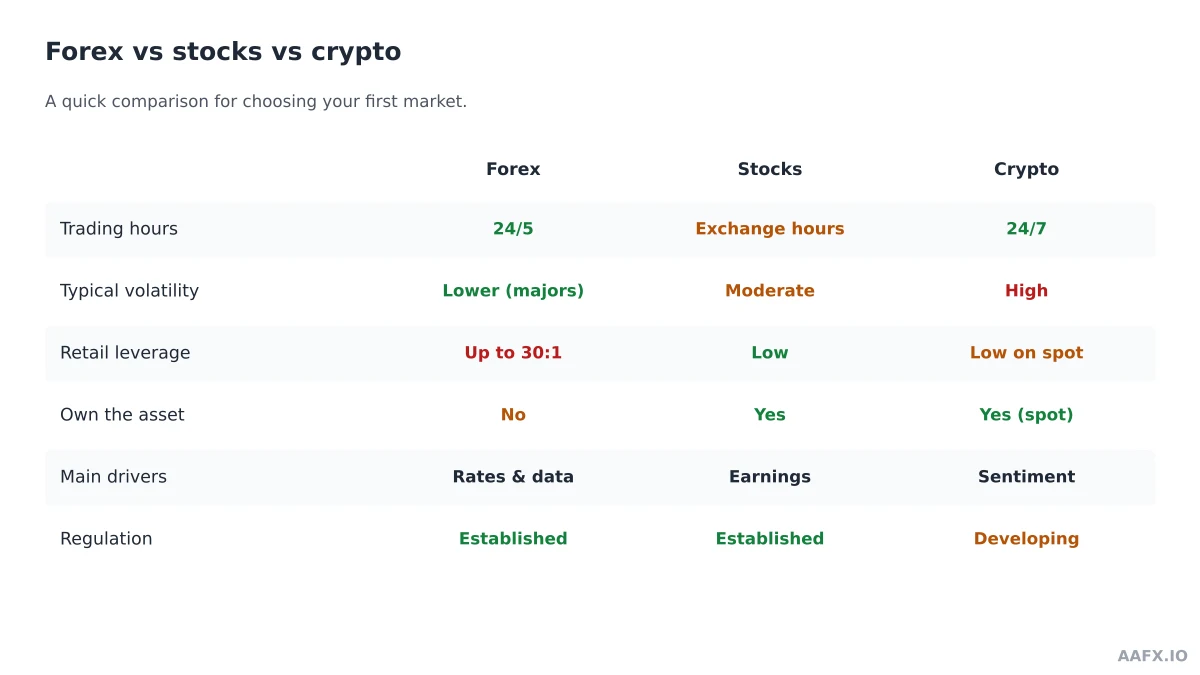
Forex vs Stocks vs Crypto: Side-by-Side
| Forex | Stocks | Crypto | |
|---|---|---|---|
| Trading hours | 24 hours, Monday to Friday | Exchange hours, with limited extended sessions | 24/7 |
| Main price drivers | Interest rates, economic data, central banks | Company earnings, sector trends, the economy | Adoption, liquidity, sentiment, regulation |
| Typical volatility | Lower on majors | Moderate, higher for single stocks | High |
| Typical retail leverage | Up to 30:1 on majors in the UK, EU and Australia | Low unless using margin or CFDs | Low on spot; high on derivatives where permitted |
| Ownership | No (CFD or spot contract) | Yes, when buying shares | Yes, on spot markets |
| Regulation | Well established for brokers | Well established | Developing and uneven |
| Learning curve | Macro concepts, leverage | Company analysis | Technology, custody, security |
How to Choose Your First Market
Ask yourself four practical questions:
- When can you actually trade? If you only have evenings in Asia, forex pairs active in the Asian session or crypto may fit better than US stocks.
- What do you enjoy reading about? Central bank news points to forex, company reports to stocks, technology and networks to crypto.
- How do you react to large swings? If a 10% drop in a day would push you into panic decisions, crypto is a hard place to start.
- How much leverage will you use? Unleveraged stock or crypto purchases cannot lose more than you invest. Leveraged forex and CFD positions can lose quickly if you size them badly.
Whichever you choose, the rules of survival are the same: risk a small, fixed share of your account per trade, use stop-losses and choose a well-regulated platform. Our guides to risk management and position sizing and how to choose a broker apply to all three markets.
Can You Trade All Three?
Yes, and many traders eventually do, often through a single multi-asset broker or a combination of a broker and a crypto exchange. But I would not start that way. Each market has its own rhythm, costs and risks. Spreading attention across all three on day one usually means learning none of them well. Start with one, build a track record, then add a second market when you understand why you want it.
My View: Choose the Market That Fits Your Life
My view is that the best first market is the one you can study and trade consistently without disrupting the rest of your life. For many working professionals that is a single major forex pair or a short list of large stocks. Crypto can be a good fit for people who understand the technology and accept large swings, but it is the least forgiving place to learn risk management. What would change my recommendation for any individual reader is their schedule and their honest response to losses. Those two factors predict success far better than which market is “hot” this year.
Frequently Asked Questions
Is forex better than stocks for beginners?
Neither is automatically better. Forex offers long trading hours and tight spreads on major pairs but is usually traded with leverage. Stocks are easier to understand for many people and can be bought without leverage. Choose based on your schedule, interests and risk tolerance.
Why do people trade crypto?
Crypto markets trade 24/7, are accessible with small amounts and can move sharply, which attracts traders seeking volatility. The same volatility, together with platform and regulatory risk, makes crypto one of the riskiest markets for beginners.
Which market is the most liquid?
The foreign exchange market is the most liquid financial market in the world, with average daily turnover of about $9.6tn in April 2025 according to the BIS.
Which market is open 24 hours?
Crypto trades 24 hours a day, seven days a week. Forex trades 24 hours a day from Monday to Friday. Stock exchanges have set opening hours, with some brokers offering limited extended-hours trading.
Can I trade forex, stocks and crypto with one broker?
Many multi-asset brokers offer all three, often through CFDs. If you want to own crypto or shares directly, you may need a crypto exchange or a stockbroker alongside a forex broker.
What is the safest market to start trading?
No market is safe, but buying large, well-known stocks or funds without leverage limits your maximum loss to the amount invested. Leveraged forex, CFDs and crypto derivatives carry higher risk.
Risk warning: Trading forex, stocks, CFDs and cryptocurrencies carries a high level of risk and may not be suitable for all investors. You can lose some or all of your capital. This guide is for educational purposes only and is not investment advice.
Sources & Methodology
Primary-source standard: Market-moving facts should link to original data releases, regulator notices, company filings or official project announcements whenever available. Secondary reporting is used for additional context, not as a substitute for original evidence.
Page last reviewed: