Quick Answer
When you buy a stock, you own a share of the company, with possible dividends and voting rights, and your maximum loss is the amount you invested. When you trade a stock CFD, you never own the share. You enter a contract with a broker to exchange the difference in price, usually with leverage, the ability to go short easily and overnight financing charges. Stocks suit long-term investors who want ownership. CFDs suit short-term traders who want leverage or short exposure and understand that leverage can magnify losses quickly.
The confusion between the two is understandable. On many trading apps, a share and a share CFD sit side by side with the same chart and almost the same price. But the two products behave very differently once you hold them for more than a day, and the differences matter most precisely when markets move against you.
This guide compares CFD trading and stock trading on ownership, costs, leverage, risk, tax and holding period, with a worked example of the same trade done both ways. For the basics of CFDs themselves, start with our guide to what CFD trading is.
What Is Stock Trading?
Stock trading means buying and selling shares listed on an exchange. The US SEC’s investor education site describes stocks as securities that give stockholders a share of ownership in a company. As an owner, you may receive dividends and can usually vote at shareholder meetings. If you buy without borrowing, the most you can lose is what you paid.
What Is CFD Trading?
A contract for difference (CFD) is an agreement between you and a broker to exchange the difference in an asset’s price between opening and closing the trade. You can go long if you expect the price to rise or short if you expect it to fall. CFDs are traded on margin, so you only deposit a fraction of the position’s value. In the EU and UK, retail leverage on individual share CFDs is capped at 5:1, meaning a margin of 20% of the position value.
CFD vs Stock Trading: Key Differences
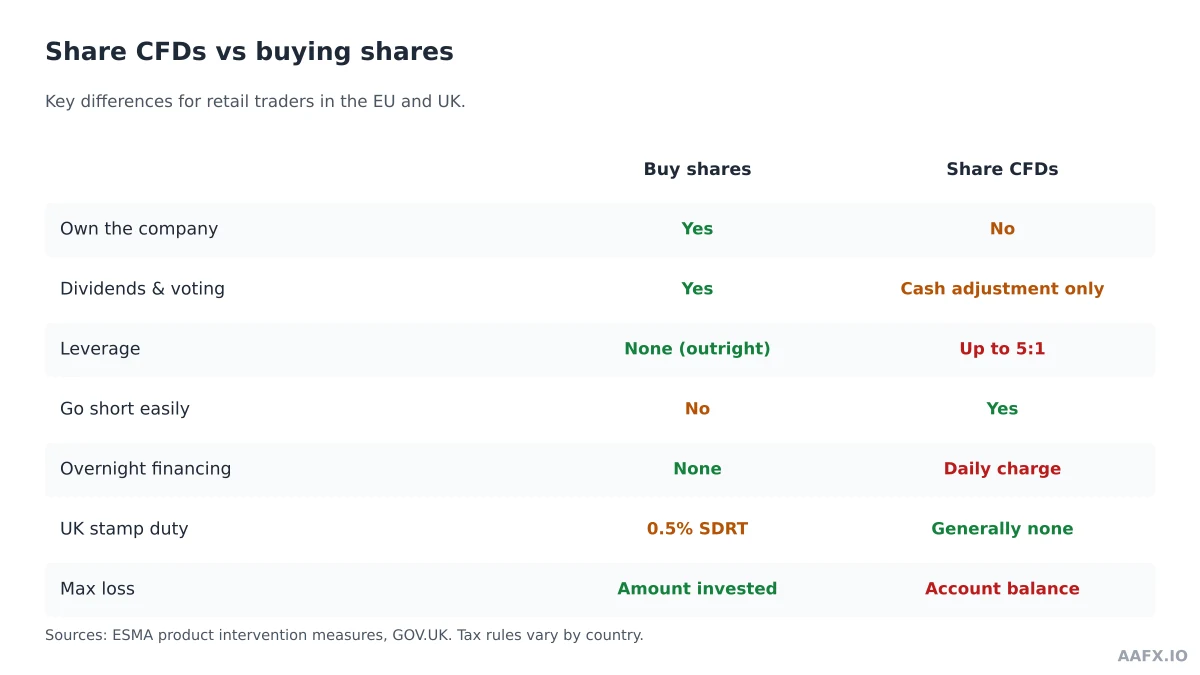
| Feature | Buying shares | Trading share CFDs |
|---|---|---|
| Ownership | Yes, you own the shares | No, you hold a contract with the broker |
| Voting rights | Usually yes | No |
| Dividends | Paid to you | Cash adjustment: credited on long positions, debited on short positions |
| Leverage | None unless using a margin account | Built in; up to 5:1 on shares for EU and UK retail clients |
| Going short | Complex; requires borrowing shares | As simple as opening a sell trade |
| Holding costs | None for outright purchases | Daily overnight financing on leveraged positions |
| Trading costs | Commission or spread, plus any transaction taxes | Spread and/or commission, plus financing |
| Maximum loss | Your investment, if unleveraged | Can exceed your margin; limited to your account balance where negative balance protection applies |
| Best for | Long-term investing | Short-term trading, hedging, short exposure |
Worked Example: The Same Trade, Two Ways
Imagine a share trading at $100 and a trader with $2,000 to use. The share then rises or falls by 5%.
| Buy shares outright | Share CFD at 5:1 leverage | |
|---|---|---|
| Capital used | $2,000 | $2,000 as margin |
| Position size | 20 shares ($2,000) | 100 shares ($10,000 exposure) |
| Result if price rises 5% | +$100 (+5% on capital) | +$500 (+25% on capital), before financing |
| Result if price falls 5% | -$100 (-5% on capital) | -$500 (-25% on capital), before financing |
| Result if price falls 20% | -$400 | -$2,000; the full margin is gone |
The CFD multiplies the result in both directions. That is useful if you are right and devastating if you are wrong, especially if the trader sizes the position by available margin rather than by risk. Our guide to risk management and position sizing shows how to size CFD positions so a single move cannot do this kind of damage.
Costs Compared
Costs work differently for each product.
- Shares: you pay a commission or spread when buying and selling, plus transaction taxes in some countries. In the UK, for example, buying shares electronically usually means paying Stamp Duty Reserve Tax of 0.5%. There is no cost to keep holding the shares.
- CFDs: you pay a spread and often a commission, and leveraged positions are charged overnight financing every day they stay open. CFDs on UK shares are generally not subject to stamp duty because you do not acquire the shares, but the financing cost grows the longer you hold.
For a trade held a few days, CFDs can be cheaper. For a position held for months, financing usually makes outright share ownership far cheaper. Tax treatment varies by country and personal circumstances, so check local rules or speak to a tax adviser.
Risks Compared
The biggest risk difference is leverage. When ESMA introduced its retail CFD restrictions, national regulators’ analysis found that 74% to 89% of retail accounts typically lose money. Brokers in the EU, UK and Australia must now publish a similar warning showing the share of their own retail accounts that lose money.
CFDs also add counterparty risk, because your contract is with the broker rather than an exchange. That is why broker choice matters so much; see our guide on how to choose the right broker. Shares held with a regulated stockbroker are usually held in your name or in nominee accounts subject to client asset rules.
When CFDs Make Sense and When Shares Do
| Your goal | Usually better choice |
|---|---|
| Build long-term wealth in companies you believe in | Shares |
| Receive dividends and voting rights | Shares |
| Profit from a short-term fall in a stock or index | CFDs |
| Hedge an existing share portfolio temporarily | CFDs |
| Trade many markets from one account | CFDs |
| Keep maximum loss limited to the amount invested | Shares without leverage |
For a broader view of how CFDs fit with other markets, see why trade forex, stocks or crypto.
My View: Own What You Want to Keep, Trade What You Want to Time
My view is simple: if you would be happy holding a company for years, buy the shares. If you have a specific short-term view, including a bearish one, and a clear exit plan, a CFD can be the more efficient tool. Problems start when traders use CFDs for long-term holdings and pay financing for months, or use maximum leverage on a stock that can gap 10% on earnings. What would change my view for an individual trader is their holding period and position sizing discipline. Get those two right and the choice between shares and CFDs becomes much easier.
Frequently Asked Questions
What is the difference between CFDs and stocks?
Buying stocks gives you ownership of part of a company, with possible dividends and voting rights. A CFD is a contract with a broker that pays the difference in price between opening and closing, without ownership, usually with leverage.
Is CFD trading riskier than buying shares?
Usually yes, because CFDs are leveraged. A small price move can produce a large gain or loss relative to your margin. Buying shares without borrowing limits your loss to the amount invested.
Do you get dividends with CFDs?
You do not receive dividends as a shareholder, but brokers usually make a cash adjustment: long CFD positions are credited and short positions are debited an amount reflecting the dividend.
Is CFD trading cheaper than buying shares?
For short holding periods, CFDs can be cheaper, especially where share purchases attract transaction taxes. For long holding periods, overnight financing on CFDs usually makes them more expensive than owning shares outright.
What leverage is allowed on share CFDs?
For retail clients in the EU and UK, leverage on individual share CFDs is capped at 5:1, meaning a 20% margin requirement. Offshore brokers may offer more, with fewer protections.
Can I lose more than my deposit with CFDs?
Retail clients of brokers regulated under ESMA, FCA or ASIC rules have negative balance protection, which limits losses to the account balance. Elsewhere, a large gap could leave you owing money.
Risk warning: CFDs are complex instruments and come with a high risk of losing money rapidly due to leverage. You should consider whether you understand how CFDs work and whether you can afford to take the high risk of losing your money. This guide is for educational purposes only and is not investment or tax advice.
Sources & Methodology
Primary-source standard: Market-moving facts should link to original data releases, regulator notices, company filings or official project announcements whenever available. Secondary reporting is used for additional context, not as a substitute for original evidence.
Page last reviewed: