A long vs short position describes whether rising or falling prices help an open trade, before costs. Buying cash shares creates long exposure. Conventional stock short selling normally involves borrowing, while derivatives create their own contractual obligations. Understanding that difference is more useful than treating buy and sell as interchangeable buttons.
This guide explains direction, ownership, costs and exits. It complements the AAFX.IO beginner trading guide and uses hypothetical calculations rather than current trade recommendations.
Risk warning: Trading can lose money. Borrowing and derivatives can create losses or obligations beyond the initial deposit. Planned exits can fail to execute at the intended price, so calculate an adverse scenario before committing capital.
Affiliate disclosure: AAFX.IO may earn a commission if you open an account through links on this page. This does not change our editorial conclusions.
What is a long vs short position?
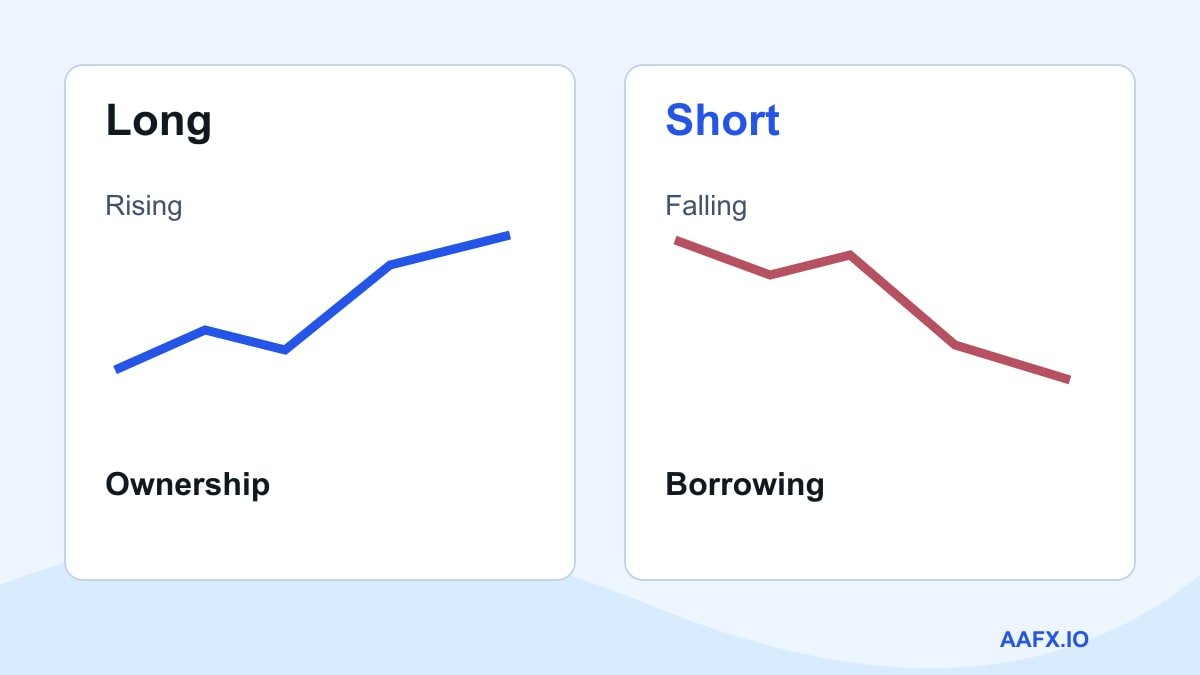
A long position has positive exposure to a price, so a rise helps it before costs. A short position has negative exposure, so a fall helps it. Direction is separate from holding period. The asset or contract determines ownership, borrowing, financing and settlement, even when platforms use similar buy and sell buttons.
How do long and short positions make or lose money?
For a simple share trade, a long position gains when the sale price exceeds the purchase price. A stock short gains when the covering price is below the opening sale price. Reverse moves create losses. Commissions, spreads, borrowing and financing reduce the result, while dividends or contractual adjustments may also matter.
Long vs Short Positions: Overview
- Long vs short position: direction, ownership and holding period
- How opening and closing each position works
- Hypothetical worked example after trading costs
- Costs, collateral and obligations beyond price direction
- Applying long and short to forex, crypto and CFDs
- Planning exits when prices move against the position
- When to avoid either direction
- AAFX.IO: make the position understandable before choosing a side
Long vs short position: direction, ownership and holding period
A position is an open exposure to an asset or contract. Long and short describe how that exposure responds to the relevant price. They do not describe confidence, skill or how quickly a trader expects a result. A position can be directionally correct and still lose money after costs or an unfavourable forced exit.
Buying ordinary shares with cash normally creates a long holding. Conventional short selling involves a sale of shares that the seller does not own, generally using borrowing arrangements for delivery. A derivative, which is a contract linked to an underlying price, can provide either direction without transferring ownership of that underlying asset.
Start by identifying the product rather than interpreting a chart alone. An app may show a company name beside both actual shares and a contract for difference (CFD), which tracks a price under an agreement with a provider. Those instruments can have different rights, charges and settlement obligations. The CFD and stock comparison develops those distinctions; this guide concentrates on directional mechanics.
Holding period is another separate decision. A long trade can last minutes, and a short can remain open for longer if its terms permit. Borrow availability, funding or expiry may interrupt that plan. Match monitoring and costs to the intended timeframe, as explained in our trading versus investing guide.
Keep the forecast and the implementation decision separate. Expecting a lower price does not establish that an available short product has manageable costs or sufficient liquidity. Expecting a higher price does not establish that a concentrated long holding fits the account. Write down the directional view first, then assess whether any suitable instrument can express it.
A practical record also specifies the account currency and the reference price used for the calculation. A chart may show a last-traded price while an executable quote includes a spread. Where an asset is priced in another currency, translation can alter the account result. Compare the actual transaction confirmation with the assumptions in the plan.
| Feature | Fully paid long shares | Conventional stock short |
|---|---|---|
| Helpful price direction | Higher price | Lower price |
| Opening action | Buy the holding | Sell under a share-borrow arrangement |
| Closing action | Sell the holding | Buy to cover and settle the borrow |
| Main obligations to check | Purchase payment and charges | Collateral, borrow terms and charges |
| Price-risk asymmetry | The holding can become worthless | No fixed upper price boundary |
This table concerns ordinary cash shares and conventional share shorts. It does not describe options, futures or every leveraged product. The comparison card below illustrates the same limited scope.
How opening and closing each position works
For a hypothetical long share position, buying 20 shares at $50 commits $1,000 before costs. Selling all 20 at $55 produces a $100 gross price gain. Selling at $45 produces a $100 gross price loss. The cash-share result follows the difference between the exit and entry prices multiplied by the number of shares.
For a hypothetical short, selling 20 shares at $50 and covering at $45 produces a $100 gross price gain. Covering at $60 produces a $200 gross price loss. The opening sale proceeds are not an immediately spendable profit: an obligation remains until the position is settled. Broker controls also determine how those proceeds and collateral are held.
A practical position record should show the opening quantity, completed fills, remaining orders and the transaction needed to close. Partial fills can leave an exposure smaller than intended, while an unfilled remainder may execute later. Confirming an order was received is different from confirming that the intended position is open or closed.
The SEC introduction to short sales explains conventional share-short mechanics. Availability and account terms still need checking with the provider. A demo account can help establish which buttons open, reduce or close exposure, although simulation does not reproduce every live fill or borrowing condition.
Hypothetical worked example after trading costs
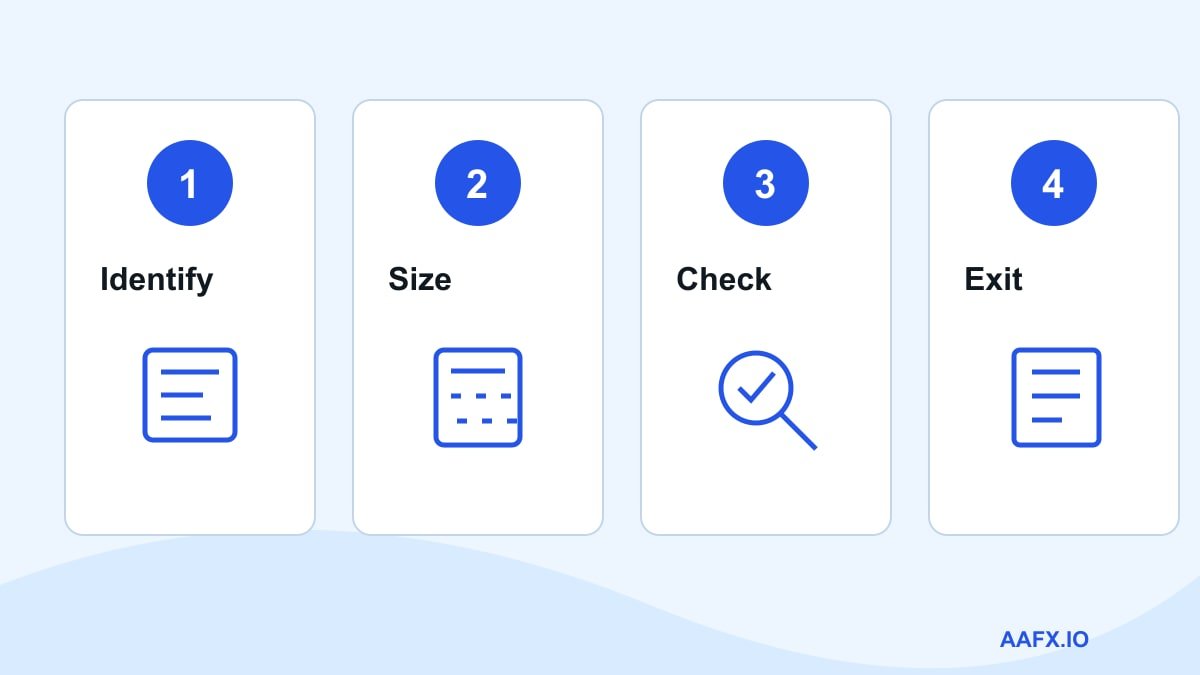
Use gross and net calculations separately. For a simple long share position, gross price result equals (exit price minus entry price) multiplied by quantity. For a simple share short, reverse the price subtraction: (opening sale price minus covering price) multiplied by quantity. Then account for all relevant charges and adjustments.
The following examples use the same quantity and entry price to make the comparison transparent. All prices and charges are invented for arithmetic, not quoted rates or forecasts. The assumed total charge is $8 for the long examples and $18 for the short examples. Different charges illustrate how equal gross gains can produce unequal net outcomes.
| Transaction | Gross price result | Assumed total charge | Net result before tax |
|---|---|---|---|
| Buy 20 at $50; sell at $55 | $100 gain | $8 | $92 gain |
| Buy 20 at $50; sell at $45 | $100 loss | $8 | $108 loss |
| Short 20 at $50; cover at $45 | $100 gain | $18 | $82 gain |
| Short 20 at $50; cover at $60 | $200 loss | $18 | $218 loss |
For the profitable long, the calculation is ($55 minus $50) multiplied by 20, less $8, giving $92. For the losing short, it is ($50 minus $60) multiplied by 20, less $18, giving a $218 loss. These results exclude dividends, taxes and currency conversion. Add those items when relevant to an actual account.
A useful sensitivity check asks what happens if the holding period doubles or the exit slips. A small favourable move may be consumed by ongoing charges. A short held longer may face changed borrowing terms. Estimate costs over several plausible durations rather than calculating only the most convenient exit. Our broker-fee guide explains common charge categories.
Costs, collateral and obligations beyond price direction
Margin is collateral required to support a position; it is not the same as the total exposure. A small deposit can therefore support a much larger price sensitivity. The difference matters on both sides. A leveraged long purchase can create borrowing and liquidation risks that do not apply in the same way to a fully paid cash holding.
A stock short can face share-borrow charges and an obligation related to distributions paid during the position. Borrow availability can also change. Read the provider agreement for recall and close-out provisions. Avoid assuming that a position can remain open until a valuation thesis eventually proves correct.
The SEC margin-account bulletin describes collateral requirements and a broker’s ability to liquidate positions under account terms. Those contractual powers can matter before a trader expects to act. Read the agreement before using borrowed funds or a short arrangement.
Compare total account cash needs under an adverse move, not just the initial ticket. A broker may change requirements, and several positions may draw on the same collateral. Keep those obligations separate from money required for household spending. Our leverage and margin guide explains the difference between deposit and exposure.
Applying long and short to forex, crypto and CFDs
A currency quote compares two currencies. Buying EUR/USD gives long euro and short dollar exposure under the relevant contract. Selling the pair reverses that direction. Our major forex pairs guide explains the quote conventions; the product agreement determines delivery, financing and settlement.
For a hypothetical linear exposure of €10,000, a move from EUR/USD 1.1000 to 1.1100 changes dollar value by $100. A long benefits and a short loses that amount before costs. This does not tell you the margin needed or how a particular provider calculates its charges. A deposit should never be substituted for the notional amount in that arithmetic.
Buying a cryptoasset outright normally creates long exposure. Selling a balance you already own usually reduces that holding. A negative position may instead require borrowing or a derivative. Check custody, which means how the asset is held, as well as the position contract. The broker versus exchange guide explains different access arrangements.
A CFD provides contractual price exposure rather than ownership of the referenced share or coin. A share short and a short CFD can express a similar view while carrying different financing, counterparty and corporate-action terms. Futures can add expiry and contract-roll considerations. Use the spot versus futures guide when comparing those forms.
Do not transfer a protection or obligation from one product into another. Jurisdiction, legal entity and client classification can change the applicable terms. Confirm the instrument name and specification at the point of dealing. A familiar chart or ticker cannot establish ownership rights, permitted holding period or what happens during a platform outage.
Planning exits when prices move against the position
A risk plan should identify an invalidation condition, meaning evidence that would make the original idea no longer useful. Translate that condition into an intended action, then test an adverse execution scenario. A trader who cannot tolerate the gap scenario should reconsider position size or whether to take the position at all.
A stop-loss is a trigger, not a guaranteed fill. The SEC stop-order bulletin explains that standard stops become market orders after triggering. A stop-limit adds a price boundary but can leave the exposure open. Check available order types and session rules with the provider.
Suppose the hypothetical long bought at $50 has an intended exit at $47. For 20 shares, the planned price risk is $60 before charges. If a gap produces a $44 fill, the realised price loss is $120. The same principle applies to a short facing a gap higher: an intended covering price does not guarantee the eventual cost.
Consider exposure at portfolio level. Several positions can respond to the same market event, even if the tickers differ. Long and short holdings are not automatically a complete hedge; their prices, funding and settlement can behave differently. The position-sizing guide explains how quantity and exit assumptions interact.
When to avoid either direction
Avoid opening a position when you cannot explain what you own or owe, how it closes, or how charges accumulate. A directional opinion is not enough to resolve those questions. Treat unclear contract terms as a reason to investigate rather than using a small deposit as a substitute for understanding.
A conventional stock short is unsuitable as a simple way to make a small account grow faster. It introduces an asymmetric price profile and borrowing obligations. A fully paid long also deserves caution if the holding is concentrated, money is needed soon, or a severe decline would disrupt essential spending. Simpler mechanics do not eliminate loss risk.
Pause if the thesis depends on an unverified social-media claim, an imminent announcement you have not checked, or the belief that a price must reverse. A short squeeze is possible under some conditions but is not a reliable prediction. Likewise, a large decline does not prove that a long purchase offers value.
Before choosing a provider, establish the contracting entity, relevant permissions and account terms. Compare the information independently rather than relying on an app’s appearance or a promotional offer. Our broker-selection guide provides a structured starting point for those checks.
| Check | Evidence to record | Reason to pause |
|---|---|---|
| Instrument | Asset or contract specification | Ownership or settlement unclear |
| Exposure | Quantity, notional and collateral | Deposit mistaken for potential loss |
| Costs | Applicable charges and assumptions | Only commission considered |
| Exit | Intended action and gap scenario | Unacceptable adverse fill |
AAFX.IO: make the position understandable before choosing a side
Neither long nor short creates a profitable edge by itself. The useful sequence is to understand the contract, calculate exposure, investigate costs and plan what happens if the idea fails. A position that cannot survive its financing or execution conditions may be impractical even when the eventual direction is correct.
Keep learning through the AAFX.IO trading pillar, the trading-styles guide and our forex risk guide. For educational videos, follow Arslan Insights on TikTok and AAFX.IO on Instagram. Treat educational examples as explanations, not instructions to open a trade.
Affiliate disclosure: AAFX.IO may receive compensation through commercial links. This guide does not rank or recommend a broker, and its examples do not establish an expected return.
Educational disclaimer: This material explains general trading mechanics and is not personal investment, legal or tax advice. Product availability and protections vary. Seek qualified advice when necessary.
Written and reviewed by Arslan Ali Butt
MPhil Behavioural Finance, MBA Finance, 10+ years in forex dealing and analysis.
Last reviewed: 28 October 2026.
How we reviewed this guide: We checked the cited SEC investor-education materials on 28 October 2026, recalculated the examples and compared the mechanics of cash shares, conventional stock shorts and price-linked contracts. Examples and charges are hypothetical. No broker-account testing is claimed. Review annually and when material product or regulatory changes affect the explanation.
Frequently Asked Questions
Does long mean a long-term investment?
Long describes the direction of exposure, not a minimum holding period. A trader can buy shares and sell them minutes later while remaining long during that interval. An investor can hold a long position for years. The intended timeframe changes research, monitoring and costs, but it does not change the basic directional meaning of the word long.
Is selling shares I own the same as selling short?
Selling an existing holding usually reduces or closes a long position. Selling short creates an obligation involving shares you do not own, normally under borrowing arrangements. Check the resulting position before submitting an order. Depending on platform settings, a sell instruction may close exposure, open a new position or leave separate positions that require individual management.
Can a short position lose more than the opening deposit?
An uncovered stock short has potentially unlimited price loss because the share price has no fixed upper boundary. Margin is collateral rather than a cap on what can be owed. Other products and account protections have different terms. Read the contract and applicable rules before assuming that the initial deposit defines the potential loss on a short position.
What does buy to cover mean?
Buying to cover means purchasing shares to reduce or close an existing stock short. The purchase helps fulfil the obligation created by the opening sale. It is different from buying shares to establish a new long holding. Review the order designation and final position because partial fills, multiple lots and platform settings can leave some short exposure open.
Do short sellers pay dividends?
Under conventional share-borrowing arrangements, a short seller may owe a payment connected with dividends paid while the position is open. The treatment, timing and tax consequences depend on the account and jurisdiction. A derivative may use a different adjustment mechanism. Check the broker agreement and corporate-action policy rather than assuming that dividend dates have no effect on the trade.
What is a short squeeze?
A short squeeze describes conditions in which rising prices and purchases to close shorts can reinforce one another. It does not mean every heavily shorted stock will rise. A trader considering a short should assess liquidity, potential gaps, borrow availability and account pressure. A valuation view can be reasonable while the route to an eventual price outcome remains costly or unmanageable.
Can I hold long and short exposure at the same time?
Yes, but the result depends on the instruments and account rules. Opposite orders may offset, or separate exposures may remain open. Related instruments can also form an imperfect hedge because they move differently. Compare the combined position, including costs, financing and settlement obligations. Two opposite labels do not establish that the portfolio has no remaining risk or cash requirement.
What does short mean when trading a currency pair?
Selling a currency pair creates negative exposure to its quoted price. For EUR/USD, that means short euro and long dollar exposure under the relevant product. A falling quote helps that direction before costs. The contract determines whether currency is delivered or gains and losses are settled another way, so check product terms alongside the currency-pair label.
Does a stop-loss guarantee the planned loss?
A standard stop-loss specifies a trigger rather than a guaranteed fill price. Once triggered, execution depends on the order and market conditions. A gap or thin liquidity can produce a larger loss than planned. A stop-limit adds a price boundary but may remain unfilled. Read the provider rules and assess whether you can absorb an adverse execution scenario.
Which direction should a beginner learn first?
Begin with a product whose mechanics you can explain rather than choosing a direction because it sounds more profitable. Fully paid cash shares involve fewer borrowing mechanics than a conventional stock short, but can still lose substantial value. Learn ownership, costs, order handling and position size in simulation before deciding whether any real-money trade is appropriate for your circumstances.
Sources & Methodology
Primary-source standard: Market-moving facts should link to original data releases, regulator notices, company filings or official project announcements whenever available. Secondary reporting is used for additional context, not as a substitute for original evidence.
Page last reviewed: