Order types define how a trading instruction seeks execution, controls price or activates after a trigger. Market, limit, stop and stop-limit instructions handle different trade-offs between price uncertainty and remaining unfilled. Understanding those differences helps you write a clearer plan before submitting a ticket.
This guide uses hypothetical stock calculations and explains what to check in other markets. Start with the AAFX.IO beginner trading guide for the underlying concepts.
Risk warning: A stop-loss is a trigger, not a guaranteed fill. Gaps, thin liquidity and account close-out conditions can produce losses beyond the intended exit. No order type makes an unaffordable position suitable.
Affiliate disclosure: AAFX.IO may earn a commission through links on this page. This does not change our editorial conclusions.
What are the main order types in trading?
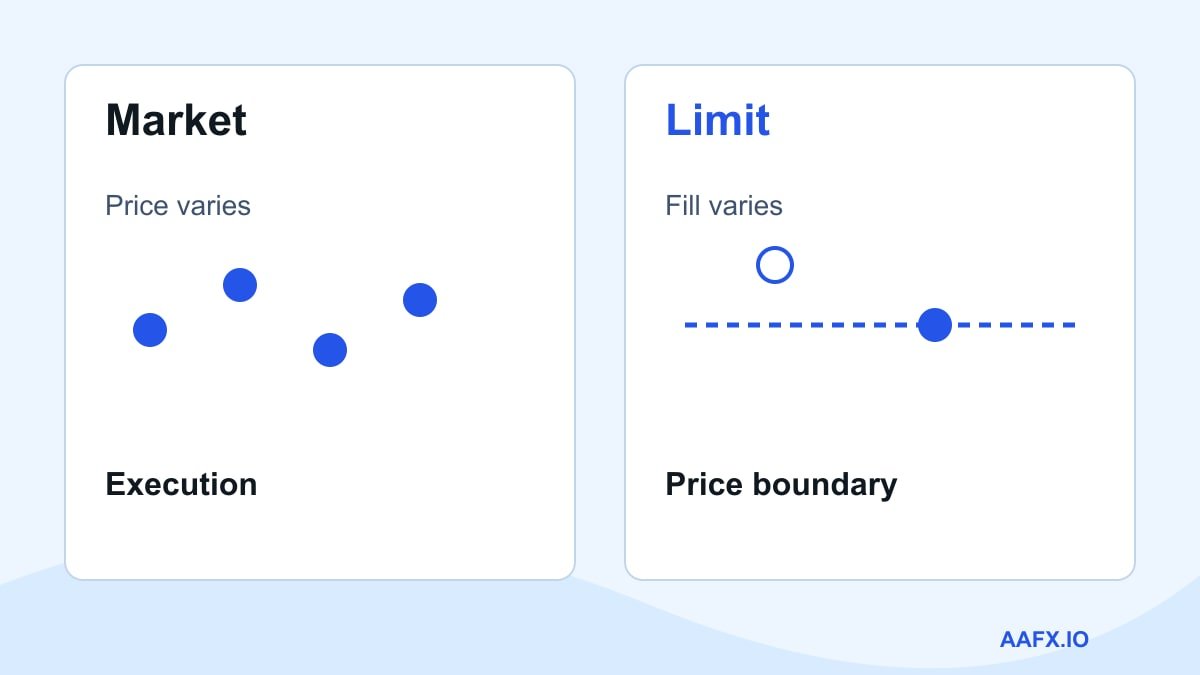
The main order types are market, limit, stop and stop-limit. A market order seeks execution at available prices. A limit order sets a price boundary. A stop activates another instruction after a trigger. The choice determines whether you accept greater price uncertainty or a greater chance that the desired trade remains unfilled.
How do I choose an order type?
Start with the purpose of the instruction: entering, reducing or closing a position. Decide whether execution or a price boundary matters more, then consider gaps, quantity and available liquidity. Check the trigger reference, eligible session and expiry. No order type can make an unsuitable position affordable or guarantee the planned outcome in every market.
Trading Orders: Overview
- Order types compared: market, limit, stop and stop-limit
- Market orders and a hypothetical multiple-fill example
- Limit orders and the risk of remaining unfilled
- Stops, stop-limits and a hypothetical price gap
- Order duration, trailing stops and linked instructions
- Applying order instructions across markets
- When to avoid an order and how to check the ticket
- AAFX.IO: check the instruction and the remaining exposure
Order types compared: market, limit, stop and stop-limit
| Order | Instruction | Main limitation |
|---|---|---|
| Market | Trade at available market prices | The final price can differ from the displayed quote |
| Limit | Buy at the limit or lower; sell at the limit or higher | The order may remain partly or entirely unfilled |
| Stop | Activate a market order after the trigger | The stop price is not a guaranteed fill price |
| Stop-limit | Activate a limit order after the trigger | A gap can leave the order unfilled |
Investor.gov’s order-type overview explains these basic price instructions. Availability, trading-session eligibility and triggering rules still depend on the broker and instrument. Read those rules before treating a label on one platform as equivalent to the same label elsewhere.
Market orders and a hypothetical multiple-fill example
Imagine a share quoted at a $24.98 bid and $25.02 ask. A small market buy might fill at the ask if enough shares remain available. The last transaction shown on a chart could be $25.00, but that does not mean you can buy the desired quantity at $25.00.
Suppose you request 100 shares. If 40 are available at $25.02 and the next 60 fill at $25.05, the total is $2,503.80 before fees, giving an average price of $25.038. This invented example shows how one order can receive multiple fills. It is not a prediction of execution quality at any broker.
A market order is intended for prompt execution, but a halted market or unavailable trading session can prevent immediate trading. Avoid interpreting “market” as a guarantee that any quantity will execute instantly under every condition. The more important practical distinction is that the instruction contains no customer-selected price ceiling for a buy or floor for a sell.
Separate the quote from the order instruction. A quote describes available prices at a point in time; an instruction tells the provider what you are willing to do. The quote can change while an order travels through a system. That timing difference is especially relevant when liquidity is thin or an announcement causes rapid repricing.
Do not estimate the purchase cost from the last chart price alone. Calculate the notional amount, meaning price multiplied by quantity, and allow for charges outside that price. After execution, compare the weighted average fill with the planned cost. A difference may reflect several fills rather than an error in the displayed arithmetic.
Limit orders and the risk of remaining unfilled
A buy limit of $25 means you will not pay more than $25 per share under that instruction, excluding fees. If the available ask remains $25.02, the order may wait. A sell limit of $27 means you will not sell below $27. Better prices are possible; execution is not assured.
Now imagine a 100-share buy limit at $25. The market briefly trades at $25, but only 20 shares reach your order before the price rises. You may receive 20 shares and retain an open order for 80. A chart touching your price is not proof that your entire order should fill: available quantity and competing orders matter.
A limit order is not always a waiting order. A buy limit above the current ask can be immediately executable at available prices up to the limit. The limit specifies a boundary, not a demand to execute at exactly that number.
Price protection is useful only if non-execution is acceptable. Suppose an order is intended to close a position before a known event. A strict limit might prevent the sale while leaving the original exposure through the announcement. Write down the consequence of no fill rather than evaluating the instruction only under the preferred outcome.
Also check the unit entered in the ticket. A limit price per share is different from the total money committed. A quantity field may refer to shares, lots or contracts. Review the estimated exposure in the confirmation screen before submission, and repeat the review when copying an old order to a different instrument.
Stops, stop-limits and a hypothetical price gap
A conventional sell stop below the current stock price can be used as an exit trigger for a long position. A buy stop above the current price can be used to cover a short or express a conditional entry. Once activated, a regular stop generally becomes a market order.
The SEC’s stop-order bulletin stresses that the execution price can differ substantially from the stop price. It also explains that stop, stop-limit and trailing-stop availability and policies vary between firms.
For example, you hold 50 shares bought at $40 and set a sell stop at $37. If the next available execution after a gap is $34, the gross loss is $300, not the $150 implied by a $37 fill. Fees add to that difference. A stop helps automate an instruction; it does not remove gap risk.
A stop-limit combines an activation threshold with an execution boundary. Consider a sell stop-limit with a $37 stop and $36.50 limit. After the trigger activates it, the resulting sell limit cannot execute below $36.50. If the market gaps to $34 and stays there, you may still own the shares.
That is not necessarily an order malfunction. The instruction protected the minimum acceptable sale price, while leaving you exposed because no acceptable buyer was available. Choosing a stop-limit instead of a stop exchanges price uncertainty for non-execution risk.
Write out both outcomes before placing the order: “If it triggers and fills, what happens?” and “If it triggers but does not fill, what position remains?” This simple exercise is especially useful when the order is intended as an emergency exit.
Planned risk is an assumption about size and an intended exit, not a promise from the market. In the hypothetical 50-share example, the intended $3 move implies $150 of price risk. The actual $6 move produces $300. Reducing position size changes both amounts; choosing a tighter stop does not eliminate the possibility of a gap.
Check whether the trigger uses a transaction, a bid, an ask or another reference. A price shown on the chart may not be the relevant reference for that account. Keep the documented rule with the trade record so a later comparison uses the right input, rather than assuming every visible touch should have activated the order.
| Instruction | Scenario | Possible result |
|---|---|---|
| Sell stop at $37 | Next available fill $34 | 50 shares lose $300 from a $40 entry before costs |
| Stop $37, limit $36.50 | Market trades at $34 | The position may remain open |
Order duration, trailing stops and linked instructions
Price instructions and duration instructions are separate. The SEC’s guide to order instructions describes common timing choices and notes that firms can apply different policies. A day order generally expires at the end of the eligible trading day. A good-till-cancelled order can remain active longer, subject to the broker’s expiry rules.
Immediate-or-cancel instructions allow an immediately available portion to fill and cancel the remainder. Other conditions may require the whole quantity or apply special session rules. Check which combinations your broker actually supports rather than assuming every timing choice works with every order type.
Keep a record of outstanding orders. An old instruction can remain active after your view changes. Requesting a cancellation is not the same as receiving confirmation that it was cancelled; an execution may occur before the request takes effect.
A trailing stop adjusts its trigger as the reference price moves favourably, according to a specified distance or percentage and the platform’s rules. It does not promise to preserve a fixed profit through gaps. A tight trail can also activate on ordinary price movement before a wider trend resumes.
Some platforms offer linked take-profit and stop instructions. Check whether filling one reliably cancels the other, how partial fills are handled and whether the orders are held by the broker or locally in software. Do not assume that closing a position manually cancels every associated pending order.
Treat order maintenance as part of the trade. Record the creation time, requested duration and any changes. If the reason for the trade disappears, reassess associated instructions as well as the position itself. An old entry order can create fresh exposure later, even after the trader believes the original idea has been abandoned.
A linked exit also deserves a specific check after a manual close. Confirm whether every related instruction was cancelled or remains outstanding. The platform may handle separate tickets differently from an integrated bracket. Read the final order list rather than relying on the absence of a position in one screen.
Applying order instructions across markets
The broad concepts transfer across markets, but the contract and triggering details can differ. A chart may display a last-traded price or a midpoint while the relevant order uses a bid, ask or another reference. In leveraged products, margin close-out can also occur independently of your chosen stop.
Ask the provider which price triggers an order, whether it operates outside regular sessions, how gaps are treated and whether the order remains active after a platform disconnect. For crypto-specific details, see the cryptocurrency order-types guide. For differences in the underlying product, compare spot and futures and CFDs and shares.
A derivative is a price-linked contract, so its dealing rules can differ from those of the underlying asset. A contract for difference (CFD), for example, does not give share ownership. Margin is collateral supporting an exposure rather than a cap on the potential account obligation. Learn the difference between exposure and margin before comparing exit distances.
A currency pair also has two sides. Buying the pair and selling the pair respond differently to bid and ask quotations. The currency-pair guide explains those conventions. Confirm the direction and trigger reference in the order ticket rather than transferring assumptions from an unrelated stock position.
When to avoid an order and how to check the ticket
Avoid using an unfamiliar order as an experiment with money needed for essential spending. First establish what makes it eligible, what activates it and what exposure remains if it fails to fill. If those questions cannot be answered from the provider documentation, practise the mechanics in simulation and seek clarification before using real money.
Pause before placing an order during an event that makes an adverse execution unaffordable. A standard stop cannot promise to contain an overnight gap, while a limit may fail to close the position. Choosing a more elaborate ticket does not resolve an unsuitable position size or the absence of a clear trading thesis.
Broker choice also affects the available instructions and information. Verify the contracting entity and compare its documented order policies using our broker-selection guide. Keep records of accepted instructions and confirmations. They provide a firmer basis for investigating an unexpected outcome than a chart screenshot alone.
- Confirm the instrument and side. Make sure the instruction opens, reduces or closes the intended exposure.
- Check quantity and notional value. A unit, share, lot or contract may represent very different exposure.
- Review the price instruction. Distinguish the trigger from any execution limit.
- Check duration and session. Know when the order becomes eligible and expires.
- Read the confirmation. Verify accepted, partially filled, filled, rejected or cancelled status.
Order selection cannot substitute for position sizing. Use the risk-management guide to evaluate adverse moves, and the broker-cost guide to understand charges that may sit outside the displayed price.
AAFX.IO: check the instruction and the remaining exposure
An order defines a request, while the resulting position defines the exposure you still carry. Review both. Record the intended quantity, actual fills, remaining orders and any costs so the account exposure can be reconciled after execution. A correctly functioning instruction can produce an uncomfortable result if its price, quantity or non-execution consequence was misunderstood. The practical goal is to understand those outcomes before submission.
Continue with the AAFX.IO trading pillar, trading styles and forex risks. Educational videos are available on TikTok and Instagram. Revisit the provider rules whenever you change product or platform.
Affiliate disclosure: Commercial links may generate compensation for AAFX.IO. This guide explains execution mechanics and does not recommend a provider or trade.
Educational disclaimer: The examples are hypothetical and exclude tax. Product rules and protections vary. This material is not personal investment, legal or tax advice.
Written and reviewed by Arslan Ali Butt
MPhil Behavioural Finance, MBA Finance, 10+ years in forex dealing and analysis.
Last reviewed: 28 October 2026.
How we reviewed this guide: We checked the cited SEC investor-education materials, recalculated the examples and reviewed common execution trade-offs on 28 October 2026. No broker-account test is claimed. Review annually and when material order-policy or regulatory changes affect the explanation.
Frequently Asked Questions
Is a market order guaranteed to fill instantly?
A market order seeks execution at available prices, but it does not guarantee instant trading under every condition. A halt, closed session or lack of available counterparties can delay or prevent a fill. Larger quantities may execute at several prices. Check the broker confirmation rather than interpreting an accepted instruction as evidence that the whole quantity has already traded.
Can a limit order execute at a better price?
A limit specifies the least favourable price you accept under that instruction. A buy can execute at the limit or lower; a sell can execute at the limit or higher. Better prices are possible when available, but execution is not assured. Fees remain relevant and are generally separate from the price boundary entered in the order ticket.
Why did my limit order not fill when the chart touched it?
A chart may show a transaction that involved too little quantity to reach your order, while other orders had priority. It may also show a different price reference from the executable bid or ask. A brief touch therefore does not prove that your entire quantity could trade. Ask the broker for the relevant order and execution records if a result is unclear.
What happens when a stop order triggers?
A conventional stock stop normally becomes a market order when its trigger condition is met. The eventual execution depends on available prices and quantity, so the fill can differ from the stop level. Product and provider policies vary. Confirm which price activates the instruction, when it is eligible and what happens during gaps before relying on it as an exit.
Is a stop-limit order safer than a regular stop?
A stop-limit addresses execution-price uncertainty by creating a limit instruction after activation, but it can leave the exposure open. A regular stop accepts price uncertainty while seeking execution after the trigger. Neither is universally safer. Compare the consequences of a worse fill with the consequences of keeping the position, especially when the order is meant to reduce urgent risk.
What is a partial fill?
A partial fill means only part of the requested quantity has traded. The remainder may stay open or cancel, depending on the instruction and time-in-force settings. Check both the resulting position and the outstanding order. Submitting a replacement for the original full quantity without checking can create more exposure than intended if the remaining portion also executes.
Does cancelling an order mean it cannot execute?
A cancellation request is not the same as a confirmed cancellation. An execution can occur before the provider processes the request, particularly in a fast market. Check the final status and position before entering another instruction. Keep any confirmation or rejection record so you can distinguish a cancelled order from an order that filled before cancellation became effective.
Do good-till-cancelled orders remain active forever?
The name does not establish an unlimited life. Brokers can impose expiry policies or handle corporate actions and other events under their own rules. Confirm the applicable deadline and session eligibility for the instrument. Review outstanding instructions periodically because an order can remain active after your original view or available account balance has changed materially.
Will my stop work if I close the trading app?
That depends on where and how the instruction is held. Some orders are maintained by the provider, while particular automation can depend on local software or a connection. Ask the provider which arrangement applies and what happens during an outage. Do not infer persistent protection from an icon on the screen or from another platform using the same label.
Can I use the same order rules for shares, forex and crypto?
The basic concepts are useful across markets, but triggering references, session rules, contract size and close-out conditions can differ. A stock chart, currency quote and derivative mark price are not interchangeable. Read the instrument and provider rules before applying familiar labels elsewhere. In a margin product, forced liquidation can also occur independently of the stop you selected.
Sources & Methodology
Primary-source standard: Market-moving facts should link to original data releases, regulator notices, company filings or official project announcements whenever available. Secondary reporting is used for additional context, not as a substitute for original evidence.
Page last reviewed: