NFP trading involves interpreting the US nonfarm payrolls report and managing exposure around its market impact. Start with the employment surprise, wages, unemployment and revisions, then assess price, execution and the possibility of staying out. No payroll figure guarantees a direction or a profit.
This evergreen AAFX.IO guide explains the report and a practical decision process. It complements the forex market analysis guide without presenting a stale monthly result as today’s forecast.
Risk warning: Leveraged event trading can cause rapid losses. Spreads, slippage, gaps and forced closure can make the outcome worse than the planned exit. Examples below are hypothetical, not investment advice.
What is NFP trading?
NFP trading means taking or managing market exposure around the US nonfarm payrolls release. Traders compare employment data with expectations and assess wages, unemployment and revisions alongside price behaviour. The report can change interest-rate expectations and market conditions, but an employment surprise is not a complete trade signal. Position size, execution and the option to stay out remain essential.
Does stronger NFP always make the US dollar rise?
No. Stronger payroll growth can support the dollar if it raises expected US interest rates relative to other markets. However, wages, revisions, prior positioning and the wider economic outlook can change that response. A strong headline may already be expected, and an initial rally can reverse. Read the whole report and observe the market rather than assuming a fixed direction.
NFP Trading: Overview
- What nonfarm payrolls measure
- When NFP is released and how to check the time
- Read the surprise, revisions, wages and unemployment together
- How NFP can affect forex, gold, bonds, stocks and crypto
- Build an NFP trading plan before the announcement
- Compare post-release continuation, reversal and no-trade approaches
- Work through a hypothetical EUR/USD trade and worse fills
- When to skip NFP and how to review the outcome
- AAFX.IO next steps for interpreting NFP
What nonfarm payrolls measure
Nonfarm payrolls, usually shortened to NFP, refer to paid jobs measured in the US establishment survey. Traders commonly use the term for the monthly change announced within the Bureau of Labor Statistics Employment Situation report. The BLS methods guide distinguishes jobs from employed people: someone employed at two establishments can appear twice in the payroll count.
The series covers many private industries and civilian government jobs. It excludes categories such as farm employees, private household employees and the self-employed. The unemployment rate comes from a different household survey. Its coverage and definitions differ, so it should not be reverse-engineered from the payroll headline.
The BLS technical note explains the reference periods. Payroll data concern the pay period containing the 12th of the reference month, while the household survey generally uses the week containing that date. A report published this month therefore describes an earlier reference period, rather than employment created during the few minutes before publication.
These are estimates, not a perfect real-time census. Seasonal adjustment helps remove recurring calendar patterns, but it does not erase uncertainty. Read the release notes when strikes, weather or unusual disruptions complicate comparison. The purpose of this guide is interpretation and planning; it does not provide the latest payroll outcome or an entry signal.
When NFP is released and how to check the time
Use the official BLS release calendar before each event. Employment Situation releases are scheduled at 8:30 a.m. Eastern Time. The familiar first-Friday description is a shortcut, not a substitute for the dated calendar. Confirm both the publication date and the reference month before comparing numbers from different screens.
Eastern Time changes with US daylight saving. At 8:30 a.m. EDT, the equivalent is 12:30 UTC and 5:30 p.m. Pakistan time. At 8:30 a.m. EST, it is 13:30 UTC and 6:30 p.m. Pakistan time. Convert for the actual date instead of saving one permanent local alarm.
Open the official Employment Situation release for the actual data. A calendar provider’s consensus is a forecast assembled separately; it is not a BLS target or promise. Two providers can show different consensus values or update them at different times, so record the source and timestamp of the estimate used.
Before publication, keep actual data blank. Afterwards, check that the displayed number belongs to the expected reference month and has the same units and adjustment basis as the forecast. This small verification step matters when a rushed comparison mixes a payroll level, a monthly change and an unemployment percentage.
For an evergreen workflow, bookmark the official calendar rather than embedding a countdown that becomes wrong after release. A calendar or website delay is also a reason to wait. The timestamp on an announcement does not establish when your feed received it or when a tradable quote became available.
Read the surprise, revisions, wages and unemployment together
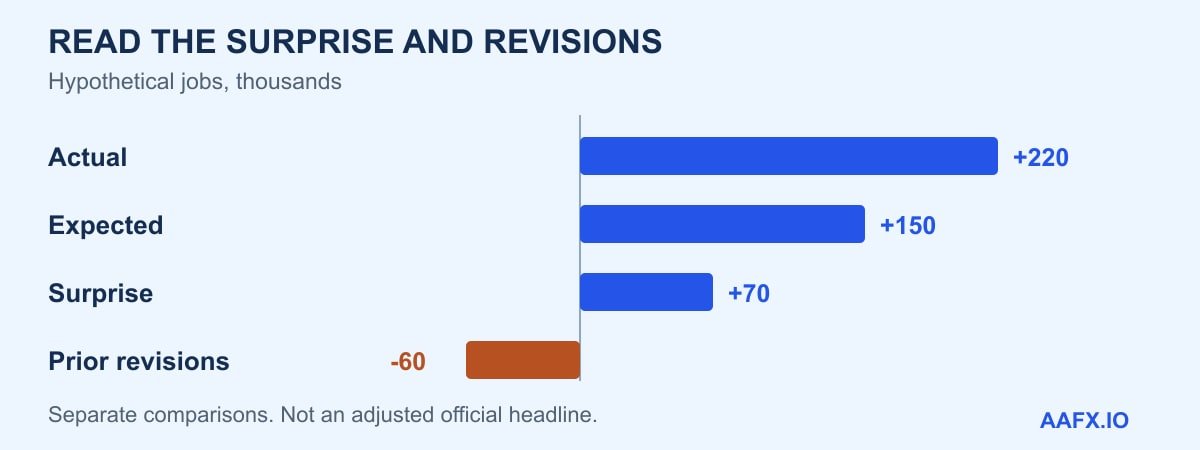
Start with a simple comparison: actual payroll change minus the pre-release expectation. In a hypothetical example, 220,000 jobs against 150,000 expected creates a positive surprise of 70,000. The calculation says what exceeded that forecast; it does not establish a profitable direction or a statistically precise threshold for a large surprise.
Now assume the two preceding months were revised down by 40,000 and 20,000 jobs. Their combined revision is negative 60,000. Keep that information beside the current surprise. Subtracting it and calling the result a new official NFP number would confuse a change in earlier estimates with the current month’s release.
The BLS revisions explainer describes two subsequent sample-based revisions before annual benchmarking. A trading journal should preserve the figures available at the decision time. A later revised series is valuable economic information, but using it in a historical test as though it were known initially introduces hindsight.
Add the unemployment rate, participation, hourly earnings and weekly hours to the interpretation. The BLS concepts guide distinguishes average earnings from wage rates and total employer labour costs. Changes in workforce composition can affect averages. One firm payroll headline with softer pay detail can communicate a different message from a broad, internally consistent acceleration.
Write a short synthesis before assigning a market bias: which components surprised, which conflicted and what remains uncertain? If your screen offers only the headline, obtain the rest of the release before treating the initial move as confirmation. More information can legitimately change the interpretation without making the first headline false.
| Input | Question to ask | Important distinction |
|---|---|---|
| Payroll change | How does the first estimate compare with expectations? | Jobs, not unique people |
| Prior revisions | How did the earlier estimates change? | Do not silently add them to the current headline |
| Unemployment and participation | Did labour-force conditions change? | Household survey, different coverage |
| Hourly earnings and weekly hours | Does the pay and hours detail change the interpretation? | An average is not a pure wage-rate measure |
How NFP can affect forex, gold, bonds, stocks and crypto
The connection runs through expectations about growth, inflation and monetary policy. The Federal Reserve’s policy explanation describes its employment and price-stability goals. A report that changes the expected policy path can therefore change relative yields and financial conditions. The Fed does not mechanically set its next rate from one payroll print.
For currencies, the comparison is relative. If markets infer a firmer US rate path while expectations elsewhere barely change, that can support the dollar. EUR/USD could then fall while USD/JPY rises, reflecting opposite dollar positions in the quotation. Our long and short guide explains why symbol direction matters before reading a chart.
Gold can react to the dollar and real yields, meaning yields considered alongside inflation expectations. Equities face competing growth and discount-rate effects. A strong report may support expected earnings while also increasing expected financing costs. Crypto can respond through broader financial conditions and positioning, but it has no fixed payroll-to-price conversion either.
These are analytical channels, not universal causal rules. New York Fed research commentary explains why market sensitivity to economic news varies over time. Its historical research does not provide today’s expected number of pips. Avoid turning an old average reaction into a fixed target or assigning a success rate without a suitable, reproducible test.
Compare the response across relevant markets, but use corroboration carefully. A move in Treasury yields can help interpret a currency reaction; it cannot prove that the next currency candle will continue. Read the fundamental analysis guide for a broader framework and distinguish a plausible explanation from a validated trading edge.
| Market | Possible interpretation | Why the response can differ |
|---|---|---|
| US dollar and major pairs | A firmer expected US rate path can support USD | Expectations abroad, revisions and positioning matter |
| Treasury prices and yields | Higher expected rates can lift yields and lower prices | Growth fears, maturity and term premium can interfere |
| Gold | Higher real yields or a stronger dollar can weigh on gold | Inflation expectations and defensive demand can offset |
| Equities and crypto | Growth news may help while tighter financial conditions hurt | Sector exposure and risk sentiment can dominate |
Build an NFP trading plan before the announcement
Begin with the decision to carry exposure through the release, wait for information, or skip it. Existing positions deserve the same review as a proposed new order. Identify the instrument, quantity, directional currency exposure and possible account consequences. The leverage guide separates required margin from the money a position can lose.
Record the scheduled time, reference month, consensus source and expected supporting figures. Mark relevant higher-timeframe structure and the pre-release range without treating either as an automatic entry. A range high can be a reference for a later decision, but a brief trade above it is not proof that the market has accepted a higher value.
Check the actual provider’s event-time order, margin and execution conditions. A spread can widen, quotes can move quickly and available fills can differ from a normal session. Do not assume that the smallest advertised spread applies during the release. Unclear execution terms are a reason to postpone an event strategy rather than substitute optimistic assumptions.
Set written entry conditions, invalidation, quantity and cancellation conditions. Include combined exposure across correlated positions. Long EUR/USD and long GBP/USD can both express dollar weakness even if they appear on separate charts. The position-sizing guide develops this account-level view.
Test the process before testing a prediction. Can you identify the correct report and reproduce the loss calculation without rushing? A demo environment can help practise controls and record keeping, but its fills do not establish live execution. A prepared plan should allow an inactive outcome; it should not require a trade merely because the event arrived.
Compare post-release continuation, reversal and no-trade approaches
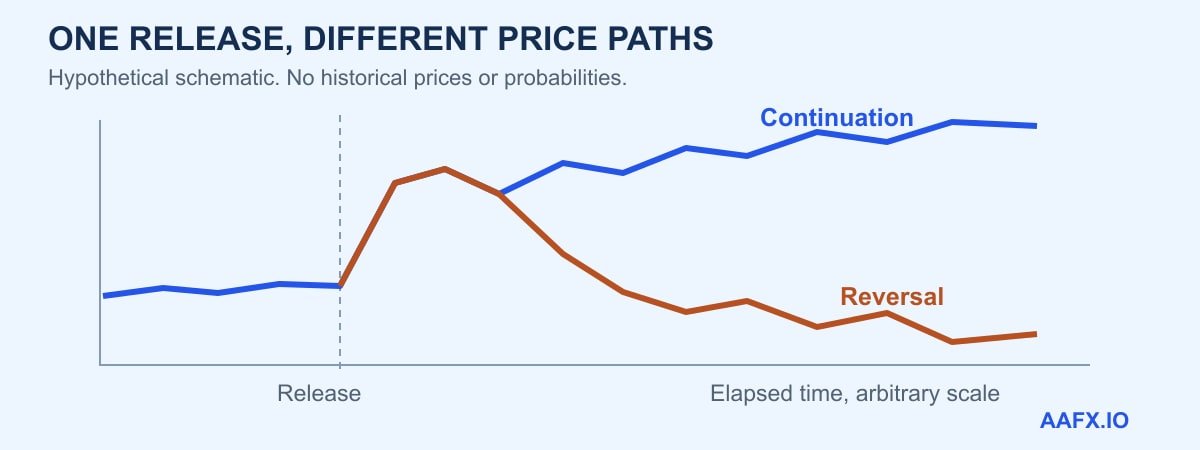
A continuation framework waits for the report and a price response consistent with the working interpretation. The trader defines what would count as a sustained break or a successful retest, then checks whether the available entry still fits the loss scenario. Waiting can reduce uncertainty about the headline, but may also leave a worse entry or no opportunity.
A reversal framework looks for an initial move that fails to hold an identified level. That failure is a condition to investigate, not permission to fade every spike. Revisions, other data or repositioning may explain the change. Define the evidence for failure before the event so that a losing continuation idea is not casually renamed a reversal strategy.
A no-trade framework applies when the report conflicts internally, the price is already far from the planned entry, execution is poor or the risk calculation no longer fits. There is no universal five-minute waiting rule that guarantees safety. A candle close is an observation convention, not a certification that the market has become stable.
Avoid assuming that a pending buy-stop above a range and sell-stop below it neatly captures whichever move occurs. A two-way swing may activate both orders, while cancellation can be delayed. A stop-limit can remain unfilled. The order-types guide explains the difference between a trigger, a price condition and an actual fill.
Assess any approach with decision-time data, realistic transaction costs and losing scenarios. The schematic below shows continuation and reversal as possibilities only. It supplies no frequency, performance estimate or preferred entry. A practical journal records the inactive setups as well as the trades, reducing the temptation to judge a rule from its most attractive screenshot.
Work through a hypothetical EUR/USD trade and worse fills
Assume a hypothetical long EUR10,000 position entered at EUR/USD 1.1000 with a planned exit trigger at 1.0970. A 0.0001 move, one pip for this illustration, changes the position by $1. Thirty pips therefore imply a $30 gross price loss. Entry notional is $11,000; the provider’s collateral requirement is a separate calculation.
Assume $2 of total dealing charges, with no extra charge added twice. An exit at the planned price would leave a $32 loss. If the actual exit is 1.0960, the gross loss is $40 and the loss with the same assumed charges becomes $42. A gap exit at 1.0930 produces $70 gross and $72 including those charges.
The assumed charge is for illustration, not a provider quote. If spread is already represented in the actual entry and exit fills, do not add that same spread again as a separate cost. Financing, conversion and other relevant charges need their own treatment. Compare like-for-like holding periods when evaluating the result.
A stop-loss is a trigger, not a guaranteed fill. The SEC stop-order bulletin explains that distinction for securities; forex contract handling must be checked separately. A stop-limit can restrict execution price while leaving exposure open. Reducing quantity lowers price sensitivity but does not make an ordinary stop a guarantee.
On hypothetical starting equity of $5,000, losses of $32, $42 and $72 equal 0.64%, 0.84% and 1.44%. Those are arithmetic comparisons, not recommended risk percentages. A trader who sizes only from the first number may underestimate the account effect when the exit differs from the trigger.
The adverse-execution scenario also changes the interpretation of a nominal reward-to-risk ratio. An attractive chart target does not establish the attainable gain or loss. Record actual fills and charges after the event, compare them with the plan and investigate the difference before repeating the same quantity at the next release.
| Exit assumption | Gross price loss | Loss with assumed charges |
|---|---|---|
| Planned 1.0970, 30 pips | $30 | $32 |
| Worse fill 1.0960, 40 pips | $40 | $42 |
| Gap exit 1.0930, 70 pips | $70 | $72 |
When to skip NFP and how to review the outcome
Skip a new event trade when you cannot explain the product, the order or the possible loss. The CFD guide explains why trading a price-linked contract differs from owning the underlying asset. A familiar symbol and a small required margin are not evidence that an event-driven position suits your circumstances.
Also step back when you are relying on an unverified result, an old calendar time or a prediction copied without context. Avoid increasing size to recover an earlier loss. If repeated entry attempts consume your planned budget, the response is to stop following that setup, not assume that the next candle owes you a reversal.
Afterwards, keep the original report snapshot, your interpretation, planned conditions, actual action and account outcome. Separate forecast error from execution error. A reasonable economic interpretation can lose money, and a profitable trade can still have broken the written plan. Neither one event nor one attractive chart establishes a durable edge.
Review missed and skipped setups using the same criteria as executed trades. If a rule is changed after every release, you may be fitting yesterday’s outcome rather than improving a repeatable process. Record what changed and why, and assess the revised approach on future observations rather than retroactively crediting it with the best historical entry.
AAFX.IO next steps for interpreting NFP
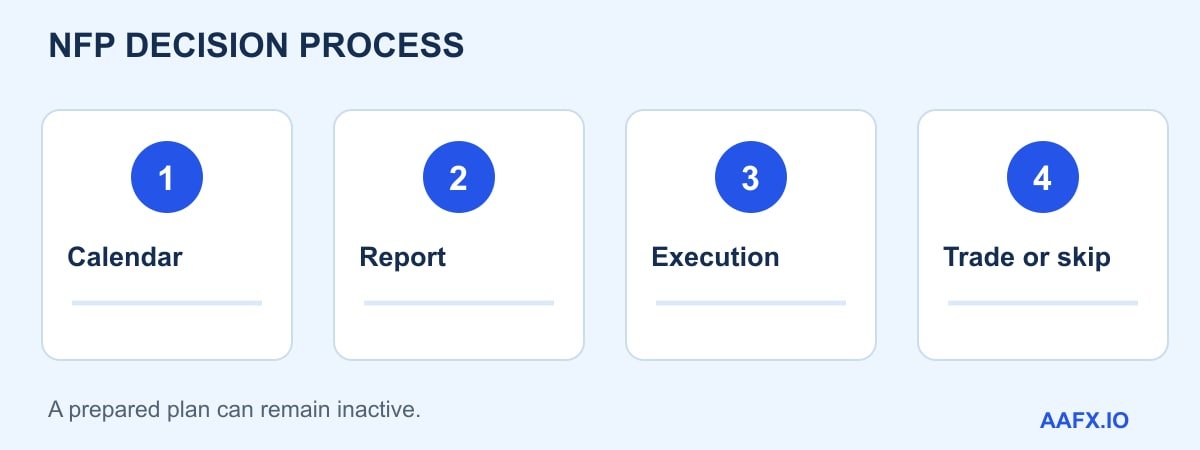
Use this guide as a sequence: verify the time, read the employment package, form a conditional interpretation, evaluate price and execution, then trade or skip under written conditions. An upside payroll surprise is information, not a complete instruction to buy dollars or sell gold.
Return to the trading foundations guide and forex market analysis guide if exposure or analysis methods need clarification. Our forex forecast directory provides longer-horizon context, which should be distinguished from an event trade. Each horizon needs its own assumptions and invalidation conditions.
Review this evergreen explanation annually and after material changes to survey methods or order guidance. Check the calendar, expectations, prices and account conditions afresh for every release. Educational videos are available on TikTok and Instagram.
Commercial disclosure: AAFX.IO may earn compensation through commercial links. Compensation does not change this guide’s conclusions or remove trading risk. No new broker offer is included in this guide.
This material is general education. It does not assess your circumstances, recommend a personal trade or guarantee an outcome.
Written, reviewed and edited by Arslan Ali Butt
MPhil Behavioural Finance, MBA Finance, 10+ years in forex dealing and analysis.
Last reviewed: 6 November 2026.
How we reviewed this guide: We checked BLS release timing, survey definitions, earnings concepts and revisions; Federal Reserve policy information and research commentary; and SEC stop-order guidance. The examples and charts are hypothetical. Market channels are conditional analysis, not tested strategy results.
Frequently Asked Questions
What does a positive nonfarm payroll number mean?
A positive monthly change means the estimated number of nonfarm payroll jobs increased relative to the previous month on the stated adjustment basis. It does not count every working person or identify how many individuals found their first job. Whether the release is a positive market surprise depends on expectations, revisions and the other employment indicators released alongside the headline.
Is NFP the same as the unemployment rate?
No. Payroll employment comes from the establishment survey and measures jobs, while unemployment is measured through the household survey and concerns people in the labour force. The surveys have different coverage and reference periods. Payroll growth and a rising unemployment rate can therefore appear together without making either series automatically wrong. Read participation and the wider report before interpreting the difference.
Is the NFP release always on the first Friday?
Do not rely on that shortcut. The Employment Situation is a monthly publication commonly associated with Friday releases, but the official BLS calendar determines the actual date and time. Holidays or other scheduling changes can matter. Check the calendar for each event, confirm the reference month and convert the stated Eastern Time into your location using the date-specific daylight-saving offset.
Can I use ADP employment data as the NFP result?
No. A separate private employment report is not the official BLS nonfarm payroll release, and differences in scope and methods prevent treating the two as interchangeable. It may inform an analyst’s expectations, but it does not establish the later BLS outcome. Label every forecast and source clearly, then verify the actual payroll figure directly in the official release before interpreting it.
Why can the dollar fall after a strong payroll headline?
The headline may be less strong than traders expected, or wages and prior-month revisions may weaken the overall message. Existing positions and the wider policy outlook also matter. Prices reflect changes in expectations rather than a simple good-data or bad-data label. A falling dollar after the release is evidence to reassess the interpretation, not proof that the market must reverse immediately.
Does weak NFP guarantee higher gold prices?
No. Softer employment can support gold if it lowers expected interest rates or weakens the dollar, but those channels can conflict with liquidity needs, positioning and other news. Gold has its own market and product risks. A jobs report alone does not determine the direction, magnitude or timing of the move, and a price-linked contract may add leverage and financing costs.
How long should I wait after the NFP release?
There is no universal waiting period that makes a trade safe. A five-minute or fifteen-minute chart is an observation choice, not a guarantee that spreads have normalised or the direction has settled. Use written conditions for price confirmation, execution quality and invalidation. If those conditions are absent, the plan can remain inactive regardless of how many minutes have passed since publication.
Should I place buy-stop and sell-stop orders before NFP?
A two-sided pending-order approach can trigger one or both sides during a sharp reversal. Wider spreads, slippage, cancellation delays and account rules can change the result from a simple chart illustration. Understand the provider’s exact order handling before considering it. This guide does not recommend a pre-release straddle, and a demo test does not establish equivalent execution with real money.
Can a stop-loss guarantee the amount I risk on NFP?
An ordinary stop does not guarantee its execution price. After triggering, a stop may fill at a worse price when the market moves rapidly or gaps. A stop-limit sets a price condition but may remain unfilled. Any separately offered guaranteed-stop feature has its own contract and charges. Calculate planned loss and adverse-execution scenarios rather than treating the stop distance as an absolute loss ceiling.
How often should this NFP guide be updated?
Review the educational framework at least annually and sooner if official survey methods, release arrangements or relevant order guidance change. The actual release date, consensus, account conditions and live market prices need a fresh check for each event. Keeping those changing inputs separate allows the guide to remain useful without presenting last month’s payroll figures as today’s trading information or a current forecast.
Sources & Methodology
Primary-source standard: Market-moving facts should link to original data releases, regulator notices, company filings or official project announcements whenever available. Secondary reporting is used for additional context, not as a substitute for original evidence.
Page last reviewed: