Crypto trading means buying and selling a digital asset, or a contract linked to its price, to profit from price moves over days or hours rather than holding for years. Before you choose an exchange or study a chart, work out which product the order ticket would create, what one round trip costs in money and who controls the coins afterwards.
This guide is the starting point for crypto trading on AAFX.IO. It follows one trade from deposit to withdrawal, with worked examples you can check on a calculator. For daily market coverage, see our cryptocurrency news section, and for the account-opening steps, our beginner’s guide to starting crypto trading.
Risk warning: Crypto assets are highly volatile and can fall close to zero. Many trading venues offer fewer protections than regulated brokers or banks. Leveraged crypto futures can lose your whole margin quickly, and an ordinary stop order can fill well beyond the price you set.
AAFX.IO may earn a commission through links on this page. This does not change our ratings or the exchanges we recommend.
How does crypto trading work?
You trade a pair such as BTC/USD on an exchange. A fully paid spot trade swaps money for the coin, so the quantity you buy sets how much a price move changes your balance. A futures trade uses margin, so the contract size sets your exposure even when the deposit is small. Your result is the price change minus fees and, for futures, funding.
Is crypto trading profitable for beginners?
It can be, but most beginners underestimate costs and volatility. Two 0.10% fees mean bitcoin must rise about 0.2% just to break even, and a sharp drop can wipe out weeks of small gains. Practise with a small spot position or on paper, size every trade from the loss you can afford, and avoid leverage until your records show a tested edge.
Crypto trading: overview
- What is crypto trading?
- Spot, futures or ETPs: choose the product first
- Who should skip crypto trading for now
- How to compare crypto exchanges
- Read the order book and choose an order type
- A spot trade from entry to exit, with fees
- Leverage, funding and liquidation in crypto futures
- Build a crypto trading plan
- Custody, transfers and record keeping
- AAFX.IO: follow one trade back to cash before you start
- Frequently Asked Questions
What is crypto trading?
A trading pair names two assets. In BTC/USD, bitcoin is the base asset and the US dollar is the quote currency. A price of $50,000 means one bitcoin costs $50,000. Buying 0.02 BTC at that price swaps $1,000 for bitcoin before fees. If the price then moves $100 per bitcoin, your position moves $2. You never need to buy a whole coin.
The quote currency matters too. BTC/USDT prices bitcoin in a stablecoin, a token designed to track the dollar. A stablecoin can trade away from its target or become hard to redeem, so a gain measured in USDT can shrink once converted into money you can withdraw. Follow the actual route back to your bank account when comparing pairs.
The last traded price only tells you what already happened. The price available to you depends on the orders waiting on your venue. A higher price on another exchange can disappear before a transfer settles. Our comparison of forex, crypto and stock trading explains how crypto differs from other markets. All prices and fees below are hypothetical, not live quotes or forecasts.
Spot, futures or ETPs: choose the product first
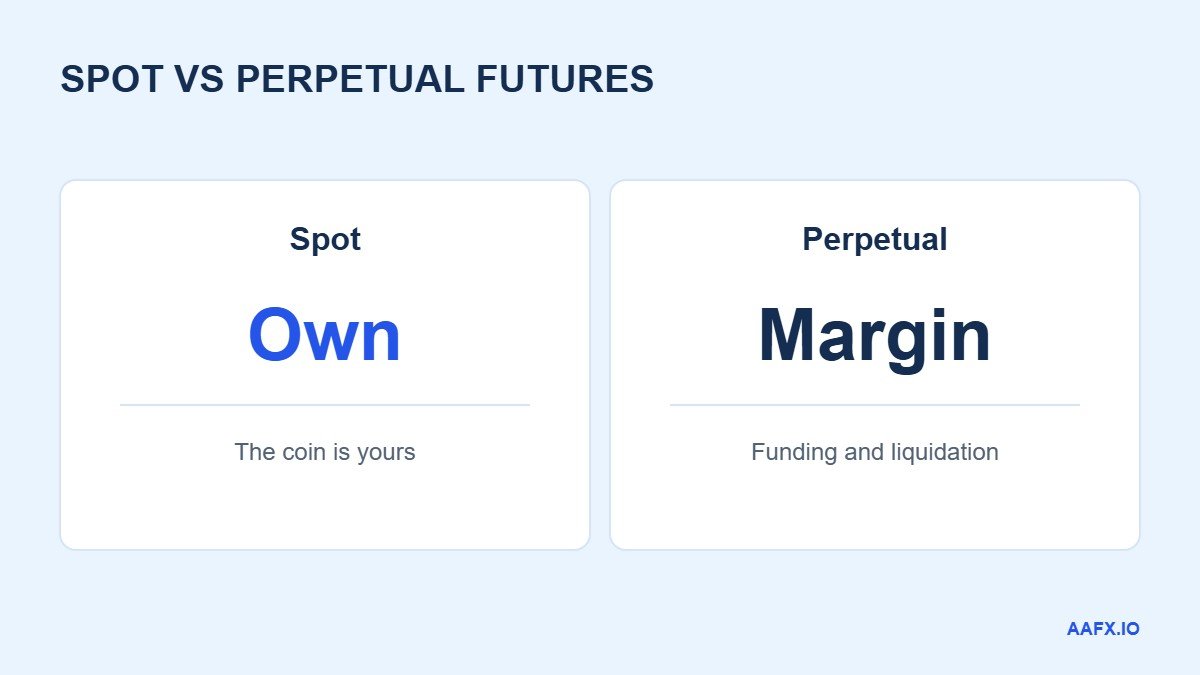
With an unleveraged spot purchase, you pay the full price and receive a coin balance. On a custodial exchange the provider holds the keys while the balance stays there. Whether you can withdraw the coin to your own wallet depends on the provider, your account and the networks it supports. If using the coin outside the platform is the goal, check that before depositing.
A perpetual futures contract gives price exposure without an expiry date. You can go long or short, but collateral, called margin, supports the position, and falling below the required margin can trigger liquidation. Funding payments may pass between long and short traders. A perpetual never gives you bitcoin to withdraw, because it is a contract on the price. Our guide to spot versus futures trading covers the difference in more depth.
| Route | What appears in the account | Question to answer before buying |
|---|---|---|
| Fully paid spot | A balance in the purchased coin | Can I withdraw it on the network I intend to use? |
| Perpetual futures | A margined contract with price exposure | How are margin, funding and liquidation calculated? |
| Dated futures | A contract with a set expiry | When and how does it settle or need rolling? |
| Exchange-traded product (ETP) | Shares held in a securities account | What does the product hold, charge and track? |
A third route runs through a normal securities account. The Investor.gov crypto assets page lists buying crypto directly, buying shares of crypto-industry companies, and buying funds or ETPs with crypto exposure as separate ways in. An ETP holder owns shares, trades during market hours and pays the fund’s expenses.
A quick test is to finish the sentence “After this order fills, I can…” If the answer is “send bitcoin to my own wallet”, you need spot with a supported withdrawal route. Choosing the product first removes platforms that cannot deliver what you want, however low their headline fee.
Who should skip crypto trading for now
Start with the money’s job. Suppose you set aside $600 for a bill due next month and buy a token with it today. A 25% fall leaves $450 before fees, and the bill still needs $600 on the same date. If a loss would interrupt an essential payment, that money is not trading capital.
Then check your time. Many crypto markets trade around the clock, but your attention does not. A plan that relies on reacting to a five-minute move at midnight clashes with a schedule that allows one check after work. Alerts help you notice a move; they cannot guarantee you can exit at a good price.
Finally, be honest about how you handle losses. Suppose a planned $20 loss becomes $30 because the exit filled late. Would you stop and record it, or double the next trade to win it back? If a loss would lead you to borrow money or hide the activity from someone who shares your finances, pause. A spreadsheet and a saved order book can teach most of the mechanics without risking a cent.
How to compare crypto exchanges
Start with the legal company named in the account agreement for your country. A familiar brand may serve different customers through different companies, and a registration for one activity does not cover every product on the menu. Expect identity checks, explained in our guide to KYC and anti-money laundering rules, and treat any venue that asks you to pay a personal account as a warning sign, as covered in our broker red flags guide.
Compare the specific pair you plan to trade. Look at the bid, ask and quantity on offer during the hours you would trade. An exchange can have a busy bitcoin market and a thin market for a smaller token, so total platform volume tells you little. Our crypto exchange reviews give a shortlist; then check current terms for your region and payment method.
Compare fees in money, across the whole journey. In this hypothetical example, Exchange A charges $2 to deposit and $1 to buy, while Exchange B charges nothing to deposit but $4 to buy. Getting into the position costs $3 at A and $4 at B. But if A charges $6 to send the coin to your wallet and B charges $2, the totals reverse.
| Hypothetical cost | Exchange A | Exchange B |
|---|---|---|
| Deposit fee | $2 | $0 |
| Trading fee on the purchase | $1 | $4 |
| Cost to get into the position | $3 | $4 |
| Withdrawal to your own wallet | $6 | $2 |
| Total for the full journey | $9 | $6 |
The cheaper exchange depends on where the money ends up. Someone selling for cash on the same platform needs the selling fee and bank withdrawal charge instead. Read the withdrawal page before the deposit page: holds, minimums, supported networks, fees and what happens if you lose your two-factor device.
Read the order book and choose an order type
An order book lists bids from buyers and asks from sellers. The gap between the best bid and best ask is the spread. If the best bid is $49,990 and the best ask is $50,000, the spread is $10 per bitcoin. Buying 0.02 BTC and selling straight back at those quotes loses $0.20 before fees.
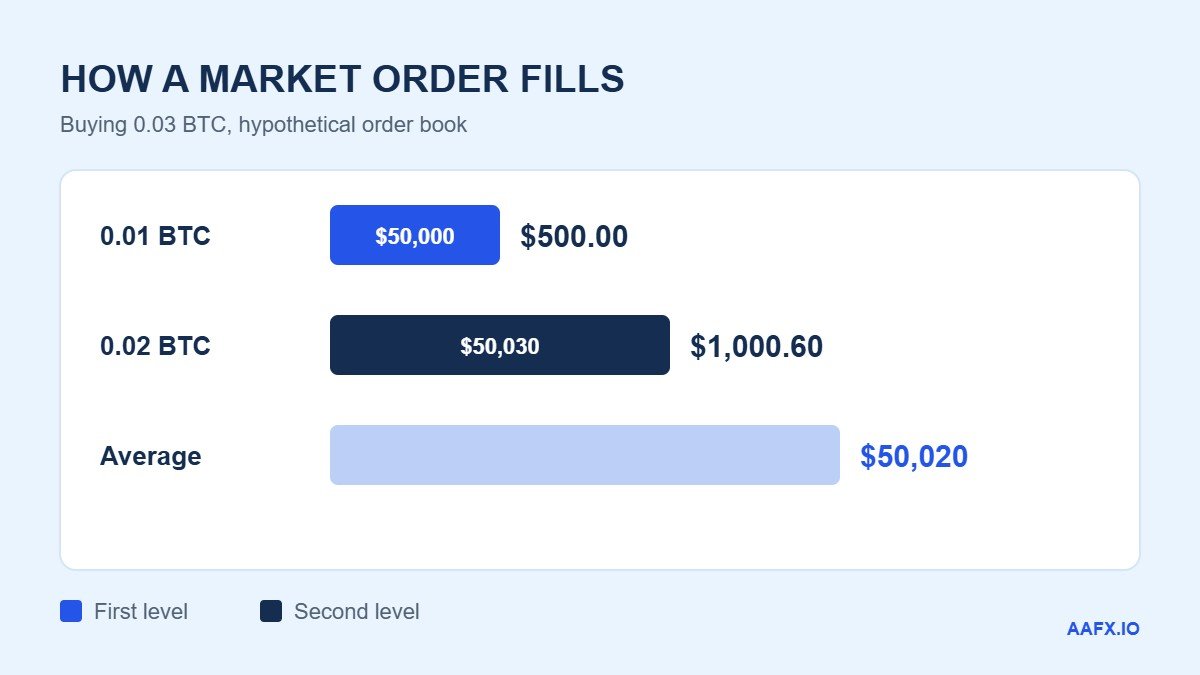
A market order fills immediately against whatever is waiting. Suppose the lowest ask offers 0.01 BTC at $50,000 and the next offers 0.02 BTC at $50,030. Buying 0.03 BTC takes both levels: $500 plus $1,000.60, or $1,500.60 in total. Your average fill is $50,020 per bitcoin, so the first price on screen applied to only a third of the order.
A limit order sets the highest price you will pay. In the same book, a buy limit at $50,000 fills 0.01 BTC and leaves 0.02 BTC waiting. Maker and taker fees depend on whether your order rests in the book or takes liquidity. The Coinbase order type guide describes a post-only option that keeps a limit order resting and rejects it if any part would execute immediately.
Stops add a trigger. A stop-limit places a limit order once the stop price is reached, so it can stay unfilled in a fast fall. A stop-market order exits but can fill at a much worse price. Check whether the trigger uses the last trade, an index or a mark price. Our guide to trading orders compares each type.
A spot trade from entry to exit, with fees
Suppose you buy 0.02 BTC at $50,000, a purchase value of $1,000, and the exchange charges 0.10% per side in dollars. You need $1,001 in total. Check whether the ticket asks for the purchase value or the total cash to spend, because some apps shrink the quantity so the fee fits inside your budget.
Now compare a winning and a losing exit. Selling at $51,000 returns $1,020 before a $1.02 fee, so you receive $1,018.98 and make $17.98 after costs. Selling at $48,500 returns $970 before a $0.97 fee, so you receive $969.03 and lose $31.97. A $20 price gain and a $30 price loss both look worse once fees are counted.
| Hypothetical 0.02 BTC trade | Exit at $51,000 | Exit at $48,500 |
|---|---|---|
| Cash spent, including 0.10% buy fee | $1,001.00 | $1,001.00 |
| Sale value | $1,020.00 | $970.00 |
| Selling fee at 0.10% | $1.02 | $0.97 |
| Cash received | $1,018.98 | $969.03 |
| Net result | +$17.98 | -$31.97 |
You can also work out the break-even price. The sale must return $1,001 after the selling fee, so you need gross proceeds of $1,001 divided by 0.999, about $1,002.00. Divided by 0.02 BTC, that is roughly $50,100 per bitcoin, before any withdrawal fee. Selling at the price you bought always leaves less cash than you started with.
Leverage, funding and liquidation in crypto futures
Suppose a contract gives $5,000 of bitcoin exposure backed by $1,000 of margin. That is five times leverage. A 1% move against you costs about $50, or 5% of your margin, before fees and funding. A 10% move costs about $500, half your collateral. Our leverage and margin guide explains why a small deposit can hide a large exposure.
You cannot work out the liquidation price from leverage alone. Maintenance margin, the exchange’s mark price, fees and whether you use isolated or cross margin all affect it. With cross margin, a loss on one contract can eat into the margin supporting another. Read the margin rules before trusting the estimate on screen.
Funding is a separate cash flow on perpetuals. If the rate for one funding period is 0.01% and longs pay shorts, a $5,000 long pays $0.50 for that period. The sign can flip. The CFTC advisory on virtual currency risks warns that margin magnifies both gains and losses and that traders may lose more than their initial investment. It also notes that many cash-market platforms are unregulated.
Closing needs as much care as opening. On some tickets a sell larger than your long opens a new short, so use reduce-only where available. And remember that a stop is a trigger, not a guaranteed fill: the SEC investor bulletin on order types explains why stop orders can execute well away from the stop price.
Build a crypto trading plan
Bitcoin, ether and smaller tokens react to different events. Research what each asset does, how new units are issued, who can change its rules and how easily you could sell your size. Our comparison of the best crypto for beginners is a starting point. Market capitalisation, price multiplied by circulating supply, does not tell you how much money is waiting to buy your position.
Size every trade from the loss you can accept. Suppose your entry is $50,000 and the price that proves you wrong is $48,500, a $1,500 distance per bitcoin. A $30 allowance for the price move permits 0.02 BTC. The worked example showed fees push that loss to $31.97, so if $30 must cover costs too, trade slightly smaller. Our position-sizing guide covers the method.
Write down what cancels the trade before you enter: a spread wider than you tested, an entry that leaves too little upside, or a scheduled announcement while you cannot watch. Count combined risk too. Several tokens that all rise and fall with risk appetite add up to one large bet.
If you test an idea on past charts, use the data in time order, keep a later period untouched for checking, and record every signal, not just the memorable winners. Charge fees on every simulated trade. When one candle touches both your stop and your target, assume the worse outcome unless finer data shows otherwise.
Custody, transfers and record keeping
The Investor.gov custody bulletin sets out the trade-off. With self-custody you control your assets and are responsible for your private keys, and losing them can mean losing access permanently. With third-party custody an exchange manages the keys, and you may lose access if it is hacked, shuts down or goes bankrupt. Ask any custodian how it uses customer assets, including lending them out.
Never share a seed phrase, the list of words that restores a wallet. The same bulletin says to store it securely and share it with no one. Anyone asking for it to “fix” a support ticket is asking for full control of your wallet. Open the platform through a saved address and contact support there.
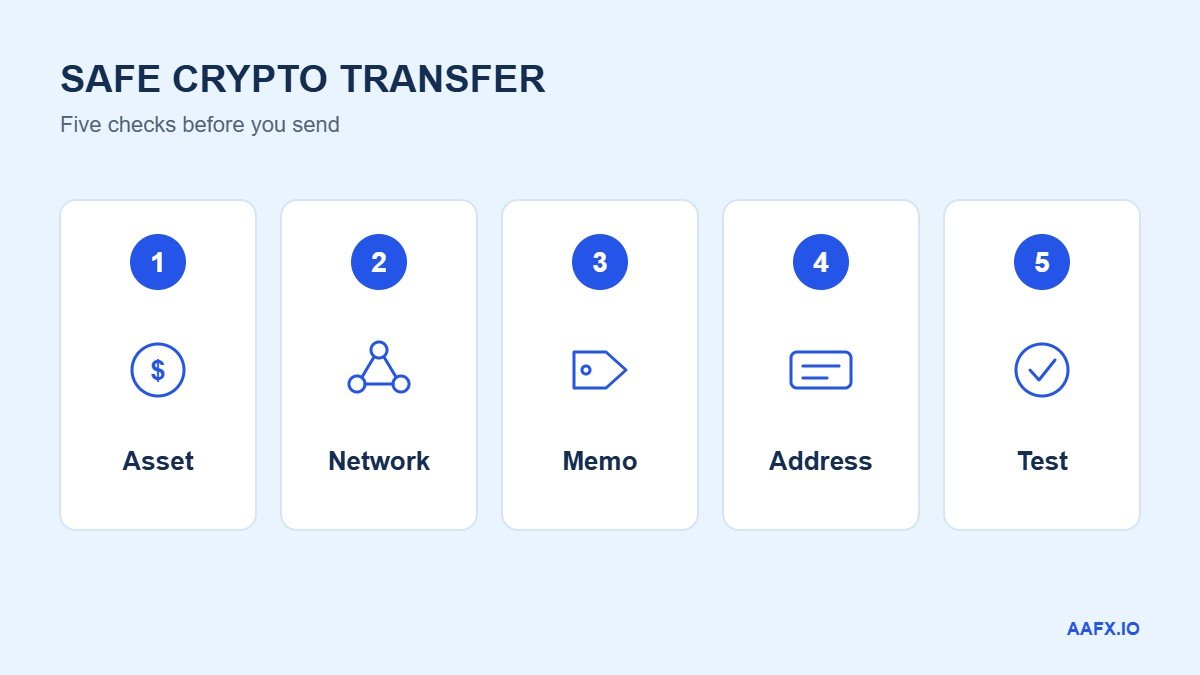
Before any transfer, match the coin and the exact network on both sides, add a memo or tag if the receiver needs one, and check the address on the final screen. Send a small test that clears the minimum deposit first. For records, save the order ID, time zone, pair, side, quantity, fill price, fee and fee currency for every trade, plus the network and transaction ID for transfers. Tax rules differ by country, and clean records make them easier to apply.
AAFX.IO: follow one trade back to cash before you start
Pick one pair and follow a hypothetical order all the way back to your bank account. Identify the product, calculate the average fill, deduct both fees and check how you would withdraw. Then repeat it with a falling price and a partial fill. If either result surprises you, that is exactly what to practise before risking money.
Next, read our guide to starting crypto trading, compare platforms in our crypto exchange reviews and follow market moves in the crypto news section. For short explainers, follow @arslaninsights on TikTok and AAFX.IO on Instagram.
Affiliate disclosure: AAFX.IO may earn a commission if you open an account through some links on our site. Commercial relationships do not affect our scores, rankings or analysis. Always verify a provider independently before depositing.
Educational information only, not personalised investment, legal or tax advice. Crypto assets can lose most or all of their value. Worked examples are hypothetical and do not represent live quotes or tested performance.
Written and reviewed by Arslan Ali Butt, MPhil Behavioural Finance, MBA Finance, with more than 10 years in forex dealing and market analysis, including crypto dealing. Last reviewed: 18 November 2026.
How we reviewed this guide: Product, custody and risk explanations were checked against Investor.gov, the CFTC virtual currency advisory, the SEC order types bulletin and the Coinbase order type guide on 18 November 2026. All prices, fees and funding rates are hypothetical inputs with the arithmetic shown. No exchange is ranked in this guide.
Frequently Asked Questions
How much money do you need to start crypto trading?
The practical minimum depends on the exchange’s order minimum, fees and payment method rather than the coin price, since you can buy fractions. Look at the cost to deposit, buy, sell and withdraw. A fixed $5 cost is 10% of a $50 trade before the price moves, so very small accounts lose a large share to fees. Practising on paper costs nothing.
Can you trade crypto on weekends?
Yes. Most crypto spot and perpetual markets trade around the clock, every day, apart from exchange maintenance. Bank transfers, customer support and crypto ETPs on stock exchanges follow normal business hours, though. Weekend markets can also be thinner, with wider spreads. A sharp move while your bank is closed does not mean you can add cash to the exchange in time.
Is holding a stablecoin the same as holding cash?
No. A stablecoin aims to track a currency such as the US dollar, but getting back to cash can depend on the issuer, an exchange, a redemption process and a supported blockchain. Many holders can only sell to another trader on an exchange. Stablecoins have traded below their targets before. Check the price you could actually get for your size and your route back to the bank.
Can a spot crypto trade be liquidated?
A fully paid spot purchase with no borrowing cannot be liquidated because the price falls. Its value can still drop close to zero, and access can be interrupted if the exchange fails or freezes withdrawals. Spot margin products are different: they involve borrowing and can be closed out. Read the balance and borrowing fields on the ticket before assuming two products with similar names work the same way.
What is the difference between maker and taker fees?
A maker order adds liquidity by resting in the order book, such as a limit order below the current price. A taker order removes liquidity by filling immediately, such as a market order. Exchanges usually charge takers more. A limit order priced to execute straight away is charged as a taker for the part that fills. Post-only settings stop that from happening.
What leverage should a beginner use in crypto?
None at first. At five times leverage, a 1% price move changes your margin by about 5%, and crypto can move 10% in a day. Learn spot trading, sizing and record keeping before touching futures. If you later use leverage, size the position from the loss you accept at your stop, then check the liquidation price sits well beyond it.
What is funding on a perpetual futures contract?
Funding is a periodic payment between long and short traders that keeps a perpetual’s price close to the spot price. When the rate is positive, longs usually pay shorts; when negative, shorts pay longs. For example, a 0.01% rate on a $5,000 position costs $0.50 per funding period. Holding a leveraged position for weeks can add up to a meaningful cost.
Is it safer to keep crypto on an exchange or in my own wallet?
Each carries different risks. On an exchange, you rely on the company staying solvent and secure. In your own wallet, you are responsible for the private keys and seed phrase, and losing them can mean losing the coins permanently. Many traders keep only active trading balances on an exchange and hold longer-term coins in self-custody with a well-tested backup.
Do I need to pay tax on crypto trading?
In many countries, selling, swapping or spending crypto can create a taxable gain or loss, but rules differ widely. Keep a record of every trade, fee and transfer, including dates, quantities and values in your home currency. Transfers between your own wallets are usually not sales, so tag them clearly. Check local rules or speak to a qualified tax adviser.
Should I buy crypto or trade it?
They answer different questions. Investing means holding an asset you believe in for years and accepting large swings along the way. Trading means entering and exiting on a plan, often within days, with a set exit if you are wrong. Mixing the two hides mistakes. For a simple long-term purchase, our guide on how to buy cryptocurrency is a better fit.
Sources & Methodology
Primary-source standard: Market-moving facts should link to original data releases, regulator notices, company filings or official project announcements whenever available. Secondary reporting is used for additional context, not as a substitute for original evidence.
Page last reviewed: