Quick Answer
The four main trading styles are scalping, day trading, swing trading and position trading. They differ mainly in how long trades are held: scalpers hold for seconds to minutes, day traders close everything before the session ends, swing traders hold for days to a few weeks, and position traders hold for weeks to months. Shorter styles need more screen time, lower trading costs and fast decision-making. Longer styles need patience, wider stops and attention to overnight financing. The best style is the one that fits your schedule, personality and capital.
One of the most useful questions I ask new traders is not “what do you want to trade?” but “how many hours a day can you actually watch a screen?” The answer usually tells me more about which style will work for them than any personality test. A trader with a full-time job who tries to scalp is setting up for frustration. A trader who needs quick feedback may struggle to hold a position trade through weeks of noise.
This guide compares the four styles on timeframe, time commitment, costs and risk, then helps you choose. It sits under our guide on what trading is and links to the strategy guides that suit each style.
The Four Trading Styles at a Glance
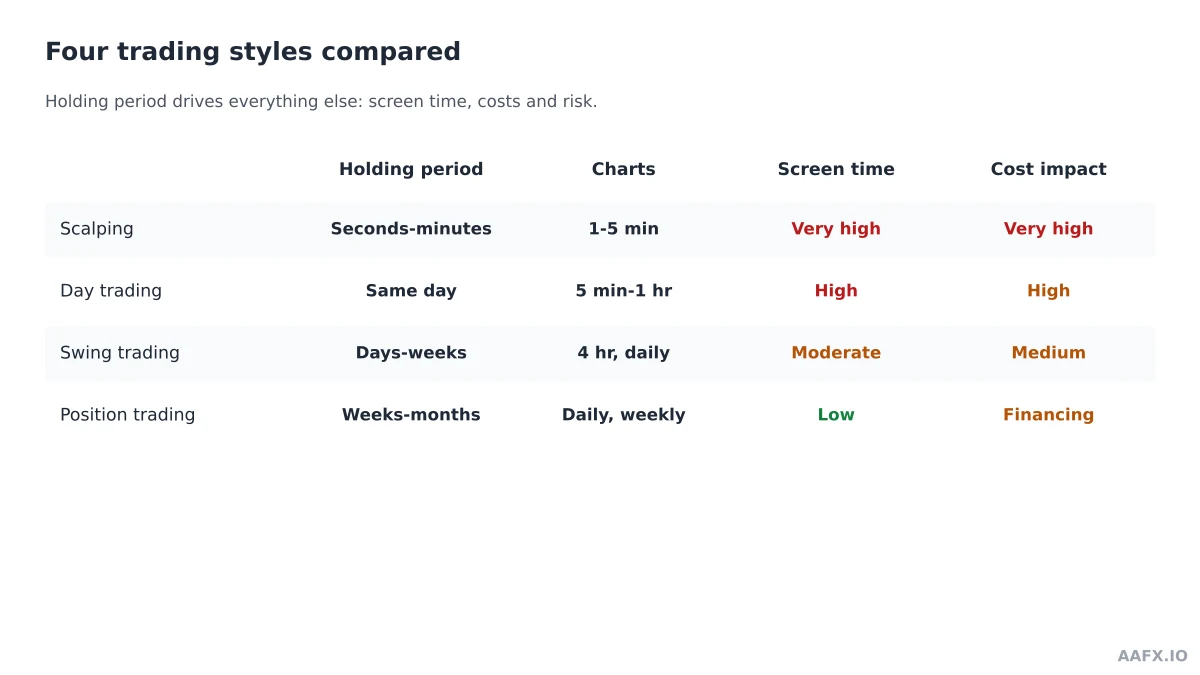
| Style | Holding period | Typical chart timeframes | Screen time | Trades per week |
|---|---|---|---|---|
| Scalping | Seconds to minutes | Tick, 1-minute, 5-minute | Several focused hours a day | Dozens to hundreds |
| Day trading | Minutes to hours, closed same day | 5-minute to 1-hour | Several hours a day | 5 to 30 |
| Swing trading | Days to a few weeks | 4-hour, daily | 30 to 60 minutes a day | 1 to 5 |
| Position trading | Weeks to months | Daily, weekly | A few hours a week | A few per month |
Scalping
Scalpers aim to capture very small price moves many times a day, often a few pips per trade in liquid forex pairs. Because each trade targets so little, costs dominate. A spread of 1 pip on a trade aiming for 5 pips consumes a fifth of the target before slippage. Scalpers usually need raw spread accounts, fast execution and brokers that allow the strategy. Our comparison of market makers vs ECN brokers explains why execution model matters so much for this style.
Suits: traders with large blocks of uninterrupted time who stay calm under pressure. Watch out for: costs, overtrading and fatigue.
Day Trading
Day traders open and close positions within the same session, so they carry no overnight risk or financing. Common approaches include trading the London or New York open, breakouts from early-session ranges and reactions to scheduled economic data. Our guide to major forex pairs lists the most active windows for each pair.
Suits: traders who can dedicate the same hours each day. Watch out for: trading out of boredom on quiet days and chasing news spikes.
Swing Trading
Swing traders aim to capture moves that unfold over several days, often entering on pullbacks within a trend or at key support and resistance levels. Decisions are usually made on 4-hour or daily charts, so the style fits around a full-time job. Stops are wider than in day trading, so position sizes must be smaller to keep risk per trade the same.
Suits: part-time traders with patience. Watch out for: weekend gaps, overnight financing and the temptation to check positions constantly.
Position Trading
Position traders hold trades for weeks or months, typically based on fundamental themes such as diverging interest rates or long-term trends. They use daily and weekly charts and accept large swings along the way. Overnight financing on leveraged positions becomes a meaningful cost over these timeframes, which is why many position traders use low leverage or unleveraged exposure. Our guide to fundamental analysis covers the macro drivers position traders follow.
Suits: traders with a strong macro view and limited time. Watch out for: large drawdowns before the thesis plays out, and financing costs.
How Costs Change by Style
Costs scale with frequency and holding time in opposite ways. Short-term styles pay many spreads and commissions but little financing. Long-term styles pay few spreads but more financing. The table below shows the pattern.
| Style | Spread and commission impact | Overnight financing impact | Account type that often fits |
|---|---|---|---|
| Scalping | Very high | None | Raw spread with commission |
| Day trading | High | None | Raw spread or low-spread standard |
| Swing trading | Medium | Medium | Standard, with competitive swap rates |
| Position trading | Low | High on leveraged positions | Low leverage; compare swaps carefully |
How to Choose Your Trading Style
- Start with your calendar. If you cannot watch markets during the day, scalping and day trading are effectively ruled out.
- Be honest about temperament. If waiting days for a trade to develop makes you anxious, position trading will be hard. If fast decisions stress you, scalping will be harder.
- Check your costs. Calculate the spread and commission as a share of your typical target. If costs take more than a fifth of the target, the style may not be viable with your current broker.
- Match risk per trade. Whatever the style, risk the same small percentage per trade and size positions from the stop. See risk management and position sizing.
- Test before committing. Trade the style on a demo or small account for at least a month and keep a journal.
Can You Combine Styles?
Many experienced traders do, for example holding a swing position based on a daily chart while day trading around it. For beginners, combining styles usually blurs discipline: a losing day trade turns into a “swing trade” to avoid taking the loss, which is how small losses become large ones. Master one style first, with written rules for how long trades are allowed to last.
My View: Your Schedule Is Your Strategy
My view is that most traders choose a style based on what looks exciting rather than what fits their life, and that mismatch causes more failures than any bad indicator. For most people with a job, swing trading on daily charts is the most realistic starting point: it needs less screen time, makes costs less dominant and leaves room for thoughtful decisions. What would change my recommendation is a trader who has several free hours at the same time each day and a low-cost raw spread account, in which case day trading the most active session becomes a realistic option.
Frequently Asked Questions
What are the four main trading styles?
Scalping, day trading, swing trading and position trading. They differ mainly by holding period, from seconds or minutes for scalping to weeks or months for position trading.
Which trading style is best for beginners?
Swing trading is often the most practical starting point for beginners with jobs, because it uses daily or 4-hour charts, needs less screen time and makes trading costs less dominant than very short-term styles.
What is the difference between day trading and swing trading?
Day traders close all positions within the same session, avoiding overnight risk and financing. Swing traders hold positions for several days or weeks to capture larger moves, accepting overnight and weekend risk.
Is scalping profitable?
Scalping can work for disciplined traders with very low costs and fast execution, but spreads, commissions and slippage take a large share of each small target. Many retail scalpers struggle to overcome costs.
How much time do I need for each trading style?
Scalping and day trading need several focused hours a day. Swing trading can be done in 30 to 60 minutes a day. Position trading may need only a few hours a week.
Can I change my trading style later?
Yes. Many traders start with swing trading and move to shorter or longer styles as their schedule, experience and capital change. Test any new style on a demo or small account first.
Risk warning: Trading forex, CFDs and other leveraged products carries a high level of risk and may not be suitable for all investors. You can lose some or all of your capital. This guide is for educational purposes only and is not investment advice.
Sources & Methodology
Primary-source standard: Market-moving facts should link to original data releases, regulator notices, company filings or official project announcements whenever available. Secondary reporting is used for additional context, not as a substitute for original evidence.
Page last reviewed: