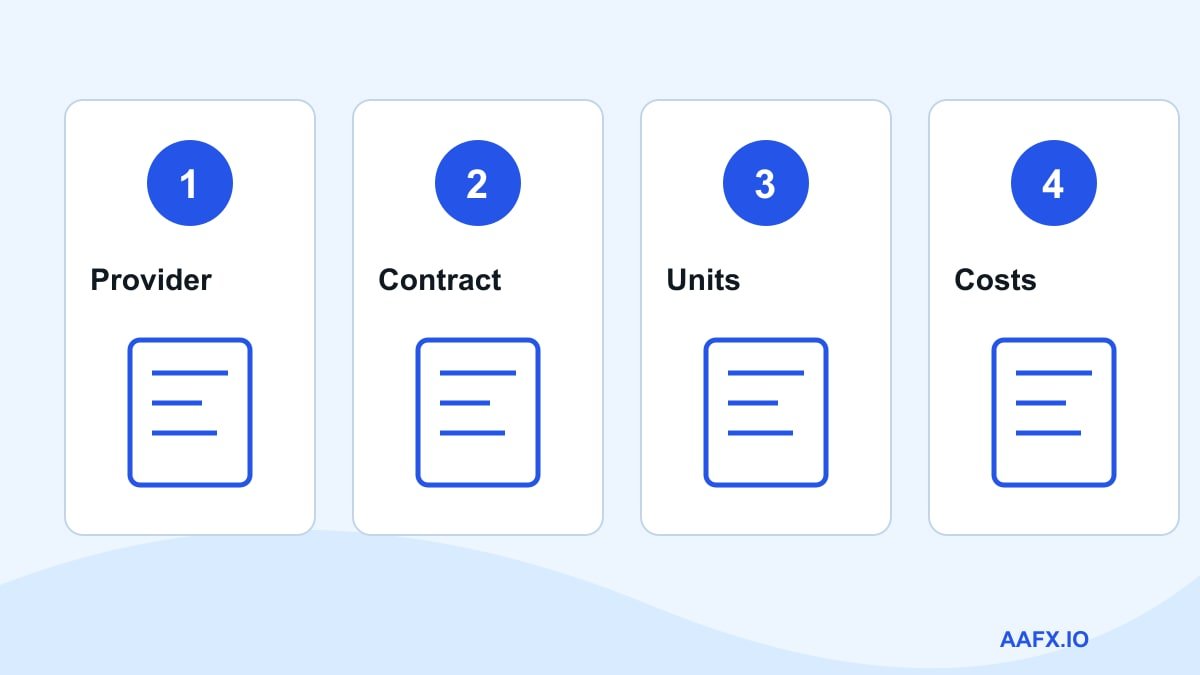
Learning how to open a forex trading account starts with the provider and currency contract, before the application or deposit. Verify the entity, complete the application accurately and understand the units, costs, margin and order rules. A currency-pair label alone does not define what you own or owe.
This forex-specific guide complements the AAFX.IO broker-selection pillar. It adds contract and exposure checks to the general onboarding process rather than recommending a provider or promising account approval.
Risk warning: Leveraged currency trading can produce rapid losses, and execution can differ from a planned exit. Provider protections and account obligations depend on the actual product, entity and applicable rules. Hypothetical examples are educational only.
Affiliate disclosure: AAFX.IO may earn a commission through links on this page. This does not change our editorial conclusions.
How do I open a forex trading account?
Verify the account provider and product, then complete the application accurately through its authenticated channel. Before funding, read the currency-contract specifications, margin and close-out rules, spreads, commissions and financing terms. Learn how orders and account balances work. Approval is permission to access a service under its terms, not evidence that a currency trade is suitable or profitable.
Is a forex account the same as holding foreign currency?
Not necessarily. A currency bank balance, deliverable foreign exchange, a retail leveraged forex contract and a currency CFD can create different rights and obligations. The currency-pair label alone does not identify the product. Read the agreement and settlement terms, establish the contracting entity and calculate exposure before treating a displayed margin figure as the cost of owning currency.
Forex Account Opening: Overview
- How to open a forex trading account: identify the contract
- Authenticate the provider and complete the application accurately
- Translate pairs and platform quantities into currency exposure
- Compare the full holding-period cost and funding arrangements
- Model margin sensitivity with hypothetical EUR/USD arithmetic
- Learn the platform and review the first order deliberately
- Who should pause before funding a forex account
- AAFX.IO: verify access, then assess the currency exposure
How to open a forex trading account: identify the contract
Start by separating the market from the instrument. Foreign exchange describes relative currency values, but an account can offer several ways to obtain that exposure. A deliverable currency transaction is different from a leveraged retail contract or a CFD. A line labelled EUR/USD does not establish which agreement you would enter when pressing buy.
Read the proposed contract and product disclosure. Record the legal entity, customer jurisdiction, price reference, settlement method and whether the position represents actual currency delivery or a gain-and-loss contract. Do not substitute a promotional description for these terms. The spot-versus-futures guide explains why a familiar market label can hide different obligations.
The CFTC OTC forex advisory describes a dealer-counterparty structure specific to that market. Its explanation should not be presented as a description of every currency transaction worldwide. Establish the product actually offered before applying a general statement about exchanges, dealers or protection.
This forex-specific guide adds contract and risk checks to a general application workflow. It does not rank providers or reproduce a brand-specific sign-up screen. Our forex foundations guide introduces the market concepts needed to understand those account choices.
Authenticate the provider and complete the application accurately
Match the contracting company to the appropriate official record and permitted activity. Then independently check its domain and contact details. A genuine licence number on an unrelated website is not an authenticated application. The FCA clone-firm guidance explains the identity problem, while each jurisdiction has its own relevant records and processes.
Use the provider channel reached through those independent checks. Application requirements depend on the entity, country, account type and circumstances. Supply accurate information and follow the actual checklist rather than a generic promise that everyone can obtain approval with the same documents. The KYC and AML guide explains common identity-check concepts.
Do not change answers about experience or finances merely to unlock a product or account classification. A more permissive account can have different obligations and protections. Ask for clarification through official support and save the proposed terms. A familiar platform or sales contact cannot establish what applies to the legal entity in the agreement.
Read the broker-selection pillar for the wider service checks. Approval does not require immediate funding or a live trade, although inactivity and closure conditions should be read. If the application changes the contracting entity, repeat the verification rather than assuming the original brand-level check covers the replacement.
Translate pairs and platform quantities into currency exposure
In EUR/USD, the euro is the base currency and the dollar is the quote currency. A price of 1.1000 means $1.10 per euro. A hypothetical EUR1,000 long exposure therefore has $1,100 of entry notional. A higher quote benefits that long exposure before costs; a lower quote works against it.
The quantity selected on a platform may be expressed in lots rather than currency units. Read the actual definition and convert it before calculating risk. A lot label is not enough. Check the minimum quantity, permitted increments, price increment and how the account translates gains and losses into its own currency.
For this guide’s hypothetical EUR1,000 exposure, a 0.0001 dollar-per-euro change produces $0.10 of gross price change. A different pair or quantity changes the calculation, and another account currency introduces a conversion step. Our major-pairs guide provides quotation context without replacing a provider specification.
Keep a written specification record with the instrument identifier, selected quantity, currency units, quote increment and conversion method. If the record cannot reproduce the platform’s displayed sensitivity, resolve the difference before entry. An incorrect unit assumption can overwhelm a carefully chosen chart level or a plausible macroeconomic view.
| Field | Question | Why it matters |
|---|---|---|
| Product and identifier | What contract is actually offered? | Determines rights and settlement |
| Quantity and multiplier | How much base currency is represented? | Determines price sensitivity |
| Account currency | How is the result converted? | Changes translated value and costs |
| Order and session rules | When and how can instructions execute? | Defines operational conditions |
Keep direction and units in the same note. Buying a currency pair and buying a company share express different exposures. For a price-linked currency contract, do not assume that a displayed long position creates a freely transferable bank balance in the base currency. The agreement determines the rights; the quoted pair and quantity determine the arithmetic of the assumed linear price movement.
Compare the full holding-period cost and funding arrangements
Start with the spread and commission for the intended pair and account, then inspect financing, conversion and other relevant charges. A published minimum spread is not a complete round-trip estimate. Costs can change with trading conditions, quantity and holding period. Use the applicable schedule instead of importing a quote from another account tier.
For an overnight position, read how financing is calculated and when adjustments are applied. Do not assume a debit or credit from the direction alone. A swap-free label also needs its own conditions and any alternative charges. The swap-free account guide introduces those questions without establishing the terms of every provider.
Our broker-fee guide explains the broader cost categories. Keep the estimate in the account currency and separate fixed charges from quantity-dependent charges. A low headline commission is not useful if an important conversion or financing cost has been omitted from the comparison.
Before funding, independently verify the recipient and supported payment route. Read deposit, withdrawal and account-currency conditions, including what could delay access. A successful small transfer does not establish authorisation or guarantee a future withdrawal. Do not send money to investigate an already suspicious contact, and do not let a bonus deadline replace provider verification.
Use the same holding period when comparing two fee schedules. A short hypothetical trade and a multiweek position can place very different weight on financing. If a charge is unclear, keep it as an unresolved cost rather than setting it to zero. That missing value can matter more than a small difference in an advertised minimum spread between account types.
Model margin sensitivity with hypothetical EUR/USD arithmetic
Assume a hypothetical EUR1,000 long exposure at EUR/USD 1.1000. Its entry notional is $1,100. If the exit is 1.0950, the price change is negative $0.0050 per euro, giving a $5 gross loss. An assumed $2 total trading charge increases the loss to $7 before tax. These are invented prices and costs, not a trade recommendation.
If a price gap instead produces an exit at 1.0900, the gross loss is $10 and the loss including the same assumed charge is $12. The quantity did not change; the execution price did. A planned exit at 1.0950 would therefore not establish a guaranteed $7 loss including costs. Actual order behaviour follows the provider rules.
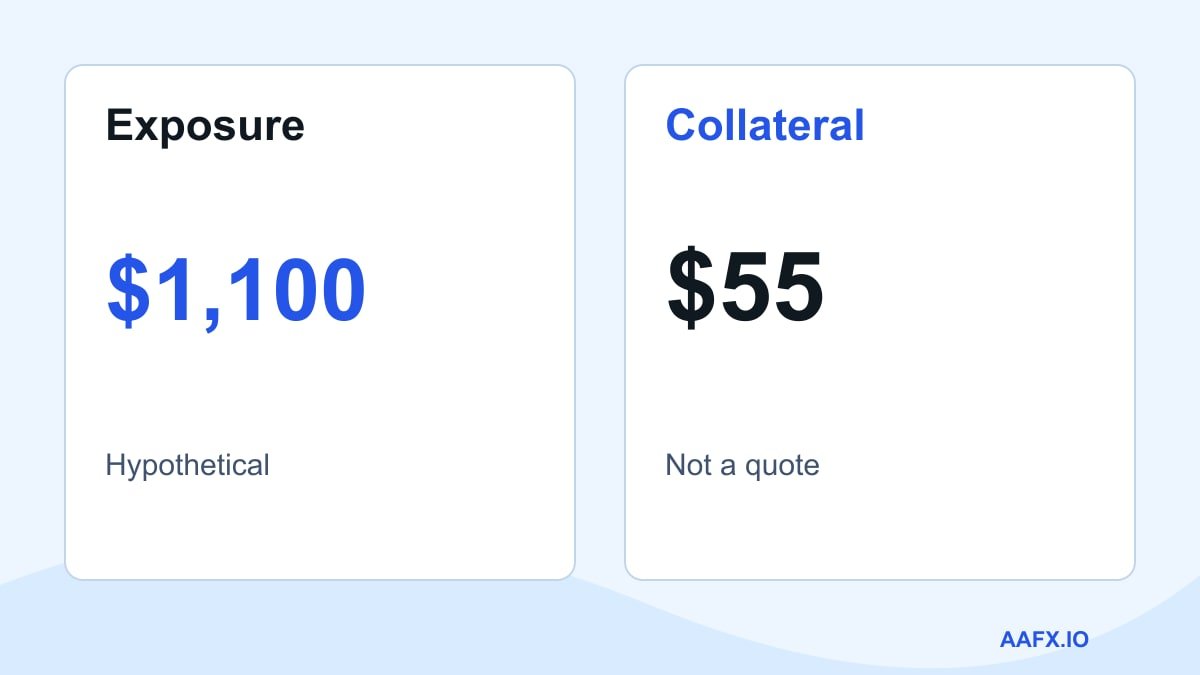
Now assume purely for illustration that the account required $55 collateral for the $1,100 entry exposure. A $5 gross loss equals about 9.1% of that collateral, and a $10 gross loss equals about 18.2%. This assumption is not an available leverage offer or a regulatory limit. It shows why collateral and notional answer different questions.
Read margin-call and close-out rules separately from the planned stop. The provider may close positions under its agreement when requirements are not met. Negative-balance protection, where applicable, does not guarantee an order price or prevent an account loss. The leverage guide and position-sizing guide develop exposure sensitivity.
| Entry and exit | Gross result | After $2 assumed charges |
|---|---|---|
| 1.1000 to 1.1050 | $5 gain | $3 gain |
| 1.1000 to 1.0950 | $5 loss | $7 loss |
| 1.1000 to 1.0900 | $10 loss | $12 loss |
Charges also change the comparison between favourable and adverse moves. In the hypothetical table, an equal $5 gross move leaves a $3 gain in one direction and a $7 loss in the other after the same assumed $2 charge. This is arithmetic, not a statement about expected performance. A record that excludes charges would overstate both outcomes.
Learn the platform and review the first order deliberately
A demo account can help you locate quantity, order type, price conditions and account information. Record questions when a control is unclear. Practice results do not guarantee live results, and a demonstration does not establish actual execution quality. Compare what you learn with the live product and account terms before considering a real instruction.
Review the pair, buy or sell direction, quantity, account, order type, time in force and session eligibility. A displayed quote is not a guarantee of execution at that price. Understand whether an order is accepted, active, partly filled, fully filled, cancelled or rejected. Those are different states, not interchangeable confirmations of a completed trade.
A stop-loss is a trigger, not a guaranteed fill. The SEC stop-order bulletin explains the order distinction in a securities context; check the actual forex provider implementation. A stop-limit order can impose a price boundary while leaving a position open if the limit cannot be met.
After execution, check the actual quantity, fill, charges and remaining orders. Record the next financing or review point and the conditions that would change the thesis. A platform login and an approved application are operational access, while deciding whether to hold currency exposure remains a separate risk decision.
Reconcile the trade record with the account display. An open position can create unrealised gains or losses, and pending charges or orders can affect the figures shown. Establish what balance, equity, free margin and buying power mean on the actual platform. Do not treat a large number in one field as settled cash available for withdrawal without reading its definition.
Who should pause before funding a forex account
Pause if you cannot translate the platform quantity into exposure, explain the contract or understand how a price change affects equity. Also pause if provider identity or payment details remain unresolved. The minimum deposit does not determine a suitable budget, and a small test position is not a substitute for understanding the specification.
Consider the monitoring burden. Currency announcements and changes in expectations can affect prices while you are unavailable. A strategy that requires immediate decisions during work or sleep may not fit your schedule. The trading-styles guide explains why holding period and available attention need to be considered together.
Keep account security separate from market confidence. Use strong unique access credentials and additional authentication where available. Review alerts and recovery arrangements, and never share passwords or one-time codes with an unsolicited contact. A secure login does not make a currency view correct or resolve a problem with the provider agreement.
A useful onboarding outcome can be a decision to wait. List the missing information, the official source that could resolve it and the implication for the account choice. You do not need access to every pair or the highest available leverage to understand foreign exchange. Broader access does not itself improve the quality of a decision.
Write down one condition that would make you decide against participation. For example, the contract unit might create more exposure than the planned budget can reasonably support, even at the minimum dealing quantity. That is a reason to reconsider the product rather than force the order to fit by ignoring the adverse scenario or assuming a guaranteed stop execution.
AAFX.IO: verify access, then assess the currency exposure
A forex account is more than an application and a deposit. The essential checks connect the provider, product, unit size, costs, margin and order behaviour. Use the hypothetical arithmetic to test understanding, then replace its assumptions with verified contract terms. None of the examples establishes a suitable trade size or a prediction for EUR/USD.
Return to the AAFX.IO broker-selection pillar and the linked guides on currency mechanics and risk. Educational videos are available on TikTok and Instagram. Review the explanation annually and whenever material provider or regulatory guidance changes.
Affiliate disclosure: Commercial links may generate compensation for AAFX.IO. This guide does not certify a provider, promise approval or guarantee a trading result.
Educational disclaimer: General information only, not individual investment or legal advice. Check the current product and account terms relevant to your circumstances.
Written and reviewed by Arslan Ali Butt
MPhil Behavioural Finance, MBA Finance, 10+ years in forex dealing and analysis.
Last reviewed: 29 October 2026.
How we reviewed this guide: We used CFTC OTC forex guidance, FCA clone-firm guidance and the SEC order explanation checked during 28-29 October 2026. No universal leverage limit, document list or funding deadline is assumed. Prices, charges and collateral in the examples are hypothetical. No provider-account test is claimed.
Frequently Asked Questions
Do I need a different account for every currency pair?
That depends on the provider and account arrangement. One account may offer several pairs, but availability does not establish identical spreads, unit sizes, margin requirements or dealing conditions. Check the specification for each instrument you intend to research. A familiar quote convention does not remove the need to understand the contract, account currency and possible loss before submitting an order.
Is the minimum deposit an appropriate trading budget?
No. A provider minimum is an account-access condition rather than a suitable allocation for your circumstances. It does not describe the exposure created by a trade or the loss from an adverse move. Separate essential spending and financial commitments from any participation decision. You can decline to fund an approved account when the product, costs or risks remain unclear.
What is a lot in a forex platform?
A lot is a dealing unit defined by the product and provider. Do not infer its size from a label such as standard, mini or micro without checking the specification. Translate the selected quantity into actual base-currency exposure and the value of a price movement. The hypothetical examples in this guide state currency units directly rather than assuming one universal platform convention.
How is a pip value calculated?
First establish the pair convention and the price increment called a pip for that instrument. For a hypothetical EUR/USD position of EUR1,000, a 0.0001 dollar change per euro creates a $0.10 gross change. Other pairs, sizes and account currencies require their own calculation. Check the specification and conversion method rather than copying a pip value from a different trade.
Does available leverage mean I should use it all?
No. Available leverage describes account terms, while your actual exposure depends on the positions chosen. A small collateral requirement can support a much larger currency position. Calculate an adverse price change and its effect on equity before considering an order. Provider limits, margin close-out and other protections vary; none makes the largest available position automatically appropriate for an individual account.
Can I leave a forex position open indefinitely?
Read the specific product terms rather than assuming that continuous exposure has no deadline or cost. Financing, rollover adjustments, maintenance, contract changes or provider closure rules may matter. A position can also be closed when collateral requirements are not met. Establish the holding-period costs and relevant conditions before entry, and review them when the provider changes its terms or product specification.
Will a demo result match a live account result?
No guarantee exists that it will. A demo can help you learn the interface and order controls, but live execution, available liquidity, charges and the experience of exposing real money may differ. Use the demonstration to identify operational questions, then verify the live terms separately. A profitable practice sequence does not establish that a strategy will produce the same outcome later.
Is a stop-loss a guaranteed limit on loss?
No. A standard stop order is a trigger for a market order, so its fill can differ from the stop price. Gaps or limited liquidity may increase the difference. A stop-limit order can remain unfilled. Read the actual provider rules and model an execution beyond the planned exit. Account-level protections, where applicable, are separate from a guaranteed order price.
Should I choose an account only by its spread?
No. Compare the spread with commission, financing, currency conversion and any relevant account or withdrawal charges. Their importance changes with pair, position size and holding period. Also verify the legal entity, product, execution arrangements and complaint terms. A narrow minimum advertised spread does not establish the lowest total cost, provider suitability or the conditions available when your order actually executes.
What should I check before the first forex order?
Review the exact instrument, buy or sell direction, base-currency quantity, account currency, order type, price conditions and session eligibility. Calculate exposure, estimated charges and an adverse execution scenario. Then check margin and close-out terms. If anything is unclear, pause and use authenticated support or educational materials rather than entering a small live position simply to discover how the contract behaves.
Sources & Methodology
Primary-source standard: Market-moving facts should link to original data releases, regulator notices, company filings or official project announcements whenever available. Secondary reporting is used for additional context, not as a substitute for original evidence.
Page last reviewed: