
Physical vs online brokers is a comparison of access channels, while service scope, costs and account rights require separate checks. A firm can offer both a branch and an app, with different arrangements behind each service.
This guide focuses on the channel decision within our trading education hub. It complements the local-office and broker-selection guides without ranking named providers.
Risk warning: Trading and investing can lose money through any channel. Leveraged products can cause substantial losses and may create liabilities beyond your deposit where applicable protections do not apply. Ordinary stops are triggers, not guaranteed fills.
Affiliate disclosure: AAFX.IO may earn commission through qualifying site links. This does not determine editorial conclusions. No new provider offer is added to this article.
What is the difference between physical and online brokers?
Physical and online describe ways to access a broker, not a complete description of the service. A branch-based firm may offer online dealing, while an online provider may offer human advice. Compare the legal entity, product, advice agreement, execution process and total costs separately. An office or an app does not establish account protection.
Is an online broker better than a broker with an office?
Neither channel is automatically better. Online dealing may suit independent order entry, while an office can be useful for planned meetings or practical support. The deciding questions are whether the verified provider offers the required service, what it costs and how problems are handled. A convenient channel cannot compensate for unclear permissions or unsuitable contract terms.
Physical vs online brokers: overview
- Physical vs online brokers: separate the channel from the service
- Identify who makes the decision and who provides the support
- Verify the company even when the office looks convincing
- Compare the complete service cost with a worked example
- Test the order workflow and the backup route
- Money, records and account rights sit behind the channel
- Match the service to the help you actually need
- When to postpone the decision
- AAFX.IO: compare the agreement behind the office or app
- Frequently asked questions
Physical vs online brokers: separate the channel from the service
A physical broker is often understood as a provider you can visit, while an online broker is accessed through a website or app. Those descriptions are convenient but incomplete. The same company may offer a branch, telephone support and online order entry. A remote meeting can also involve a human professional without any visit to an office.
Place the channel on one line of your comparison and the service on another. Execution-only means the customer directs the relevant investment decision under that arrangement. An advised or managed service creates a different relationship governed by its own agreement and applicable rules. Do not infer either arrangement solely from how the customer logs in or communicates.
The SEC’s Investor.gov broker explanation describes US securities brokerage services and questions about products, fees and conflicts. It provides context, not a universal legal definition for every forex or CFD account. Our broker-role guide explains why the product and agreement matter alongside the provider label.
Start by describing what you need the relationship to do. Do you want to enter your own orders, discuss a financial plan, obtain regulated advice or resolve administrative questions? A provider that is excellent for one task may not offer another. More contact routes do not necessarily create a broader advice obligation.
This guide compares access and service delivery. It does not rank named firms, claim first-hand branch visits or conclude that a particular account is suitable. Keep the office question distinct from whether the legal company is authorised to provide the proposed activity to you.
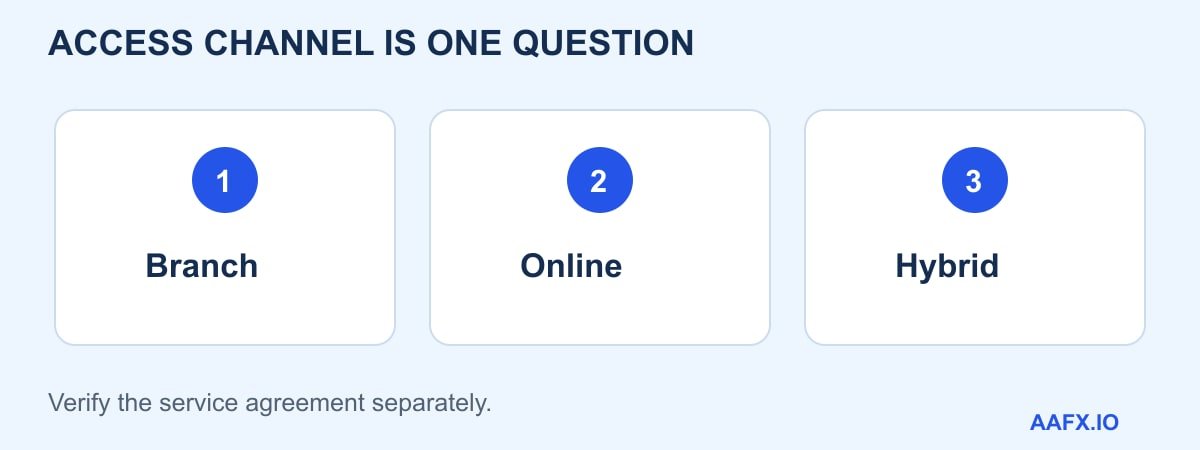
| Access channel | Possible service arrangement | What to verify |
|---|---|---|
| Branch or office | Assisted dealing or a separate advice service | Meeting purpose, agreement and charges |
| Website or app | Self-directed dealing or an advised offering | Product rights and service scope |
| Hybrid access | Several routes to one account, if supported | Entity, balances, records and channel terms |
Identify who makes the decision and who provides the support
Ask what happens when you discuss a proposed investment with staff. Are they explaining platform functions, describing public research or making a personal recommendation under an agreed service? Those activities should not be treated as interchangeable. Request the document describing the relationship and how the provider is paid for it.
A relationship manager can be useful for documents, account questions or contact coordination. The role does not by itself establish that your portfolio will be monitored or that someone will warn you before a loss. Confirm any promised ongoing review in the agreement, including the accounts covered, frequency, limits and cost.
Likewise, an online research library is not automatically individual advice. It may be general information available to many customers. Evaluate its dates, product coverage and limitations. If you need help assessing your wider finances, establish whether the relevant professional service is actually available rather than expecting an order-entry platform to supply it implicitly.
Our forex broker-selection checklist covers the wider account decision. Add a service-scope column to it and record unanswered questions. The goal is to connect the assistance you expect with the assistance the provider has agreed to deliver, rather than judging the relationship from a friendly introductory meeting.
Keep responsibility for order handling clear. If instructions are taken over the phone, ask how they are confirmed and recorded. If you enter them yourself, learn how to verify acceptance, execution, rejection or cancellation. A reassuring conversation is not the same as evidence that a specific order was placed correctly.
Verify the company even when the office looks convincing
Write down the legal company named in the proposed agreement and identify its role. A local office might belong to the account provider, a separate group company or an introducing business. Ask which company will hold the relationship and accept your funds. A common brand does not establish that all of those functions belong to the same entity.
The FCA clone-firm warning explains why authentic details can be copied by an impersonator. For UK checks, use the official route and verified contacts rather than relying on a number or address supplied by the person approaching you. Other jurisdictions have their own registers and requirements. Check the relevant permission as well as the company’s existence.
A meeting can make a business feel familiar without resolving these questions. An attractive office, professional stationery or a video call can support communication, but none independently authenticates every service or payment instruction. Avoid letting the convenience of a visit replace the evidence needed to connect the proposed account with the genuine provider.
Use our licence-check workflow for the identity record and the local-office guide for the distinction between presence and permission. This comparison does not establish whether a particular firm must maintain an office in your country; that requires the relevant local rules and service details.
If the office presentation, website domain, contract or payment recipient conflict, pause. Resolve the mismatch through an independently verified route before sending funds or identity documents. A small test payment is not a reliable way to investigate an unauthenticated relationship, because completing one transaction does not validate the entire arrangement.
Compare the complete service cost with a worked example
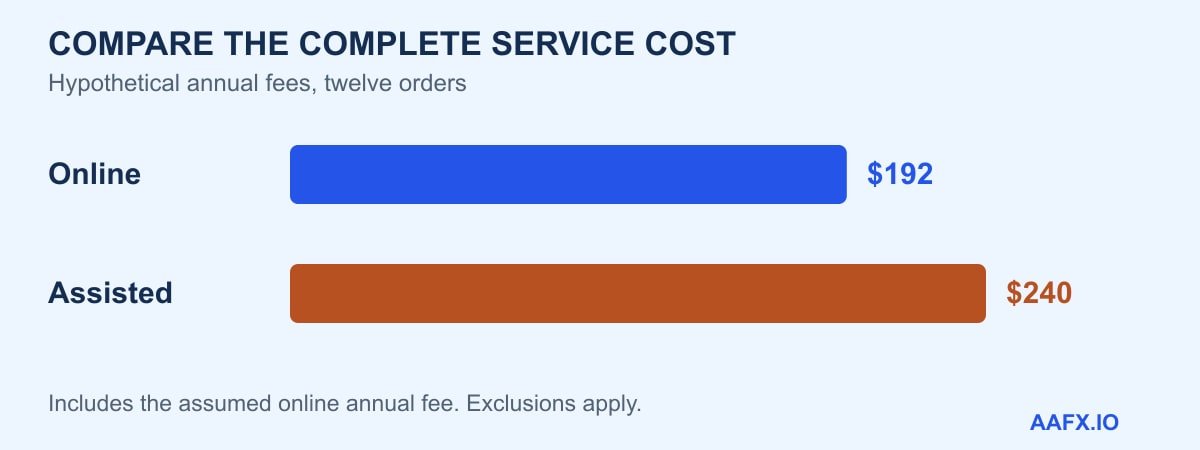
Use the same expected activity to compare channels. Imagine an entirely hypothetical year with 12 identical orders. An online route charges $6 per order and an annual service fee of $120. Its illustrated total is 12 multiplied by $6, plus $120, or $192. This example ignores trading gains, losses, financing, conversion, tax and other excluded charges.
Now assume an assisted route charges $20 per order with no annual service fee in the example. Its total is 12 multiplied by $20, or $240. The difference is $48 for the year, not the $168 suggested by comparing only the per-order commissions. Neither schedule is a real provider quote or a claim about typical branch and online prices.
The calculation changes with activity. At two assumed orders, the first route costs $132 and the second $40 under these invented terms. At 24 orders, the totals are $264 and $480. The cheaper route therefore depends on the scenario, and a fixed service charge can matter more when transactions are infrequent.
Cost equivalence also requires service equivalence. If one route includes an agreed professional service and the other only accepts instructions, the prices describe different purchases. Identify what the additional service provides, whether it is needed and whether a separate charge applies. Do not assume that paying more proves the quality or suitability of the advice.
Check actual minimum charges, subscriptions, assisted-order fees and product-specific costs. Our broker-fee guide provides the categories. Lower transaction costs do not establish a safer company, better execution or a profitable strategy. Keep the financial comparison separate from those judgments.
| Hypothetical orders per year | Online: $6/order + $120/year | Assisted: $20/order |
|---|---|---|
| 2 | $132 | $40 |
| 12 | $192 | $240 |
| 24 | $264 | $480 |
Test the order workflow and the backup route
An online interface can make order entry fast, but speed alone does not establish correct execution. Identify the instrument, volume unit, order type, session and expiry before submitting an instruction. Learn where the platform distinguishes an accepted order from an executed trade. An order that remains pending is not evidence that the desired position exists.
The order-type guide explains trigger, price and fill distinctions. The SEC stop-order bulletin describes why a securities stop is not a guaranteed execution price. Check the particular contract and execution policy for forex or CFDs rather than assuming that terminology creates identical obligations across products.
For assisted dealing, ask how instructions must be authenticated, how the order is repeated back and what confirmation will be provided. Check whether a telephone instruction has different charges or product restrictions. A human intermediary can help explain a workflow, but their presence does not remove market gaps, liquidity limits or the possibility of a misunderstanding.
Write down the contingency procedure for a platform or connectivity failure. Establish support hours, the official backup number and any limits on alternative dealing routes. Test navigation and account-history access in a suitable demonstration environment where available. Do not deliberately send a live order merely to test a support route or assume that every outage has a guaranteed workaround.
Assess whether the process matches when you can realistically supervise the account. A branch open during local business hours may be convenient for documents but irrelevant to an overnight market event. Conversely, a continuously accessible app does not mean that every underlying market or human support function is continuously available.
Money, records and account rights sit behind the channel
Identify what the account actually holds. An actual share account, a CFD agreement and a foreign-exchange product can create different rights even when they appear within a similar app. A branch visit does not transform a derivative into ownership of the underlying asset, and an online interface does not itself determine how assets are held.
The client-funds guide separates custody, contractual claims and protection arrangements. Read the agreement that applies to the chosen entity and account. If a protection scheme is mentioned, check its eligibility and exclusions at the official source. Do not treat a brand logo or an office address as a promise that every loss is covered.
Check the deposit recipient and withdrawal procedure through authenticated channels. Keep a record of the instructions, dates and relevant charges. A late request to send money to another beneficiary deserves independent resolution, even if it appears to come from a staff member you previously met. Familiarity cannot authenticate a changed payment instruction.
Examine statement access and record retention before committing to a service. Can you locate transactions, cash adjustments, contract notes and the agreement version? Can you obtain a clear explanation of an error? An archive that is easy to use can matter more in a dispute than an attractive interface or a nearby office.
Keep your own appropriate copies of material records while protecting sensitive information. Use the genuine secure channel for documents rather than a convenient unsolicited message. Complete these checks before deciding whether to open an account, so the convenience of a communication channel does not displace verification of the recipient.
Match the service to the help you actually need
A self-directed customer who understands the product may value clear order controls, reliable records and transparent pricing more than a scheduled office meeting. Another person may need a professional service that considers a wider financial situation. Those are different needs, so comparing only the convenience of an app with the convenience of a branch misses the main decision.
Write three tasks you expect to perform regularly and two problems you would need help resolving. For each, identify the channel, responsible team, opening hours and expected cost. Use specific tasks such as replacing a document or investigating an execution query rather than vague labels such as premium support or personal attention.
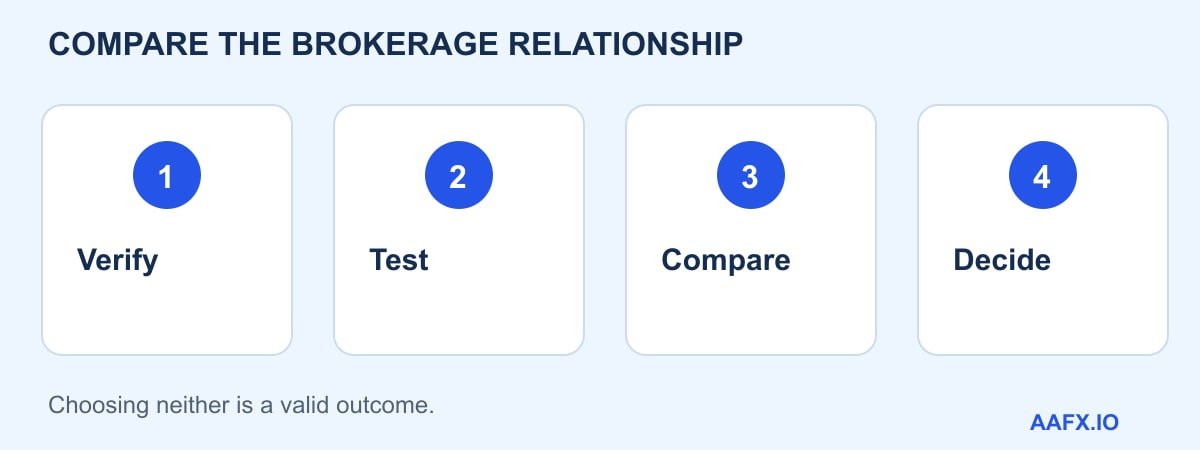
Then identify conditions that would rule out the service. These might include an unverified entity, an unsuitable product, inaccessible records or an order workflow you cannot use reliably. A firm can be genuine and still fail a practical requirement. There is no need to select a winner when every candidate leaves a material question unresolved.
Our account-opening guide develops the next steps after the provider and service are understood. Avoid treating a low minimum deposit or an easy application as a suitability test. If the intended activity uses leverage, review exposure and margin before deciding what account functions you require.
| Need | Evidence to request | Reason to pause |
|---|---|---|
| Personal recommendation | Identified service agreement and responsible professional | Advice scope unclear |
| Independent orders | Demo workflow, order policy and statements | Volume or status misunderstood |
| Help with problems | Official support and escalation procedure | No authenticated route |
| Several channels | Documented account and fee arrangements | Channels link to different unexplained entities |
When to postpone the decision
Pause when the contract does not match the service described in conversation. Also pause if staff discourage independent checks or claim that relevant official contact details should be ignored. A deadline, bonus or promise of exclusive access does not remove the need to authenticate the relationship. Obtain a clear written answer to a material question before proceeding.
Do not use a broker channel to solve a different problem. A trading app cannot turn essential short-term spending money into an appropriate risk budget. An office meeting cannot make an unfamiliar leveraged position understandable without examining its terms. If the product itself is unsuitable, improving customer service does not resolve that mismatch.
Consider your ability to use and monitor the arrangement during stress. A simple interface in a demonstration can still be difficult during a fast market or personal disruption. Human assistance can also be delayed. Use realistic constraints in the comparison rather than assuming uninterrupted access, immediate support or perfect execution.
Revisit the decision when the entity, charges, products or advice relationship change. Maintain the original comparison so you can identify what has changed instead of starting from a vague recollection of the welcome meeting. The channel is part of a continuing service relationship, not a permanent quality label attached to the first experience.
AAFX.IO: compare the agreement behind the office or app
The useful comparison has three layers: who provides the service, what that service includes and how you access it. Verify them independently, then compare equivalent costs and workflows. A branch, a website and a hybrid arrangement can each be useful under the right documented conditions. None alone establishes safety or a favourable investment result.
Continue with the linked broker-selection and account-opening guides. For educational videos, follow @arslaninsights on TikTok and AAFX.IO on Instagram. Keep the provider agreement and official records as the basis for the decision rather than replacing them with a video, salesperson description or comparison badge.
Affiliate disclosure: Verify the actual provider and service independently. A commercial relationship is not evidence of authorisation, suitability or account protection.
Educational information, not personalised investment, legal or tax advice. Cost examples are hypothetical, not current fee quotes or evidence of tested service quality.
Written and reviewed by Arslan Ali Butt, MPhil Behavioural Finance, MBA Finance, with more than 10 years in forex dealing and market analysis. Last reviewed: 7 November 2026.
How we reviewed this guide: Checked the linked SEC Investor.gov broker and order guidance and FCA clone-firm guidance on 7 November 2026. Jurisdiction-specific material is identified in context. The fee comparisons are original hypothetical calculations; no branch visit, provider account test or investment result is claimed. Intended for annual review, with earlier changes after material service or rule developments.
Frequently Asked Questions
Does a physical office prove that a broker is authorised?
No. An address or meeting room is evidence of a location, not confirmation of the permissions needed for a particular financial service. Match the contracting entity and relevant official record independently. Check the domain and contact details as well. A company name displayed on an office door does not establish the protection applying to your account or the identity of every representative.
Do online brokers only provide execution services?
No. Some online services focus on customer-directed orders, while others offer different advisory or managed arrangements. Read the actual agreement instead of inferring the service from its delivery channel. Human support, research material and an adviser relationship are different things. Establish which service you are buying, what responsibilities it creates and how the provider charges for that arrangement.
Is a relationship manager the same as an investment adviser?
Not necessarily. A relationship manager may help with administration, account access or service questions without agreeing to provide personalised investment advice. Ask what the role includes and whether any recommendation is provided under an identified advisory arrangement. Keep the answer and applicable agreement. A job title or a friendly conversation does not define the full scope of the professional relationship.
Are branch-assisted trades always more expensive?
No universal price rule applies. A provider may price channels differently, bundle services or use minimum charges. Compare the current schedule for the exact product, order size and account. Include subscriptions, financing and other relevant costs. A hypothetical assisted-order fee can illustrate arithmetic, but it cannot establish that every branch service costs more or that a cheaper channel provides equivalent support.
Can I use a branch broker and still trade online?
Possibly, if the provider and account offer both channels. Confirm whether they access the same legal account, products, balances and order history. Ask whether channel-specific charges or restrictions apply and what happens when one route is unavailable. A hybrid service should be evaluated from its documented arrangements rather than assumed merely because the firm has both an office and a website.
Does phone support guarantee I can close a trade during an outage?
No. Check the published contingency procedure, operating hours, authentication requirements, product eligibility and any assisted-order charge. The backup route may have limitations, and an outage can coincide with a fast market. Do not assume that a support number guarantees execution at a chosen time or price. Plan exposure with the possibility that your preferred communication route will be unavailable.
Should I meet a broker before opening an account?
A meeting may help clarify a complex service or practical question, but it does not replace independent identity and permission checks. Use verified contact routes and keep written records of material terms. An account can also be assessed remotely if reliable evidence is available. The objective is a clear, authenticated agreement, rather than completing a meeting as a substitute for due diligence.
Can an office in my country belong to a different group company?
Yes, a brand can use several legal companies for sales, administration or account provision. Identify the company named in your own agreement and establish what the local office actually does. Do not transfer a licence or protection from one entity to another because they share a logo. Resolve any mismatch between the office presentation, payment recipient and contracting company before funding.
Are online brokers suitable for beginners?
That depends on the product, service and person rather than the presence of an app. A beginner still needs to understand the contract, order process, costs and potential losses. A demonstration can help with navigation but does not prove suitability or future results. If independent order entry is confusing, seek clarification rather than assuming that an easy sign-up process makes the investment appropriate.
How often should I review my choice of broker channel?
Review it when the account entity, service agreement, charges, product needs or support arrangements change. Also reassess whether the channel still matches the time and assistance you actually need. Preserve dated records and compare the current terms with the original decision. This guide is intended for annual editorial review, while material changes to an existing account warrant attention when they occur.
Sources & Methodology
Primary-source standard: Market-moving facts should link to original data releases, regulator notices, company filings or official project announcements whenever available. Secondary reporting is used for additional context, not as a substitute for original evidence.
Page last reviewed: