The real difference between regulated vs unregulated brokers is what happens to your money when something goes wrong: a regulated retail account usually comes with segregated client money, capped leverage, negative balance protection, a complaints route and sometimes a compensation scheme, while an unregulated provider offers none of these by law. Neither type stops you losing money on a bad trade.
This guide compares those protections one by one and shows, with worked numbers, where each one changes the outcome. It sits under our forex broker reviews hub. If you want the step-by-step register lookup instead, read our guide on how to check a broker’s licence.
Risk warning: Leveraged forex and CFD trading carries a high risk of losing money quickly, at any broker. Regulation does not protect you from market losses, and an ordinary stop order can fill beyond its price. All account figures in this guide are hypothetical.
AAFX.IO may earn a commission through links on this page. This does not change our ratings or the brokers we review.
Is it safe to trade with an unregulated broker?
It is much riskier. Without a licence for the service, nobody independent checks how the firm holds client money, how it prices trades or whether it can pay withdrawals. You also lose access to an ombudsman and any compensation scheme. Some unregulated firms operate honestly, but if one fails or refuses a withdrawal, your options are usually limited to private legal action abroad.
Does a regulated broker guarantee my money is safe?
No. Regulation means the firm must follow rules on client money, leverage, conduct and complaints, and a regulator can act if it breaks them. You can still lose your whole deposit on trades. If a regulated firm fails, segregation and any compensation scheme help, but a scheme only covers eligible claims up to a limit, such as £85,000 in the UK.
Regulated vs unregulated brokers: overview
- What regulation actually covers
- Six protections compared side by side
- Client money and what happens if a broker fails
- Compensation schemes and their limits
- Leverage caps, margin close-out and negative balances
- Complaints and dispute resolution
- Professional client status: protections you give up
- Why traders end up with unregulated brokers
- Comparing two regulated brokers after the checks
- AAFX.IO: price the protection before the spread
- Frequently Asked Questions
What regulation actually covers
A regulator grants permission for specific activities, such as dealing in derivatives with retail clients. A firm can hold permission for one activity and not another, so a licence for money transfers says nothing about leveraged EUR/USD contracts. What matters is whether the legal entity named in your client agreement holds permission for the product you will trade, in the country where you live.
One brand can open accounts through several companies. Two people applying on the same website can be given different agreements depending on their country, one with a UK or EU entity and one with an offshore sister company. The protections in this guide follow the entity in your agreement, not the logo on the home page. Our offshore brokers guide explains this cross-border split.
An unregulated provider has no permission from a relevant authority for the service it offers you. That can be a firm with no licence anywhere, a company holding a licence for a different activity, or an impersonator copying a real firm’s details. The UK regulator’s guidance on clone firms shows how that last trick works. For a map of who supervises what, see our guide to forex, crypto and stock regulators.
Six protections compared side by side
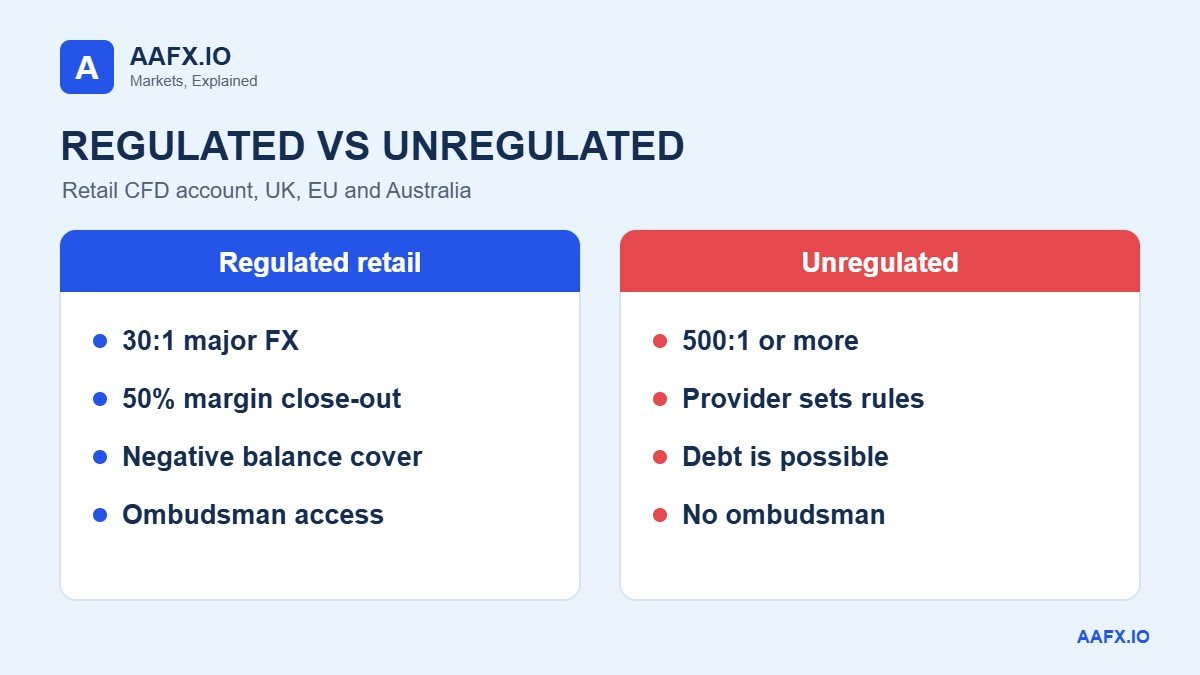
The table sets out what a retail client typically gets in three major regimes against what an unregulated provider must offer. Rules differ by country and change over time, so treat it as a checklist for your own agreement rather than a guarantee.
| Protection | UK (FCA) and EU (for example CySEC) retail | Australia (ASIC) retail | Unregulated provider |
|---|---|---|---|
| Client money held separately | Required | Required | No legal requirement |
| Leverage cap on major FX pairs | 30:1 | 30:1 | Often 500:1 or more |
| Margin close-out rule | At 50% of required margin | Standardised close-out | Set by the provider |
| Negative balance protection | Required for retail CFDs | Required for retail CFDs | Only if promised in the contract |
| Independent complaints body | Financial Ombudsman Service or national scheme | AFCA | None |
| Compensation if the firm fails | FSCS up to £85,000; Cyprus ICF up to €20,000 | No general scheme for CFD losses | None |
Figures checked on 19 November 2026. ASIC’s CFD order currently runs to 23 May 2027, and ASIC opened a consultation in October 2026 on extending and amending the order. US retail forex follows different rules, covered in the leverage section below.
Client money and what happens if a broker fails
Where client money rules apply, the broker must hold customer funds apart from its own operating money, usually in designated bank accounts. The balance on your trading screen is the firm’s record of what it owes you. Segregation is what should stand behind that record if the firm collapses, because client money is kept out of the pot used to pay the firm’s own creditors.
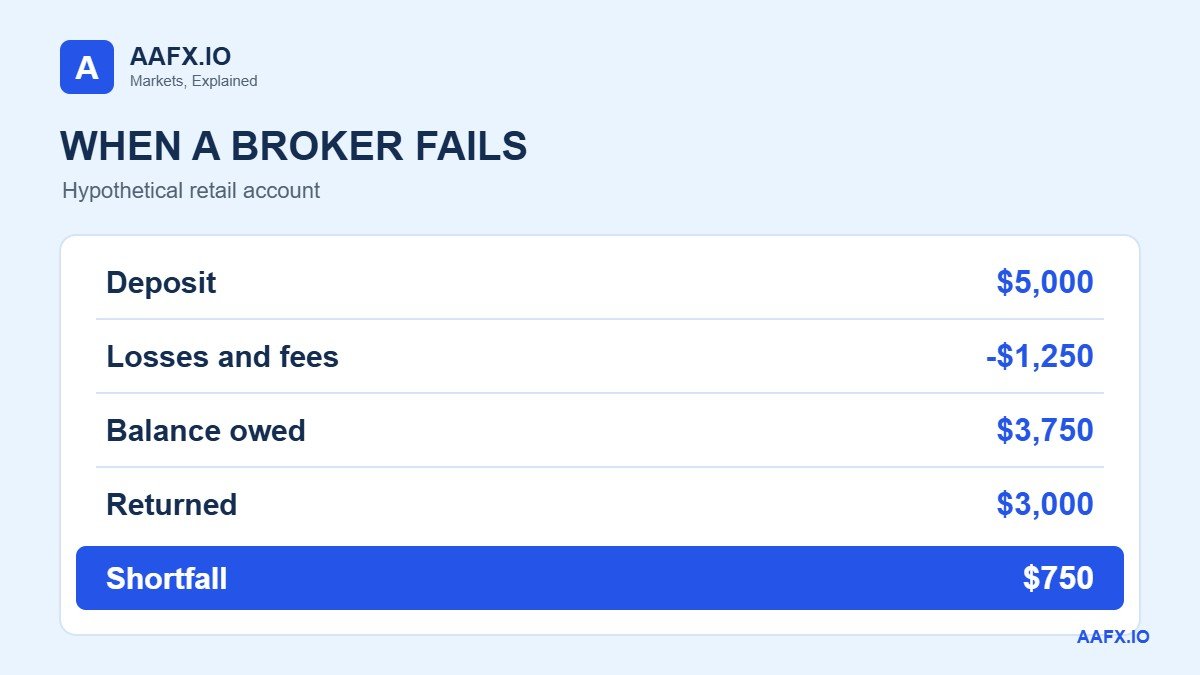
Here is how the different losses separate in a hypothetical failure. An account starts with $5,000. Closed trading losses take $1,200 and disclosed fees take $50, leaving a balance of $3,750. The broker then fails, and the administrator eventually returns $3,000 from the client money pool. The extra $750 shortfall has a different cause from the trading loss and the fees.
| Hypothetical account line | Amount | Can a scheme help? |
|---|---|---|
| Opening deposit | $5,000 | Not applicable |
| Closed trading losses | -$1,200 | No, market losses are never covered |
| Disclosed fees | -$50 | No |
| Balance owed by the broker | $3,750 | Not applicable |
| Returned from client money | $3,000 | Not applicable |
| Shortfall after the failure | $750 | Possibly, if the claim is eligible |
With an unregulated provider there may be no segregated pool at all, so the whole $3,750 can sit among the firm’s general creditors. Segregation also does not guarantee a quick or full return; it reduces the risk of a shortfall.
Compensation schemes and their limits
A compensation scheme pays eligible clients when an authorised firm cannot return their money. It never pays for poor trades. The FSCS investment guidance explains when the UK scheme can consider a claim, and the cover limit belongs to the entity and the activity, not the brand.
Two details catch traders out. First, the UK deposit limit rose to £120,000 on 1 December 2025, but that applies to bank deposits; investment firms, including CFD brokers, stay at £85,000 per person per firm. Second, the Cyprus Investor Compensation Fund pays the lower of €20,000 or 90% of an eligible claim, so a €10,000 claim would receive at most €9,000.
In the US, the main securities scheme, SIPC, does not cover retail forex contracts. US retail forex clients rely on the dealer’s capital and segregation rules rather than a compensation fund. Some brokers add private insurance on top of a statutory scheme; read its terms, because it usually covers only insolvency and has its own caps.
Leverage caps, margin close-out and negative balances
Three rules work together. A leverage cap limits how big a position you can open for a given margin. A margin close-out rule makes the broker start closing positions as equity falls, in the UK and EU when it drops to 50% of the margin required. Negative balance protection stops a retail CFD account from owing more than was deposited. The FCA set out all three in its permanent CFD restrictions.
The US works differently. The CFTC requires a security deposit of at least 2% on major currency pairs and 5% on others, which caps leverage at 50:1 and 20:1, but US rules do not require negative balance protection, so a gap can leave a debt. The CFTC’s retail forex advisory explains the dealer’s role as your counterparty.
A worked example shows what high leverage does and does not change. Two dollar accounts each open $15,000 of EUR/USD exposure. One posts $500 of margin (30:1); an unregulated account posts $30 (500:1). A 1% move against both costs $150 in each. The difference is that $150 is 30% of the first margin and five times the second, so the high-leverage account is closed out, or pushed into a negative balance, far sooner.
A stop-loss is a trigger, not a guaranteed fill. The SEC investor bulletin on stop orders explains why a stop can execute well away from its price, which is exactly when negative balance protection matters. Our leverage and margin guide covers the arithmetic in more detail.
Complaints and dispute resolution
At a regulated broker, a complaint goes to the firm first. If it does not resolve the issue within the set time, an eligible client can usually take it to a free, independent body. In the UK, the Financial Ombudsman Service explains the process, and its decisions can bind the firm. Australia uses AFCA, and EU countries have their own schemes.
An unregulated provider has no such route. A dispute over a refused withdrawal or a disputed trade price usually means suing the company in its home country, often at a cost larger than the balance. A website promising “international arbitration” without naming the forum or the rules leaves that question open.
Build the record either way. Save the agreement, statements, order confirmations and every support reply, and note amounts in their original currency. If a $800 withdrawal arrives as $770, a fee schedule showing $10 still leaves $20 to explain, and that narrow figure makes a far stronger complaint than “money is missing”.
Professional client status: protections you give up
Brokers sometimes invite experienced traders to become professional clients, usually to unlock higher leverage. Under UK and EU rules, professional status removes the retail leverage caps and can remove negative balance protection and access to the ombudsman. The FCA has warned retail CFD traders about losing protections this way, and through moves to overseas providers.
Ask for the eligibility criteria and a written list of protections under each status before agreeing. Never let a salesperson fill in the questionnaire or overstate your experience. If the switch also moves you to a different legal entity, treat it as opening a new account with a new broker.
Why traders end up with unregulated brokers
Most people do not set out to choose an unregulated firm. They follow an advert promising 500:1 leverage or a deposit bonus, get passed from a regulated entity to an offshore one during sign-up, or are contacted by an “account manager” on social media. High leverage and bonuses are exactly the features retail rules restrict, so their presence is a reason to check the entity.
Walk away if you are asked to pay into a personal account or a crypto wallet sent in chat, or to pay a “tax” or “release fee” before a withdrawal. Sending more money never proves a displayed balance exists. Our forex broker red flags guide lists the warning signs, and identity checks are explained in our KYC and AML guide.
If you already have money with a provider you cannot verify, stop new deposits, request a withdrawal in writing, contact your bank or card provider through its official channel and report the firm to your regulator. Be wary of “recovery services” that ask for an upfront fee.
Comparing two regulated brokers after the checks
Once two firms pass the entity and permission checks, compare costs on the same terms. On a 10,000-euro EUR/USD round trip, one pip is $1. Broker A quotes 1.4 pips with no commission, costing $1.40. Broker B quotes 0.4 pips plus $1 commission, also $1.40. If B’s spread widens to 1 pip at your trading time, its cost rises to $2.00.
Add withdrawal fees and overnight financing to the comparison, and read the execution policy to see how orders are filled when markets gap. Our guides to choosing a forex broker and CFD trading costs walk through the full comparison.
AAFX.IO: price the protection before the spread
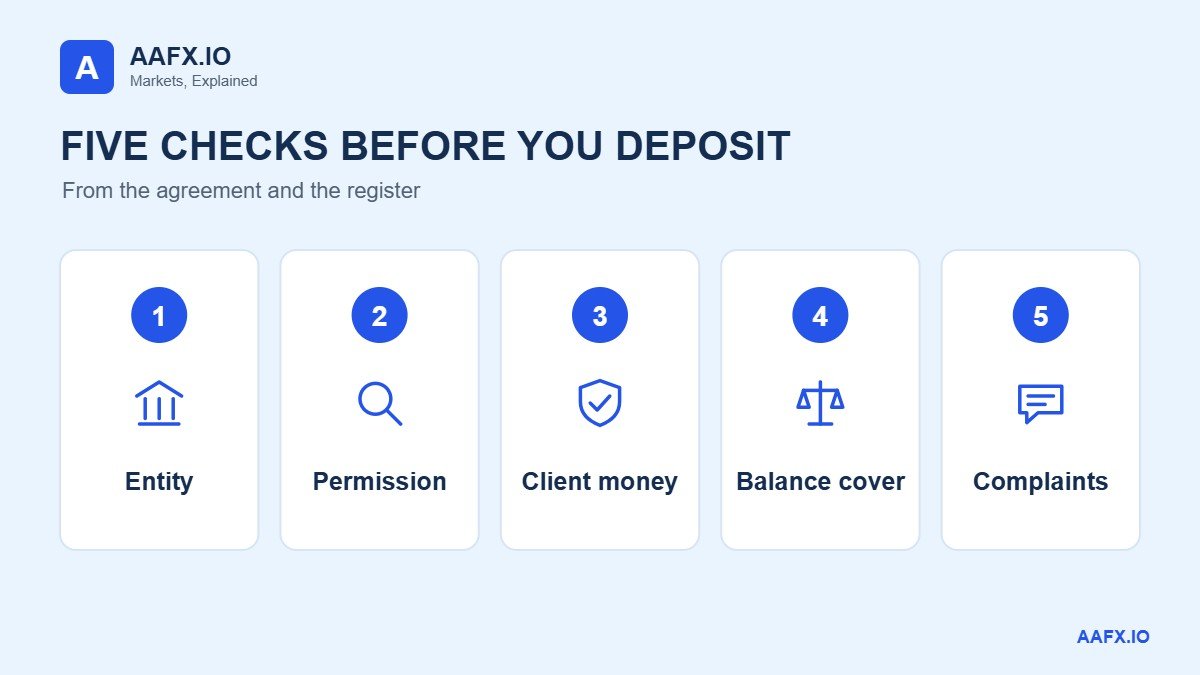
A tight spread is worth little if the firm holding your money has no duty to segregate it, cap your leverage or answer to an ombudsman. Check the entity in your agreement, confirm its permission on the regulator’s register and list which of the six protections apply to you. Only then compare spreads, commissions and platforms.
Next, read our forex broker reviews, the broker licence checking guide and the offshore brokers guide. For short broker safety explainers, follow @arslaninsights on TikTok and AAFX.IO on Instagram.
Affiliate disclosure: AAFX.IO may earn a commission if you open an account through some links on our site. Commercial relationships do not affect our scores, rankings or analysis. Always verify a provider independently before depositing.
Educational information only, not personalised investment or legal advice. Leveraged forex and CFD trading carries a high risk of loss. Account examples are hypothetical, and protection rules vary by country and client category.
Written and reviewed by Arslan Ali Butt, MPhil Behavioural Finance, MBA Finance, with more than 10 years in forex dealing and market analysis. Last reviewed: 19 November 2026.
How we reviewed this guide: Leverage caps, close-out rules, negative balance protection and compensation limits were checked against FCA, FSCS, CFTC and ASIC sources and the Cyprus ICF terms on 19 November 2026. All account figures are hypothetical, with the arithmetic shown.
Frequently Asked Questions
How can I tell if a forex broker is regulated?
Find the full legal name and licence number in the client agreement, not the home page. Then search that name on the regulator’s own website, opened directly rather than through a link the broker sent. Check that the status is current, the permissions cover derivatives for retail clients and the contact details match. Our licence-checking guide walks through each register.
Are all offshore brokers unregulated?
No. Many offshore companies hold a licence in their home jurisdiction, but the rules there may not include leverage caps, negative balance protection, an ombudsman or a compensation scheme. The question is which protections that licence gives you, and whether the firm may serve clients in your country. A licence alone does not mean the protections in this guide apply.
What happens to my money if a regulated broker goes bust?
An administrator takes control and returns client money from the segregated pool, which can take months. If there is a shortfall, eligible clients may claim from the compensation scheme, up to £85,000 per person per firm in the UK or the lower of €20,000 or 90% of the claim in Cyprus. Open trades are usually closed, and trading losses are never covered.
Can I lose more than my deposit with a regulated broker?
Retail CFD clients in the UK, EU and Australia have negative balance protection, so the account cannot go below zero. Professional clients may not have it. In the US, retail forex rules do not require negative balance protection, so a large gap could leave you owing the dealer. Check the protection clause in your own agreement before trading.
Why do unregulated brokers offer 500:1 leverage?
Because no rule stops them. Regulators cap retail leverage on major pairs at 30:1 in the UK, EU and Australia and 50:1 in the US, because high leverage lets small price moves wipe out accounts. At 500:1, a 0.2% move against you consumes the entire margin. High leverage is a marketing tool, not a sign of a better broker.
Is a small successful withdrawal proof that a broker is safe?
No. It shows one payment worked once. It does not prove which entity holds your money, whether it is segregated or whether a larger request will be honoured. Some fraudulent platforms deliberately pay small withdrawals to build trust before larger deposits. Use a small test withdrawal only after the entity, licence and contact checks are complete, and keep the receipt.
Does broker regulation cover crypto trading?
It depends on the product. Crypto CFDs from a licensed broker fall under derivatives rules: retail leverage is capped at 2:1 in the EU and Australia, and the UK bans crypto derivatives for retail clients altogether. Buying actual coins on an exchange is covered by separate rules, and compensation schemes generally exclude crypto assets. Check the permission for your exact product.
Should I accept a move to professional client status?
Only if you meet the criteria honestly and understand what you give up. Professional status can remove retail leverage caps, negative balance protection and access to the ombudsman. Ask the broker for a written comparison of protections before and after. If the higher leverage is the main attraction, that is usually a reason to stay a retail client.
What should I do if an unregulated broker refuses my withdrawal?
Stop sending money, including any fee requested to release funds. Save every message, statement and payment record. Contact your bank or card provider through its official channel to ask about a chargeback or recall, and report the firm to your national regulator and the police fraud unit. Ignore recovery companies that ask for upfront payment to get funds back.
How often should I recheck a broker I already use?
Recheck whenever the firm sends a new agreement, changes its payment details, offers a new product, transfers your account or asks you to change client category. A yearly look at the register is sensible even without changes. Save the date of each check, because a licence can be restricted or withdrawn after you open your account.
Sources & Methodology
Primary-source standard: Market-moving facts should link to original data releases, regulator notices, company filings or official project announcements whenever available. Secondary reporting is used for additional context, not as a substitute for original evidence.
Page last reviewed: