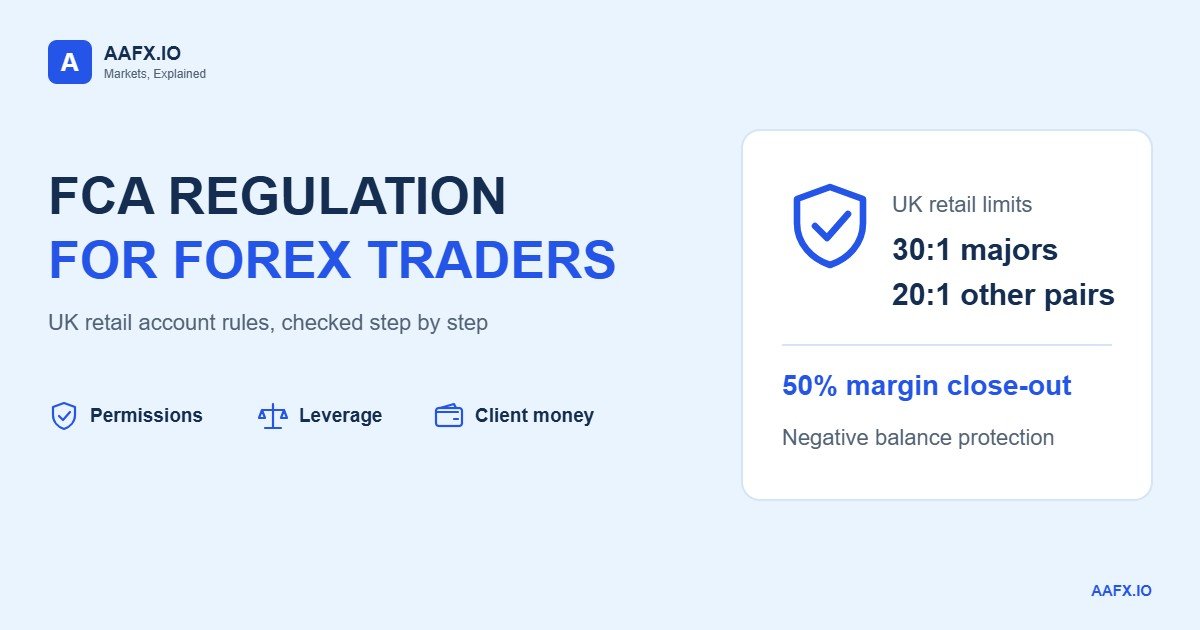
FCA regulation gives UK retail forex traders a way to verify their broker, and it caps leverage and limits losses on covered accounts. Those protections only apply when the company that actually holds your account is authorised by the Financial Conduct Authority, offers that product to you as a retail client and has not moved you onto different terms.
Here is the problem many traders meet. A broker advertises a UK business, but the company named on the agreement you sign is overseas. Which rules apply? This guide answers that question in order: the firm, the product, your client category, then the safeguards. It sits in our AAFX.IO learning hub, and our guide to financial regulators puts the UK framework alongside other regulators.
Risk warning: Leveraged forex trading can consume the entire balance of a retail account. Market gaps can move the execution price beyond a planned exit. The examples in this guide are hypothetical.
AAFX.IO may earn a commission through links on this page. This does not change our ratings or the regulatory checks we explain.
Does FCA authorisation cover every account under a broker’s brand?
No. A trading group can use the same brand for accounts opened with several legal entities. Read the legal name in your agreement and check its permissions on the FCA record. Also confirm that it offers the specific product to retail clients. A UK telephone number or a sterling balance cannot establish those details on its own.
How much leverage can a UK retail forex account offer?
30 to 1 is the regulatory ceiling for major currency pairs, and 20 to 1 applies to other currency pairs under the UK retail CFD rules. A provider can set a lower limit than the rules allow. Check the pair, your account classification and the margin on the deal ticket before comparing the size of two trades.
FCA regulation for forex traders: overview
- Where FCA regulation applies to a forex account
- Match the agreement to the firm’s permissions
- FCA regulation leverage limits and margin
- Calculate the account close-out level
- Separate a trading loss from a client-money shortfall
- Bonuses, risk warnings and other retail rules
- Who should skip a professional or offshore account switch?
- Take the problem to the right organisation
- AAFX.IO checks before funding a UK retail account
- Frequently Asked Questions
Where FCA regulation applies to a forex account
For most retail traders, “forex trading” with a broker means leveraged rolling spot forex or currency contracts for difference (CFDs). A CFD is a contract that pays the difference between the opening and closing price without you owning the currency itself. The FCA treats these leveraged products as restricted speculative investments and applies a specific set of retail rules to them.
Three facts decide whether those rules protect you. First, the firm: the legal entity that holds your money and is your counterparty must be FCA-authorised for that activity. Second, the product: the rules cover the CFDs and rolling spot contracts named in your agreement. Third, your classification: the retail protections apply to retail clients, not to clients classified as professional.
The first fact causes the most confusion. A UK company and its overseas affiliate may share a brand, a website and even a support team. If you were redirected during sign-up, the agreement may name the overseas company. If your paperwork names several firms, read our explainer on what a broker does and ask in writing which firm owes you your balance.
Match the agreement to the firm’s permissions
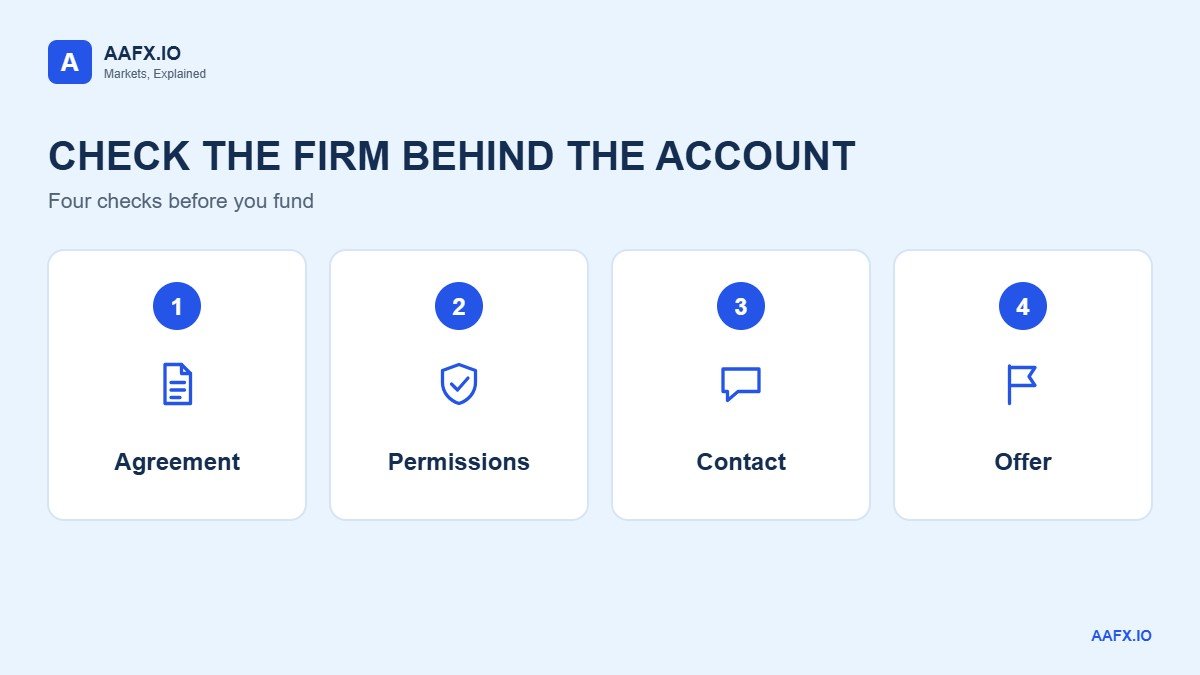
Start with the legal name or firm reference number printed in your account agreement. Enter it into the FCA Firm Checker and read the record carefully. Look at the permitted activities, any restrictions, the client types it may serve and the official contact details. Do this before funding, not after.
| Check | Where to look | What to confirm |
|---|---|---|
| Legal identity | Account agreement | The legal name matches the regulated firm on the register. |
| Permitted activity | FCA record | The firm can offer the service to your client category. |
| Contact details | Official record | The website and contact route belong to that firm. |
| Specific offer | Verified firm contact | The firm issued the agreement and payment instructions. |
Firm-verification checklist. Checked 27 November 2026.
Be aware that a genuine reference number can be copied. Scammers clone the name, number and address of real firms. If an email or website uses a different domain from the one on the register, contact the firm through the details on its official record and ask whether it issued the offer.
Some businesses are appointed representatives, meaning they operate under another authorised firm, called the principal, which takes responsibility for them. In that case, confirm the scope of the arrangement with the named principal. Our step-by-step guide on how to check a broker’s licence walks through the register in more detail, and the regulated versus unregulated brokers guide explains what you give up without authorisation.
FCA regulation leverage limits and margin
Initial margin is the collateral you post to open a position. It is not the size of the position. At 30 to 1 leverage, a £30,000 position needs about £1,000 of margin, but your exposure to the market is still £30,000. Every 1% move is worth £300, not £10.
The FCA’s retail CFD policy statement, PS19/18, defines a major pair as any two of the US dollar, euro, Japanese yen, pound sterling, Canadian dollar and Swiss franc. Major pairs carry a minimum margin of 3.33%, which is 30 to 1. Other currency pairs, along with gold and major stock indices, carry 5%, or 20 to 1. AUD/USD therefore falls in the 20 to 1 group, even though it is widely traded.
| Currency pair | Retail category | Maximum leverage (ratio) | Initial margin on £30,000 (£) |
|---|---|---|---|
| EUR/USD | Major | 30:1 | About 1,000 |
| GBP/CHF | Major | 30:1 | About 1,000 |
| AUD/USD | Other | 20:1 | 1,500 |
FCA retail limits and hypothetical margin amounts. Checked against PS19/18 on 27 November 2026.
These are ceilings, and many providers set lower leverage on some pairs or at certain times, such as over weekends or around elections. A 1% adverse move on £30,000 of exposure costs about £300 before charges and currency conversion, whatever margin you posted. Our guide to trading with leverage explains how collateral relates to exposure.
Calculate the account close-out level
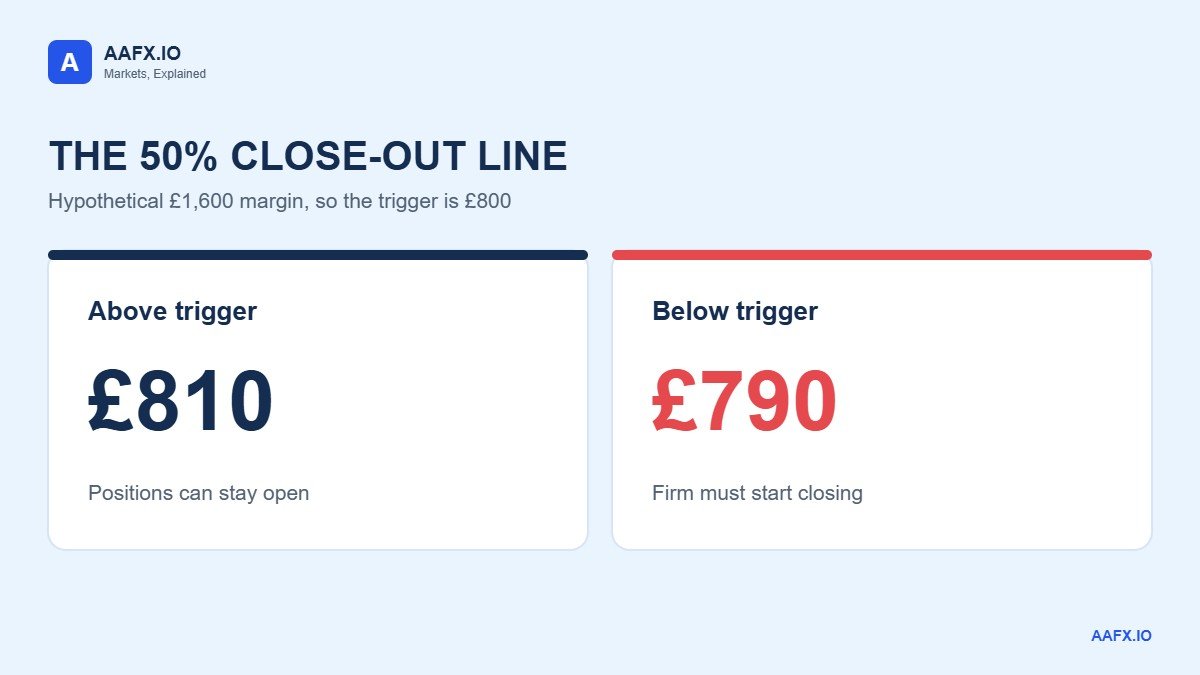
UK retail rules include a margin close-out protection. When your net account equity falls to 50% of the total initial margin required for all open positions, the firm must close one or more of them as soon as market conditions allow. The test runs across the whole account, not trade by trade.
Hypothetical example. You hold two positions that require £1,000 and £600 of initial margin, a total of £1,600. Half of £1,600 is £800. With £810 of equity, the account is above the threshold and the positions can stay open. If equity falls to £790, the firm must start closing positions.
Two details matter here. The 50% rule is a minimum, so a firm’s own terms can close positions earlier. And the firm’s liquidation policy decides which position closes first, which may not be the one you would choose. Read that policy before you trade several positions at once.
An ordinary stop-loss is a trigger, not a guaranteed fill. It becomes an order to close at the next available price, and a gap can produce a worse fill than the level you set. The SEC bulletin on stop orders explains why the execution price can differ from the stop price.
How negative balance protection works
UK retail negative balance protection limits your liability on a covered CFD account to the funds in that account. Suppose you fund £1,000 and a weekend gap produces a calculated loss of £1,250. The loss can consume the whole £1,000, but the additional £250 falls within the protection in this example, so you should not owe it to the firm.
Separate a trading loss from a client-money shortfall
Client money is your cash held by the firm. The FCA’s client-money rules in CASS 7 require firms within scope to keep it separate from the firm’s own money. Segregation protects your balance if the firm fails. It does nothing to offset trading losses, which reduce your balance before any failure.
If a firm does fail and money is missing, the Financial Services Compensation Scheme may cover up to £85,000 per eligible person, per firm for qualifying investment claims against firms that failed after 1 April 2019. Ordinary market losses are excluded. FSCS pays for money a failed firm cannot return, not for trades that went wrong.
Keep every statement and distribution notice, because they let you separate the two. In the reconciliation below, the £600 shortfall is a different thing from the earlier £2,000 market loss.
| Event | Amount (£) | What the figure means |
|---|---|---|
| Original deposit | 12,000 | Starting cash |
| Realised trading loss | 2,000 | Loss before broker failure |
| Balance owed | 10,000 | Amount remaining before distributions |
| Returned by administrator | 9,400 | Money already recovered |
| Unresolved balance | 600 | Possible shortfall, subject to eligibility |
Hypothetical reconciliation. FSCS investment limit and eligibility checked against the scheme on 27 November 2026.
In this example only the £600 could form part of a compensation claim, and only if you are eligible and the claim qualifies. The £2,000 loss is gone whatever happens to the firm.
Bonuses, risk warnings and other retail rules
The same retail rules ban firms from offering monetary and non-monetary incentives to trade restricted products. That covers deposit bonuses and account-opening offers. If a firm calling itself UK-regulated offers you a bonus on a CFD account, check which company is making the offer and whether you are being moved to a non-UK entity. Our forex broker red flags guide lists other warning signs.
UK firms must also show a standardised risk warning that includes the percentage of their own retail accounts that lose money. That figure describes how common losses were among the firm’s clients over the calculation period. It does not tell you the average size of those losses or the chance that your next trade will win.
Finally, remember that FCA rules set minimum standards. They do not make a firm cheap, fast or suitable for you. Compare spreads, financing charges and execution terms separately, using our broker selection guide.
Who should skip a professional or offshore account switch?
Some firms invite retail clients to “opt up” to professional status, or to open an account with an offshore sister company, in exchange for higher leverage. Pause if you rely on retail protections and the firm has not explained in writing exactly what changes.
In October 2025 the FCA warned CFD investors not to give up their retail protections. It raised concerns about high-pressure tactics to move clients to professional status and about firms redirecting clients to offshore providers without equivalent protections. Before agreeing, ask which leverage limits, negative balance protection, close-out rules and client-money terms would apply to the new account.
If the switch involves a new contracting company, check that company’s regulator and its dispute route before moving any money. Our guide to offshore forex brokers explains what typically changes.
Take the problem to the right organisation
Complain to the firm first, in writing, through the route set out in your agreement. For most investment complaints, the firm has up to eight weeks to respond. You can normally refer an eligible case to the Financial Ombudsman Service once you have a final response, or after eight weeks without one. The usual deadline is six months from the date of the final response, subject to exceptions. Follow the ombudsman’s complaint instructions.
Match the problem to the right body. For a disputed fill, request the order time, side, execution price and account equity, and save the statement and complaint reference. For suspected impersonation of a regulated firm, contact your payment provider promptly and report the offer to the FCA using contact details you find independently. For a firm’s insolvency, follow the administrator’s instructions and check your eligibility with FSCS.
A margin complaint in writing
Keep the request specific. For example: “Please provide my equity, aggregate required margin, execution time and the account term used to close order 412.” A precise question gets a precise answer, and it shows the ombudsman exactly what the firm was asked.
AAFX.IO checks before funding a UK retail account
Before funding, record three things: who holds the account, when the firm can close your trades and where you can dispute a payment. If you cannot answer all three from your own documents, you are not ready to deposit. FCA regulation is a strong starting point, but it only protects you when the right company, product and client category line up.
Go back to our guide to financial regulators for the wider picture, read the CFD risk guide to assess leveraged exposure, and compare providers in our forex broker reviews. For short explainers, follow @arslaninsights on TikTok and AAFX.IO on Instagram.
Affiliate disclosure: AAFX.IO may earn a commission if you open an account through some links on our site. Commercial relationships do not affect our scores, rankings or regulatory checks. Always verify a provider independently before depositing.
Educational information only, not personalised investment, financial or legal advice. Leveraged forex and CFD trading carries a high risk of loss. All examples are hypothetical.
Written and reviewed by Arslan Ali Butt, MPhil Behavioural Finance, MBA Finance, with more than 10 years in forex dealing and market analysis. Last reviewed: 27 November 2026.
How we reviewed this guide: UK retail safeguards were checked against FCA policy statement PS19/18 and FCA publications, compensation limits against the FSCS, and complaint deadlines against the Financial Ombudsman Service on 27 November 2026. All margin, close-out and reconciliation figures were recalculated by hand.
Frequently Asked Questions
Does an FCA listing guarantee I can withdraw immediately?
No. A withdrawal can depend on available funds, open positions, settlement or identity checks. Ask the firm for the specific amount you can withdraw, the reason for any delay and a written timeframe. Save the request and the reply. If you dispute how the firm has handled the withdrawal, complain through the formal channel listed in your agreement and keep the case reference.
Do all regulated forex brokers show the same loss percentage?
No. A provider’s standard CFD risk warning generally reflects the results of its own retail accounts over the calculation period. Different client groups and trading patterns produce different figures. The percentage tells you how common a loss was in that group. It does not tell you the average amount lost or the chance that your next trade will be profitable.
Which documents should I save before my first deposit?
Four records make a useful start: the agreement naming the counterparty, your retail classification notice, the verified contact details and the funding instructions. After paying, add the receipt and your first statement. These connect the firm you researched to the account you funded. Repeat the check if you later receive a notice moving your balance to another company.
Is a firm reference number enough to identify a genuine offer?
No. A scammer can copy the reference number of a genuine business together with its address and trading name. Use contact details you obtain independently from the official register to ask whether the firm sent that offer. Quote the website and payment instructions in question. Wait for confirmation through that verified route before sending documents or money.
Does a profitable trade prevent a margin close-out?
No. The close-out calculation looks at equity and required margin across the whole account. A loss on another open position can outweigh the profit on the trade you are watching. Read the firm’s liquidation policy to see how it chooses positions for closure, and save your statements and trade records in case you need to reconstruct the sequence later.
Does AUD/USD qualify for the UK retail major-pair limit?
No. The Australian dollar is not on the FCA list used for this retail leverage rule, so AUD/USD falls into the other-pair category even though it is widely traded. On £30,000 of market exposure, a 20 to 1 limit implies £1,500 of initial margin. A provider can also ask its customers to post more than the regulatory minimum.
Does FSCS investment protection reimburse normal trading losses?
No. The scheme considers eligible claims against failed firms and does not cover losses caused by poor investment performance. If prices moved against you before the firm failed, separate that loss from any money the administrator cannot return. Statements showing deposits, trade results and distributions help establish which part of your original balance is still in dispute.
Do two accounts with the same firm double the FSCS investment limit?
No. The investment limit applies per eligible person, per failed firm. Two account numbers or two trading names can belong to one legal entity. Check the company name on each agreement and keep statements for both accounts. If separate companies are involved, ask the scheme to assess each firm rather than assuming the outcome from a shared group logo.
Must I wait eight weeks after receiving a final complaint response?
No. The eight-week period is the time a firm has to respond. If an eligible complaint has already received a final response and you remain unhappy, you can usually refer it to the Financial Ombudsman Service straight away. Check the referral deadline in the letter, and keep copies of the final response and your original complaint.
Will an account denominated in pounds give me UK retail protection?
No. Sterling is only the account currency. An overseas firm can hold a balance in pounds, and a UK firm may offer accounts in other currencies. What matters is the contracting company, its permissions, the product and your client category. If you were redirected during registration, read the agreement shown at the final step before relying on an earlier page.
Sources & Methodology
Primary-source standard: Market-moving facts should link to original data releases, regulator notices, company filings or official project announcements whenever available. Secondary reporting is used for additional context, not as a substitute for original evidence.
Page last reviewed: