Forex trading signals are alerts that name a currency pair, a direction, an entry price, a stop-loss and a target, so you can decide whether to place the same trade. The provider publishes the idea, but your broker decides the price and size you can actually trade. Judging a signal means checking both the idea and the order you could place when the alert reaches you.
This guide explains how signals work, how to read a provider’s track record and how to test a service before paying for it. You can see how AAFX.IO publishes its own calls on our signals page, and follow wider currency coverage in our forex news section.
Risk warning: Forex trading is leveraged and can cause rapid losses. No signal service can guarantee profits, and past results do not predict future ones. A stop-loss is a trigger, not a guaranteed exit price.
AAFX.IO may earn a commission through links on this page. This does not change our ratings or analysis.
What are forex trading signals?
A forex signal is a trade idea sent by an analyst or an automated system, usually through Telegram, email or an app. A complete signal names the pair, buy or sell, the entry, the stop-loss, the take-profit and how long the idea stays valid. You then decide whether to copy it, adjust the size to your account or skip it.
Are forex signals worth it?
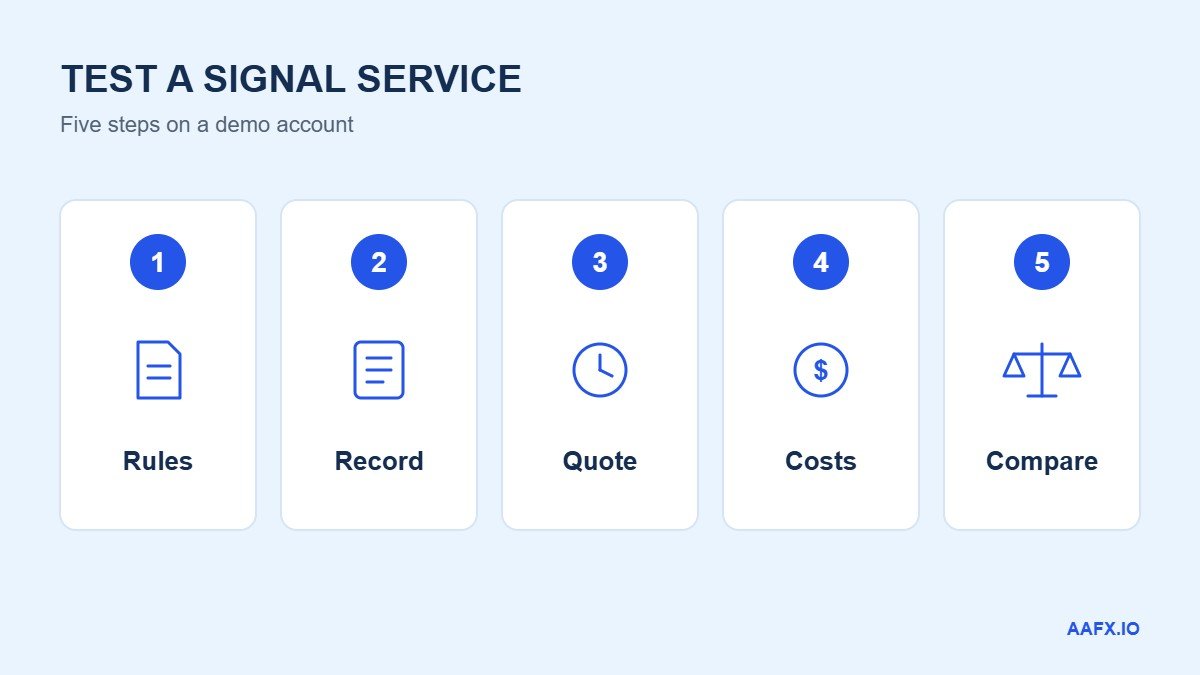
Only if you can act on them at close to the published price and the record still shows a profit after your spread, commission and subscription. A high win rate alone proves little. Test any service on a demo account for several weeks, record every alert including misses, and compare your results with the provider’s before paying or trading live.
Forex trading signals: overview
- What a forex trading signal contains
- How signal providers create and deliver signals
- Work through a signal before you place the order
- Why your broker’s result can differ from the signal
- How to read a signal performance record
- Free vs paid forex signals
- How to forward test a signal service
- When to skip a signal, and who should avoid them
- AAFX.IO: judge a signal by the trade you could actually place
- Frequently Asked Questions
What a forex trading signal contains
Start with the time the alert was issued, its time zone and its status. A message forwarded at noon can contain an idea issued at breakfast and cancelled an hour later. “Buy above” describes an order waiting for a price, while “bought at” describes a position the author already holds. Know which one you are reading before you look at the target.
A long EUR/USD signal buys euros against dollars; a short sells them. The entry tells you what puts the trade into effect. The stop is where the provider plans to exit if the idea fails, and the target is where it plans to take profit. Neither guarantees an execution price. The expiry tells you how long an unfilled order stays valid, not necessarily when to close an open trade.
| Signal field | Hypothetical EUR/USD alert | What to check |
|---|---|---|
| Direction and entry | Buy limit at 1.0800 | Is the current offer still above 1.0800? |
| Stop-loss and target | Stop 1.0770, target 1.0860 | Does your actual entry still leave enough room? |
| Validity | Cancel if unfilled by 12:00 UTC | Is there a separate rule for closing an open trade? |
| Updates | Refers to the original alert ID | Can you see every change and cancellation in order? |
A signal should also make sense next to the analysis behind it. If the reason is a pullback in an uptrend, find the level buyers are expected to defend. If it is a range trade, identify both edges. Our guide to forex technical analysis explains these chart concepts. You should be able to say why the stop sits at that exact price before copying the numbers.
How signal providers create and deliver signals
A discretionary analyst combines chart levels, the economic calendar and judgement about how the market is behaving. The benefit is context; the difficulty is knowing whether the same evidence would produce the same call another day. Look for a reason published with the original alert, not commentary written after a big move.
A rules-based system might require an hourly candle to close above resistance before entering. Ask how it defines resistance, which price feed it reads and whether it waits for the candle to close. A macro signal starts from a surprise in a release such as inflation or a central bank decision. Check our economic calendar against the alert’s trading window, because spreads can widen sharply around releases.
Delivery matters too. Email keeps the original text but may arrive late. A Telegram channel is fast but messages can be edited. Copy-trading tools open and close trades for you once you grant permission, so find out how they round sizes, map symbols between brokers and behave if the connection drops. Always confirm in the broker’s own order history that a stop is attached to the position you meant to protect.
Work through a signal before you place the order
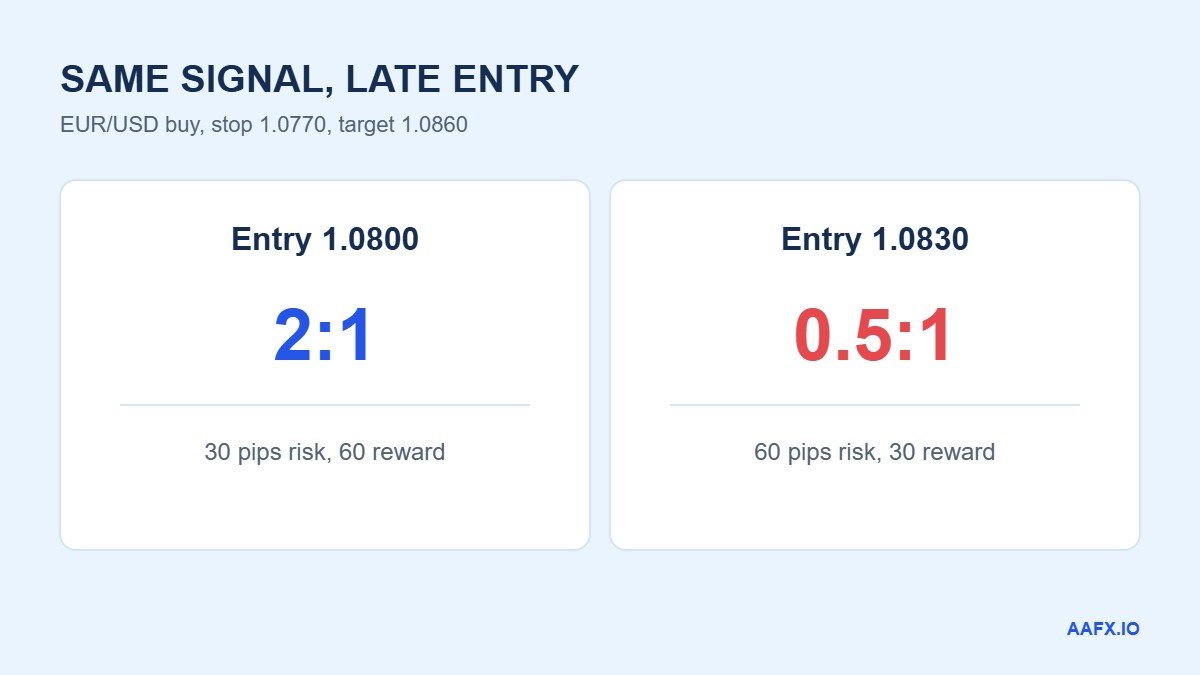
Take the hypothetical alert above. If your buy limit fills at 1.0800, the stop is 30 pips away and the target 60 pips away, a 2:1 reward-to-risk ratio. On EUR/USD one pip is 0.0001. That ratio describes distances only; it says nothing about the chance of reaching either level.
Now suppose you see the alert late, with the offer already at 1.0830. Buying now leaves 60 pips to the same stop and only 30 to the same target, so the ratio falls to 0.5:1. The direction may still be right, but it is no longer the trade the provider described. Placing a fresh limit at 1.0800 could mean buying a second test that the author never intended.
Size the trade in money before entering. In a USD account, 10,000 units of EUR/USD move $1 per pip. At the original entry, a 30-pip stop risks $30. At the late entry, the same size risks $60. Halving the size to 5,000 units brings the risk back to $30, but the target now pays only $15. Our position size calculator turns any entry and stop into a size, and our guide to the major forex pairs covers pip values on other pairs.
Why your broker’s result can differ from the signal
Charts may show the bid, the ask or the midpoint, but a buy fills at the ask and a sell at the bid. If the bid touches 1.0800 while the ask stays at 1.0802, a buy limit at 1.0800 may never fill. The provider can record an entry while your account has no position at all.
Exits work the same way. A stop-market order exits once triggered but can fill at a worse price in a fast market, and a stop-limit can stay unfilled. The SEC investor bulletin on order types explains why stops do not guarantee an exit price. Our guide to trading orders compares the options.
When one candle contains both the stop and the target, its high and low cannot tell you which came first. A fair record either checks finer, timestamped data or marks the trade as unresolved. A record that gives itself the target in every such case looks better than the evidence supports.
How to read a signal performance record
Start with what the record actually measures. AAFX.IO’s signal performance dashboard lists closed signals with entry and exit prices and notes that its pip counts run from entry to the first take-profit level where applicable. One listed EUR/USD buy at 1.0850 closed at 1.0940, which is 90 pips. Turning that into a cash result for you still needs your size, your fills and your costs.
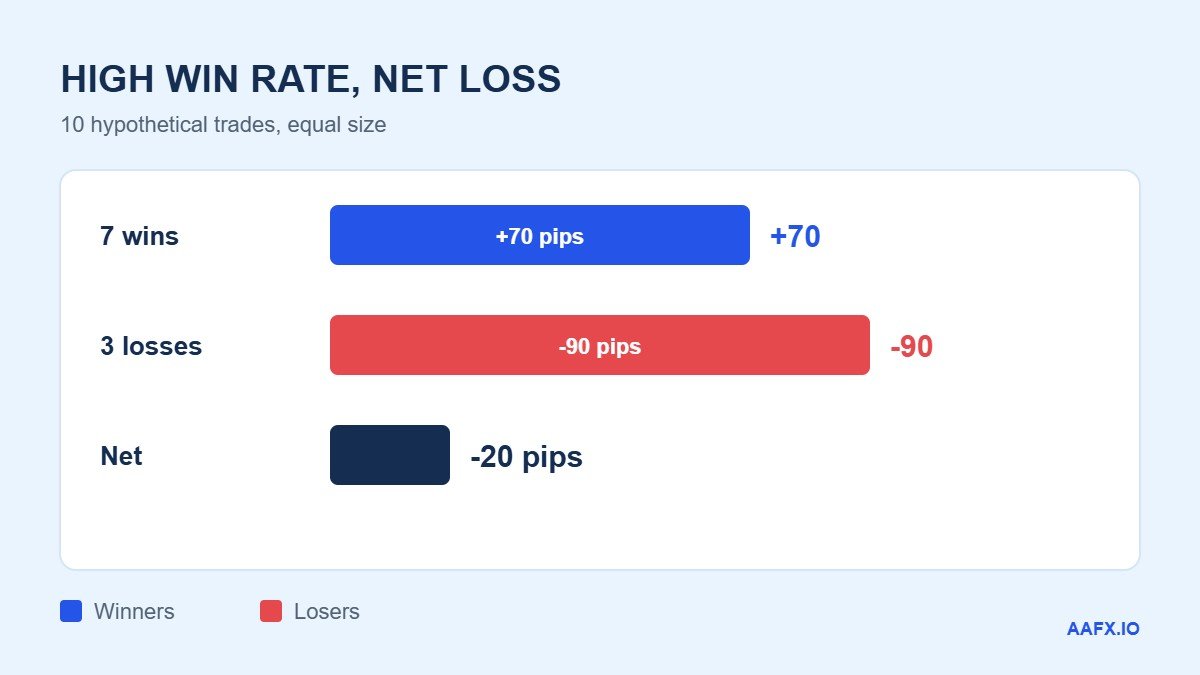
Then count everything over a fixed date range: alerts issued, triggered, cancelled, still open and closed. Check how the provider treats trades closed at breakeven. Most importantly, never judge a service by win rate alone, because a few large losses can outweigh many small wins.
| Hypothetical series of 10 signals | Trades | Pips each | Total pips |
|---|---|---|---|
| Winners | 7 | +10 | +70 |
| Losers | 3 | -30 | -90 |
| Net result (70% win rate) | 10 | n/a | -20 |
At 10,000 units of EUR/USD, that 70% win rate loses $20 before costs. Comparing results in units of initial risk, called R, fixes the problem of different stop sizes: risking $40 and making $80 is +2R, and losing the full $40 is -1R. Also check drawdown. An account that rises from $1,000 to $1,200 and falls to $960 has a 20% drawdown from its peak, even though it is only $40 below where it started.
Finally, separate live calls from reconstructed ones. A backtest applies rules to past data; a dated live feed shows whether the call existed before the move. If a signal lists two targets and half the position closes at +20 pips while the rest closes at entry, the result is +10 pips on the full position, not +20.
Free vs paid forex signals
Price is only one line in the comparison. Free channels are often paid for by broker referrals, so ask who pays the provider and whether you must open an account with a particular broker. A paid service may offer better change notices or simply more alerts. A disclosure explains incentives; it does not prove the strategy works after your costs.
Put the subscription in the same units as your results. A $30 monthly fee spread over 12 trades you actually take costs $2.50 per trade. If you only manage 4, it is $7.50 each. At 10,000 units of EUR/USD, $2.50 equals 2.5 pips; at 1,000 units it equals 25 pips. A flat fee can eat most of a small account’s gains.
| Question | Why it matters |
|---|---|
| When are alerts usually sent? | Intraday calls are of little use if you only check after work |
| Is there a complete, dated history? | Screenshots of winners hide the losses |
| Who pays the provider? | Referral income can favour more trading or a specific broker |
| How are changes and cancellations sent? | Missed updates can leave you in a trade the provider has closed |
| What are the renewal and refund terms? | Automatic renewals keep charging after you stop using it |
Be sceptical of promised returns, perfectly smooth profit curves or a “secret system”. The CFTC advisory on trading systems warns that hypothetical results can look impressive, that promoters may cherry-pick trades, and that no trading system can guarantee profits. Any request to deposit more or share login details to unlock results is a stop sign, as our broker red flags guide explains.
How to forward test a signal service
Choose the provider, pairs, test dates and the hours you can watch before collecting any results. Decide in advance what counts as an eligible alert, the widest spread you accept and how late is too late to enter. Then use a demo account and record every eligible alert in order. If an alert arrives during a meeting, mark it missed; if the entry never trades, mark it unfilled. Delete nothing.
Reconcile at least one winner in cash. Suppose the provider reports a buy at 1.1000 and an exit at 1.1040, 40 pips. Your demo bought 10,000 euros at 1.1003 and sold at 1.1038, 35 pips or $35. After a $1.20 round-trip commission, you made $33.80, about 85% of the headline. Repeat the exercise on a loser, because slippage often hurts more on the way out.
At the end, compare three numbers: the provider’s results, the results for alerts you could have taken in your hours, and your actual demo fills after costs. The first gap shows how much your schedule costs you; the second shows spread, delay and execution. A short test can quickly show operational problems, but a few weeks of trending markets prove little about how the service handles a range.
When to skip a signal, and who should avoid them
Passing can be the right call even when every field is filled in. Suppose three alerts arrive together: buy EUR/USD, buy GBP/USD and sell USD/CHF. All three are bets against the dollar. At $30 of planned risk each, you have about $90 riding on one idea. Our position sizing guide explains how account-level limits sit alongside individual stops.
Write a short skip rule you can apply in real time: skip if the entry price was already reached before you received the alert, if the spread is above your limit, or if the trade duplicates exposure you already hold. Record which rule applied, and review the skipped group over the whole test rather than reacting to one missed winner.
Signals are a poor fit if you cannot act within minutes of an intraday alert, if your account is too small for the provider’s stop sizes, or if you would follow calls without understanding why they work. Our guides to forex trading risks and trading styles help you decide what kind of trading suits your time and temperament first.
AAFX.IO: judge a signal by the trade you could actually place
Open one dated alert and write down the first price at which you could have acted. Recalculate the distance to the stop and target from that price, size the trade in money and record the result after costs. When you can explain the gap between the provider’s numbers and yours on winners, losers and missed trades, you know what the service is really worth to you.
See how AAFX.IO publishes its calls on our signals page and performance dashboard, and follow daily currency coverage in the forex news section. For short market explainers, follow @arslaninsights on TikTok and AAFX.IO on Instagram.
Affiliate disclosure: AAFX.IO may earn a commission if you open an account through some links on our site. Commercial relationships do not affect our scores, rankings or analysis. Always verify a provider independently before depositing.
Educational information only, not personalised investment advice. AAFX.IO signals and all examples in this guide are for information only; past performance does not guarantee future results. Worked examples are hypothetical.
Written and reviewed by Arslan Ali Butt, MPhil Behavioural Finance, MBA Finance, with more than 10 years in forex dealing and market analysis. Last reviewed: 18 November 2026.
How we reviewed this guide: The AAFX.IO performance dashboard, the CFTC trading systems advisory and the SEC order types bulletin were checked on 18 November 2026. All other prices, pips and fees are hypothetical inputs with the arithmetic shown. No third-party signal provider is rated in this guide.
Frequently Asked Questions
Are forex signals the same as a trading strategy?
No. A strategy is the full set of repeatable rules for finding, sizing and exiting trades. A signal is one trade those rules produced. A service can publish precise entries without explaining how it picks them. If you want to learn the method, check whether each alert explains the market condition, the trigger and the point where the idea stops making sense.
What should I do if a signal gives an entry range?
Work out the stop and target distances at both ends. For a hypothetical buy zone of 1.0800 to 1.0810 with a stop at 1.0770 and target at 1.0860, the low end offers 60 pips against 30, while the top offers 50 against 40. Both fit the zone but give different economics. A record that always assumes the best end needs a stated fill rule.
Are longer-term forex signals easier to follow?
They give you more time to read the alert and check the price, which helps if you work during market hours. But holding through several sessions adds overnight financing, weekend gaps and more news events. A slower signal only suits you if you can also act on its updates. A trade that takes days to develop can still need an exit while you are unavailable.
Can I compare signal providers by total pips?
Not on their own. Pips measure price distance, while your cash result depends on the pair, trade size, costs and how partial exits are counted. Ten pips on a large position can be worth more than fifty on a small one. Compare providers over the same period and pairs, and convert results into money or units of initial risk before deciding.
Are free forex signals on Telegram safe to follow?
Some are run by genuine analysts, but many free channels earn money from broker referrals or are fronts for scams. Check for a complete, dated history including losses, and never send money or login details to anyone in the channel. If a channel pushes a specific unregulated broker or promises guaranteed profits, treat it as a red flag and walk away.
Should I use automatic copy trading for signals?
Copy trading saves time, but you hand control of entries and exits to software. Find out how it sizes trades for your account, maps symbols between brokers and behaves if the connection drops or you pause it. Test it on a demo account first, and check in your broker’s own history that every copied trade carries the stop you expect.
How much money do I need to follow forex signals?
Enough that the provider’s stop distances fit your risk limit at your broker’s minimum trade size. If a signal uses a 40-pip stop and your broker’s minimum is 1,000 units, the smallest trade risks about $4 on EUR/USD. Add the subscription cost per trade. If one stopped-out trade would cost more than about 1% to 2% of your account, the account is probably too small.
What win rate should a good signal service have?
There is no magic number. A service winning 40% of trades can be profitable if winners are much larger than losers, while one winning 80% can lose money if a few losses are large. Look at average win against average loss, net results in units of risk, maximum drawdown and whether the record includes every alert issued over a fixed period.
Why did my trade lose when the signal shows a win?
Usually because you entered at a different price, your broker’s spread was wider, or your stop triggered on a quote the provider’s chart did not show. Partial exits and moved stops can also be counted differently. Save the original alert, your first available quote and your actual fills, then compare them line by line to find where the difference came from.
Does AAFX.IO publish its signal results?
Yes. AAFX.IO publishes monthly summaries and closed signals with entry and exit prices on its performance dashboard, including losing trades. The dashboard notes that pip counts run from entry to the first take-profit level where applicable. Treat it like any provider’s record: check the date range, convert pips to your own trade size, and allow for your spread and timing.
Sources & Methodology
Primary-source standard: Market-moving facts should link to original data releases, regulator notices, company filings or official project announcements whenever available. Secondary reporting is used for additional context, not as a substitute for original evidence.
Page last reviewed: