The biggest forex broker red flags are a company name that does not match the regulator’s register, payment instructions to a personal account or crypto wallet, and any fee you must pay before a withdrawal is released. Each one can be checked before you deposit, usually in under an hour, and any one of them is reason enough to stop.
This guide focuses on warning signs. For the full selection process, including costs, platforms and service, use our guide to choosing a broker and the forex broker reviews hub. UK rules are used as examples, so check the regulator responsible for the company that would hold your account.
Risk warning: Leveraged forex and CFD trading can cause rapid losses, even with a genuine, regulated broker. Spotting a fraud protects your deposit from theft; it does not protect it from market losses.
AAFX.IO may earn a commission through links on this page. This does not change our ratings or the brokers we recommend.
What are the biggest red flags with a forex broker?
Treat these as stop signs: a legal name that differs from the regulator’s register, unsolicited contact with pressure to deposit quickly, promised returns, payment to a personal account or crypto wallet, and any request to pay a fee or tax before a withdrawal is released. A genuine broker publishes its entity, charges and withdrawal terms in writing.
How can you tell if a forex broker is a clone firm?
A clone firm copies a genuine broker’s name, address or reference number but gives you different contact details. Search the regulator’s own register, not a link you were sent, and compare the website, email domain and phone number with the register entry. If anything differs, or the caller says the register is out of date, stop.
Forex broker red flags: overview
- Forex broker red flags at a glance
- Red flag 1: the name does not match the register
- Red flags 2 and 3: cold contact and pressure to act fast
- Red flag 4: promised returns, bonuses or no-loss trading
- Red flag 5: an offer to move you offshore for more leverage
- Red flags 6 to 8: where your money goes in and out
- Red flag 9: costs nobody will confirm in writing
- Red flag 10: a warning or complaint record you cannot explain
- How to check a forex broker before you deposit
- AAFX.IO: one unexplained red flag is enough to walk away
- Frequently Asked Questions
Forex broker red flags at a glance
Most broker frauds rely on the same few tricks: borrowing a real firm’s identity, rushing you, and controlling the payment route. Genuine brokers can also show warning signs, such as vague costs or an offshore entity you did not expect. The table separates what each sign can mean from the check that settles it.
| Red flag | What it can mean | What to check |
|---|---|---|
| 1. Name or contact details differ from the register | Clone firm using a real broker’s identity | Regulator’s register, reached independently |
| 2. Unsolicited call, message or social media approach | Scam outreach or an unauthorised introducer | Who employs the caller and their permissions |
| 3. Pressure, secrecy or a deadline | An attempt to stop you checking | Whether the offer still stands after a week |
| 4. Promised returns or no-loss features | Misleading marketing or fraud | The written terms and risk warning |
| 5. Offer to move you to another entity | Weaker rules and protections | The new agreement, regulator and complaint route |
| 6. Payment to a personal account or wallet | Money not reaching the regulated firm | Beneficiary name against the agreement |
| 7. Withdrawal fees you cannot find in writing | Hidden charges or delaying tactics | The published funding and withdrawal policy |
| 8. Pay first to release a withdrawal | Advance-fee fraud | Stop paying and contact your bank |
| 9. Costs nobody will confirm in writing | Pricing you cannot verify on a statement | Fee schedule for your pair and size |
| 10. Regulator warning or unexplained complaints | Past or current misconduct | Dated notices and the legal entity named |
Red flag 1: the name does not match the register
Start with the client agreement, not the website banner. Find the sentence naming the company that provides the service and copy its full legal name, reference number and country. A trading brand can sit on top of several companies, so the logo tells you little about who would hold your money.
Then reach the regulator through its own website. The FCA’s clone firm guidance warns that fraudsters use a genuine firm’s name and address or copy its reference number. They may copy an authorised firm’s website with small changes such as the phone number, or use email addresses that only resemble the real firm’s or come from free providers like Gmail.
The FCA’s advice is to search the firm on its Firm Checker, confirm it has permission for the service you want, and check that the contact details listed match the ones you were given. A caller who claims the register is out of date is itself a warning sign. Our broker licence checklist walks through the same test for other regulators.
Red flags 2 and 3: cold contact and pressure to act fast
Regulated brokers rarely need to chase you on WhatsApp or Telegram. The FCA’s ScamSmart guidance notes that scammers often call out of the blue and may also use email, text or social media. It also flags bonuses or discounts for investing quickly and claims that an opportunity is only available briefly.
Watch for the softer tactics too. Scammers may tell you that you have been specially chosen and should keep the opportunity secret, or build a friendship before mentioning money. An “account manager” who calls daily, praises your trading and asks for a larger deposit fits this pattern, even when the platform looks professional.
One request deserves an immediate no: installing screen-sharing or remote-access software so someone can “help set up” your account. The FCA warns against downloading software or apps from untrusted sources because scammers can take control of your device and reach your bank account. A genuine broker’s support team can guide you without controlling your computer.
Red flag 4: promised returns, bonuses or no-loss trading
No broker can promise a monthly return, because your result depends on the market and your own trades. Treat any fixed return, “managed account” with guaranteed profit or copy-trading offer that cannot lose as a stop sign. For UK retail CFD accounts, the FCA’s CFD rules also prohibit firms from offering retail clients cash or other inducements, so a large deposit bonus from a supposedly UK-regulated firm should prompt questions.
Be equally careful with “risk-free” claims about stops. A stop-loss is a trigger, not a guaranteed fill. Suppose you buy 10,000 EUR/USD at 1.1000 with an ordinary sell stop at 1.0960, a planned loss of about $40. If the market gaps and the stop fills at 1.0945, the loss is about $55 before fees. The SEC investor bulletin on order types explains why ordinary stops can fill beyond your price.
Negative balance protection does not change this either. Under the FCA’s rules it stops a covered retail client losing more than the money in the account, but you can still lose that entire balance.
Red flag 5: an offer to move you offshore for more leverage
A common upsell goes like this: “Your UK account is limited to 30:1, but our international entity offers 500:1.” The FCA caps retail CFD leverage between 30:1 and 2:1 depending on the asset, and requires firms to close positions when account funds fall to 50% of the required margin. Moving to an offshore group company usually means giving up those protections.
Treat any entity switch as a fresh application. Get the new agreement, check the new company on its own regulator’s register and find out where a complaint would go. Higher leverage also speeds up losses, as our leverage and margin guide shows. Our guide to offshore brokers explains what changes when the contracting company moves abroad.
Compensation can change too. The UK Financial Services Compensation Scheme covers eligible claims up to £85,000 per person, per firm, for firms that failed after 1 April 2019, and it does not cover losses from poor investment performance. An account with an offshore sister company would normally sit outside that scheme.
Red flags 6 to 8: where your money goes in and out
Red flag 6: paying a personal account, a crypto wallet or a new beneficiary
Your deposit should go to an account in the name of the regulated company on your agreement, or to a payment processor the firm names in writing. If a representative asks you to pay a personal account, sends a crypto wallet address or changes the bank details by message, stop and confirm the instructions through contact details you found independently. Our guide to how brokers handle client funds explains what a proper deposit route looks like.
Identity documents need the same care. A genuine broker will ask for them through a secure portal as part of its KYC and anti-money laundering checks, not through a personal messaging account.
Red flags 7 and 8: withdrawal fees and pay-to-release demands
Read the withdrawal policy for the payment method you would actually use before you deposit. Note any fee, the stated processing time and what happens if your card expires. A broker’s “processed in one day” is not the same as money arriving in your bank, so separate the two.
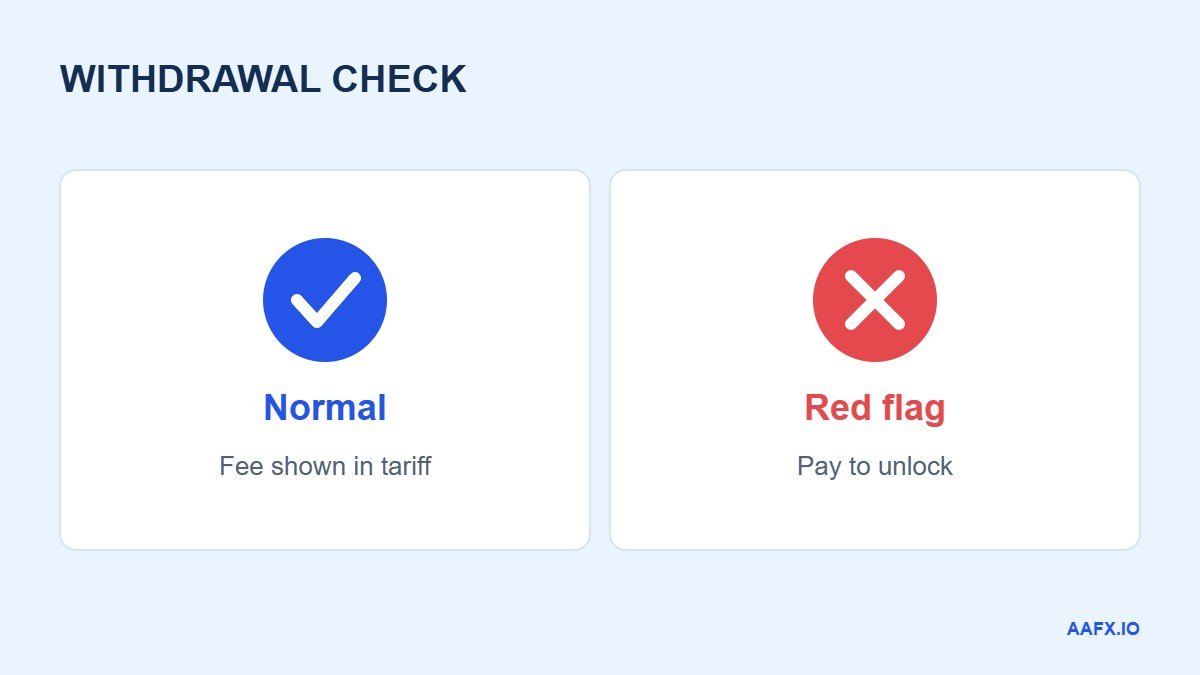
Any demand to pay before you can withdraw is a serious red flag, whether it is called a tax, an insurance fee, a “liquidity deposit” or an account upgrade. A genuine broker deducts published fees from the withdrawal itself. If you have already lost money, beware of anyone offering to recover it for an upfront fee. The FCA calls these recovery room scams.
Red flag 9: costs nobody will confirm in writing
A broker that will not say what a trade costs is hard to hold to account. Ask support a question with a checkable answer: “For a USD account, what is the commission on 0.10 lot of EUR/USD, and is it per side or for the round trip?” A good reply names the fee schedule and the basis. A vague “our spreads are very competitive” is a mild red flag on its own and a serious one alongside others.
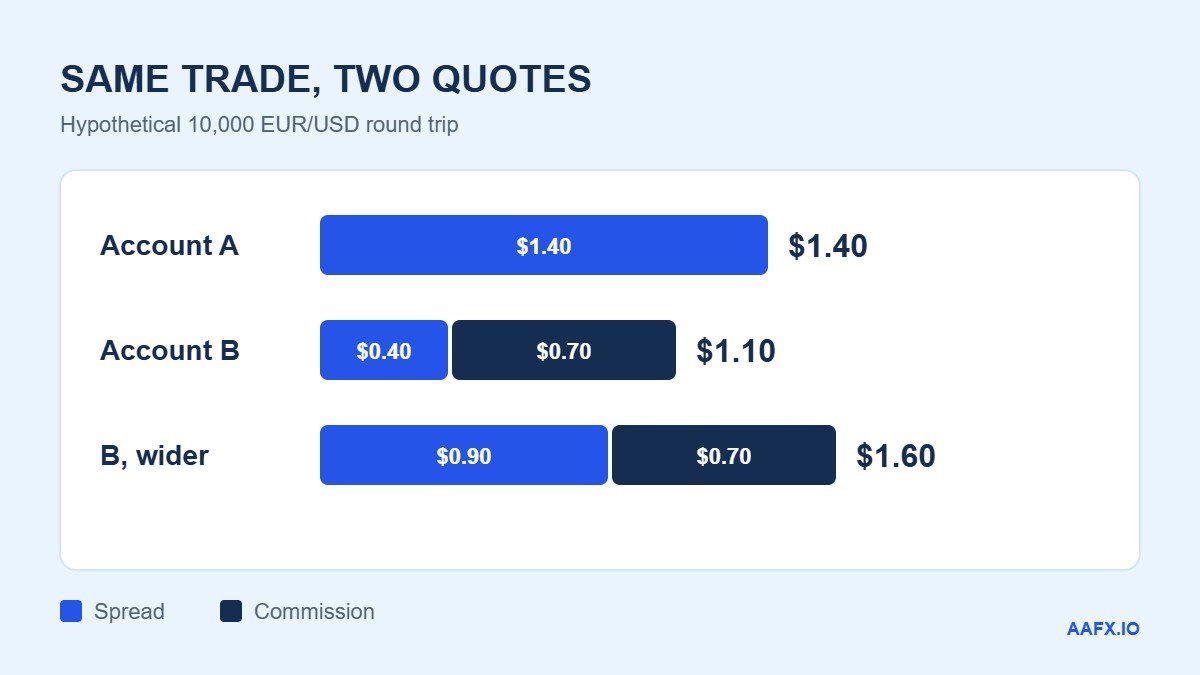
Once you have written terms, price one realistic trade. In this hypothetical example, you buy and sell 10,000 euros against the dollar in a USD account within the same session, so one pip is worth $1. Account A quotes a 1.4-pip spread with no commission. Account B quotes 0.4 pip plus $0.70 of commission for the round trip.
| Hypothetical EUR/USD cost | Account A | Account B |
|---|---|---|
| Spread paid over the round trip | 1.4 pips ($1.40) | 0.4 pip ($0.40) |
| Commission, open and close combined | $0.00 | $0.70 |
| Total for one round trip | $1.40 | $1.10 |
| Total for 20 round trips | $28.00 | $22.00 |
| One round trip if B’s spread widens to 0.9 pip | $1.40 | $1.60 |
Account B is cheaper at its quoted spread, but A wins if B’s spread widens to 0.9 pip. That is why written, verifiable figures matter more than a headline. Our guide to how brokers make money explains each fee type, and our CFD platform comparison shows the same test applied to three named brokers.
Red flag 10: a warning or complaint record you cannot explain
Online reviews can point you to the right question, but they rarely settle it. Several posts about a delayed withdrawal matter more when they name the legal entity, the date and the payment method. A dated regulator notice naming the same company deserves closer attention. Read what it says about the activity, the period and any outcome.
Regulators publish warning lists for exactly this purpose. Search each list by brand name and legal name, because clones often use a slight variation. A missing entry does not prove a firm is safe, since these lists depend on tips and are never complete.
| Where the account would be | Check registration | Check warnings |
|---|---|---|
| United Kingdom | FCA Firm Checker and Financial Services Register | FCA Warning List |
| United States | NFA BASIC for firms and individuals | CFTC RED List |
| Any jurisdiction | The local regulator’s own register | IOSCO I-SCAN alerts database |
The CFTC’s RED List names foreign entities that appear to be acting in a capacity that requires CFTC registration without having it. IOSCO’s I-SCAN gathers alerts from member regulators about firms not authorised in their jurisdictions, including some using names similar to authorised firms. Inclusion on the RED List is not a finding of wrongdoing, but it is a strong reason not to deposit.
How to check a forex broker before you deposit
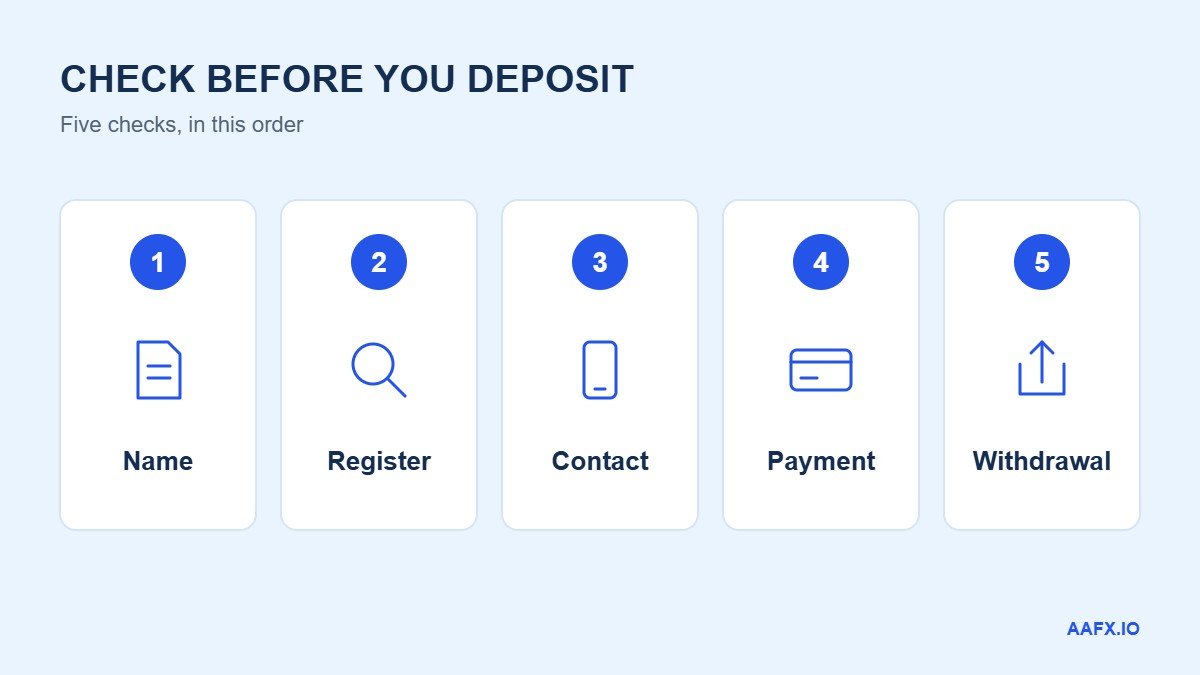
Run the same five checks, in this order, on every broker you consider. The order matters, because the early checks can save you from wasting time on the later ones.
- Name: copy the legal entity from the client agreement, not the homepage.
- Register: find that entity on the regulator’s own website and confirm its permissions.
- Contact: use the register’s contact details to confirm the website and representative are genuine.
- Payment: check the beneficiary name on the deposit instructions matches the entity.
- Withdrawal: read the withdrawal policy and fees for your payment method.
Then check that the account fits you. Suppose you want to risk no more than $15 on a trade with a 50-pip stop. That is $0.30 per pip, or 3,000 euros of EUR/USD, which is 0.03 lot. A broker whose minimum order is 0.10 lot would risk about $50 at the same stop, so it is a poor fit even if everything else checks out. Our position-sizing guide covers other stop distances.
Walk away if any identity or payment check fails, or if the firm will not answer in writing. Pressure to deposit before you finish these checks is itself a reason to stop. When everything matches, our guide to opening a forex account covers the next steps, and our article on whether a broker needs a local office helps if a branch is part of the pitch.
AAFX.IO: one unexplained red flag is enough to walk away
A genuine forex broker can show you who it is, where your money goes and what you will pay, in writing and before you deposit. Clone firms and unauthorised brokers depend on you skipping those checks. If the name, the payment route or the withdrawal terms do not add up, there is always another broker.
Once a broker passes, compare it properly with our broker selection guide and the AAFX.IO broker reviews. For short explainers on scams and trading costs, follow @arslaninsights on TikTok and AAFX.IO on Instagram.
Affiliate disclosure: AAFX.IO may earn a commission if you open an account through some links on our site. Commercial relationships do not affect our scores, rankings or analysis. Always verify a provider independently before depositing.
Educational information only, not personalised investment, legal or tax advice. If you think you have been targeted by a scam, contact your bank and your regulator straight away. Worked examples are hypothetical and do not represent live quotes.
Written and reviewed by Arslan Ali Butt, MPhil Behavioural Finance, MBA Finance, with more than 10 years in forex dealing and market analysis. Last reviewed: 18 November 2026.
How we reviewed this guide: Warning signs and checks were taken from the FCA’s clone firm and ScamSmart guidance, the FCA’s retail CFD rules, the FSCS, the CFTC RED List, NFA BASIC and IOSCO I-SCAN, all checked on 18 November 2026. Cost and sizing examples use stated hypothetical inputs. No broker is named or ranked in this guide.
Frequently Asked Questions
Is an offshore forex broker always a scam?
No. Many large broker groups run genuine offshore entities alongside their UK, EU or Australian companies. The issue is that offshore rules are usually lighter, with higher leverage, weaker complaint routes and often no compensation scheme. Check that the offshore company appears on its own regulator’s register, read its agreement, and decide whether you are comfortable giving up the protections you would get onshore.
Can a regulated broker still show red flags?
Yes. Regulation confirms a firm has permission to operate; it does not guarantee good service. Warning signs at a regulated broker include costs nobody will confirm in writing, pressure from sales staff, unexplained withdrawal delays and attempts to move you to an offshore entity. Check the regulator’s register for past enforcement notices and keep written records of every answer you receive.
Why would a broker ask me to install remote access software?
A genuine broker has no reason to control your computer. Requests to install screen-sharing tools such as AnyDesk or TeamViewer to “set up” an account or “help” with a trade are a common scam tactic. The FCA warns that scammers can use downloaded software to take control of your device and reach your bank account. Refuse, end the call and verify the firm independently.
Is it normal to pay a fee before withdrawing?
A broker may charge a published withdrawal fee, but it normally deducts that fee from the amount you withdraw. Being asked to send new money first, described as a tax, insurance, verification or liquidity payment, is a classic advance-fee fraud. Do not pay. Save all messages, contact your bank immediately and report the firm to your regulator.
What should I do if I already sent money to a suspicious broker?
Stop sending money, even if you are told it will unlock your balance. Contact your bank or card provider straight away, since some payments can be disputed or recalled if you act quickly. Report the firm to the regulator and your national fraud reporting service. Keep screenshots, emails and transaction records, and be wary of anyone offering to recover your money for a fee.
Are deposit bonuses a red flag with forex brokers?
They can be. For UK retail CFD clients, the FCA’s rules prohibit firms from offering cash or other inducements, so a large bonus from a firm claiming UK regulation is a warning sign. Elsewhere, bonuses are sometimes legal but often come with trading volume conditions that lock your deposit. Read the bonus terms in full and check whether accepting it restricts your withdrawals.
Does the FSCS protect my forex trading losses?
No. The FSCS can compensate eligible claims if an authorised UK firm fails, up to £85,000 per person, per firm, for firms that failed after 1 April 2019. It does not cover losses from poor investment performance, including losing trades. It also normally does not cover accounts held with an offshore sister company, even under the same brand.
How do I check a forex broker in the United States?
Firms offering retail forex to US residents generally need registration with the CFTC and membership of the National Futures Association. Search the firm and any individual who contacts you on NFA BASIC, which shows registration status and disciplinary history. Then check the CFTC RED List, which names foreign entities that appear to need CFTC registration but do not have it.
Are online reviews reliable for spotting a bad broker?
Treat them as leads rather than proof. Reviews can be faked in both directions, and many complaints concern market losses rather than misconduct. Give more weight to detailed, dated reports that name the legal entity and payment method, and more again to regulator notices. Look for patterns across several sources instead of relying on a single score or star rating.
What is a recovery room scam?
A recovery room scam targets people who have already lost money. Someone contacts you claiming they can get your money back from a fraudulent broker, often posing as a lawyer, regulator or recovery agency, but asks for an upfront fee. The FCA warns about these offers. Genuine regulators do not charge to handle complaints, so verify any such contact independently before replying.
Sources & Methodology
Primary-source standard: Market-moving facts should link to original data releases, regulator notices, company filings or official project announcements whenever available. Secondary reporting is used for additional context, not as a substitute for original evidence.
Page last reviewed: