The best CFD trading platforms in AAFX.IO’s broker reviews are IC Markets Raw, Pepperstone Razor and Tickmill Raw, scored 8.8, 8.6 and 8.4 out of 10. Each wins for a different reason. IC Markets suits traders comparing MetaTrader and cTrader pricing, Pepperstone suits trading straight from TradingView charts, and Tickmill offers a fixed forex commission you can check against any statement.
This comparison sits inside our forex broker reviews hub. It covers fees, charting, order handling and account protection, using provider documents checked on 18 November 2026. The right pick still depends on which company would open your account and how long you plan to hold each trade.
Risk warning: CFDs are complex leveraged products. Losses can build quickly and, where negative balance protection does not apply, can exceed your deposit. An ordinary stop order can fill beyond the price you set.
AAFX.IO may earn a commission through links on this page. This does not change our ratings or the order in which brokers appear.
Which CFD trading platform is best in 2026?
IC Markets Raw has the highest AAFX.IO score of the three at 8.8 out of 10, followed by Pepperstone Razor at 8.6 and Tickmill Raw at 8.4. The gap is small, so match the account to your charting platform and holding period. A TradingView user may get more value from Pepperstone than from the top overall score.
How do you choose a CFD trading platform?
Start by confirming the legal company that would open your account on the regulator’s register. Then price one realistic trade, including spread, commission and overnight financing for your usual holding period. Finally, rehearse entering, amending and closing that trade on a demo account, including from your phone, before you deposit any money.
Best CFD trading platforms: overview
- Best CFD trading platforms at a glance
- How AAFX.IO scored the three CFD brokers
- IC Markets Raw: best for comparing MetaTrader and cTrader
- Pepperstone Razor: best for trading from TradingView charts
- Tickmill Raw: best for a simple forex commission benchmark
- What one EUR/USD trade costs on each account type
- Which account protections apply to you
- How to test a CFD platform on demo before funding it
- Who should skip these three CFD platforms
- AAFX.IO: match the platform to your trade, not the headline score
- Frequently Asked Questions
Best CFD trading platforms at a glance
A CFD broker supplies the contract, while the platform is the software you use to see prices and send orders. Two accounts can run the same MetaTrader app yet charge different spreads, contract sizes and financing rates. A useful shortlist therefore names three things together: the legal entity, the account type and the software.
All three picks offer a raw-spread account. You pay a tight market spread plus a fixed commission, so each cost is visible on its own line. That model suits active traders who want to see what they pay. Our guide to market makers and ECN brokers explains how this pricing differs from a spread-only dealing desk.
| Broker and account | AAFX.IO score | Forex commission (published) | Platforms | Best for |
|---|---|---|---|---|
| IC Markets Raw | 8.8/10 | $3.50 per lot per side on MetaTrader; $3 per $100,000 traded per side on cTrader (EU entity) | MT4, MT5, cTrader | Comparing MetaTrader and cTrader pricing |
| Pepperstone Razor | 8.6/10 | From £2.25 per lot per side on a GBP account (UK entity) | MT4, MT5, cTrader, TradingView, Pepperstone platform | Placing orders from TradingView charts |
| Tickmill Raw | 8.4/10 | $3 per lot per side, or the account-currency equivalent (UK entity) | MT4, MT5, Tickmill mobile app | A fixed forex commission benchmark |
The commissions come from UK and EU provider pages checked on 18 November 2026, so treat them as examples of how each charge works. A reader elsewhere should check the agreement actually offered locally, because an offshore entity can quote different leverage, fees and protections. Our guide to choosing a broker lists the account checks to run before comparing prices.
How AAFX.IO scored the three CFD brokers
AAFX.IO’s review methodology scores brokers on 87 criteria across seven categories. Regulation and safety and trading costs carry up to 20 points each. Trading platforms carry 15, instruments and markets 10, customer support eight, and education and deposits and withdrawals seven each. The overall score out of 10 is the points total divided by 87, rounded to one decimal place.
Our Tickmill review, last updated on 9 August 2026, shows the full breakdown below. Tickmill earned 73 of 87 points, which rounds to 8.4 out of 10. The same review’s peer table lists IC Markets Raw at 8.8 and Pepperstone Razor at 8.6, but not their category points, so we report those two scores exactly as published.
| Category | Maximum points | Tickmill Raw |
|---|---|---|
| Regulation and safety | 20 | 18 |
| Spreads and trading costs | 20 | 17 |
| Trading platforms | 15 | 13 |
| Instruments and markets | 10 | 7 |
| Customer support | 8 | 7 |
| Education and research | 7 | 5 |
| Deposits and withdrawals | 7 | 6 |
| Total | 87 | 73 (8.4/10) |
A score helps most when you know which category drives your own decision. Someone who only trades EUR/USD may not care about a longer instrument list. Someone who closes index trades from a phone may value a clear mobile order ticket above a tenth of a pip. And a high overall score is no use if the account is not offered where you live.
IC Markets Raw: best for comparing MetaTrader and cTrader
The main reason to look at IC Markets is that one regulated provider publishes two ways to pay for raw pricing. Its EU Raw Spread account page quotes $3.50 per lot per side on MetaTrader 4 and 5. One standard lot therefore costs $7 in commission for the round trip, before the spread. That account is offered by IC Markets (EU) Ltd, which is regulated by the Cyprus Securities and Exchange Commission (CySEC).
cTrader is priced differently. The IC Markets EU costs policy charges $3 per $100,000 of US dollars traded, per side. One standard lot of EUR/USD is €100,000 of base currency, which at an illustrative rate of 1.10 is $110,000 of turnover. The entry commission is therefore $3.30, and the exit charge shifts slightly if the rate moves. The same volume on screen does not mean the same bill on both platforms.
IC Markets suits traders who already run MetaTrader indicators or Expert Advisors (automated trading scripts) and want to see whether cTrader would be cheaper or easier. The best test is practical. Reproduce an ordinary order on each platform, attach a stop, amend it and find the closed trade in history. A few cents of commission matter less than an order ticket whose volume unit you could misread.
Pepperstone Razor: best for trading from TradingView charts
Pepperstone earns its place if TradingView is where you already mark levels and plan orders. Its UK TradingView page lists CFD Razor as the CFD account that connects to TradingView and states that the Standard CFD account does not. If chart trading is your reason to choose Pepperstone, open Razor rather than Standard. A UK spread betting account can also connect, but it is a different product with different tax treatment.
On costs, Pepperstone’s UK pricing page shows Razor commission from £2.25 per lot per side on forex and spot gold for a GBP account. Trades placed through TradingView are charged at $7 per lot for the round trip. Index and commodity CFDs carry no separate commission on Razor, so for those markets the spread and overnight financing are the costs to compare.
One caution applies to any chart-led setup. You still need to pick the broker’s tradable symbol, not just a chart with a similar name. A cash index CFD, a futures contract and a reference index can show different prices and session hours. Before placing a demo order, match the contract unit, currency and trading hours to the broker’s specification. A chart alert on its own does not mean an order was accepted.
Tickmill Raw: best for a simple forex commission benchmark
Tickmill’s UK Raw account page quotes $3 per lot per side, or the equivalent in your account currency, on forex and precious metals CFDs. Opening and closing one standard lot of EUR/USD therefore costs $6 in commission. The account is offered by Tickmill UK Ltd, which is authorised by the Financial Conduct Authority (FCA). The page states a minimum deposit of 100 in the base currency and retail leverage up to 1:30.
That fixed number makes Tickmill a handy benchmark. You know one cost component before you look at the variable spread, and it is easy to reconcile against a statement. Take two or three quotes during the session you actually trade and note the time. A London-morning EUR/USD quote and one taken near the daily rollover reflect very different conditions, and a handful of observations cannot establish a long-run average.
The trade-off shows up on a small account. Check the minimum volume and step size for the exact symbol. If the smallest order already risks more than you are prepared to lose at your planned exit, a low commission does little for you. The position-sizing guide shows how to work back from the loss amount and stop distance. You can open a Tickmill account here once those checks pass.
What one EUR/USD trade costs on each account type
Here is a worked example with hypothetical quotes, separate from the provider prices above. You buy and then sell one standard lot of EUR/USD in a USD account, and the market midpoint does not move. One pip on €100,000 is worth $10. Buying at the ask and selling at the bid costs one full spread over the round trip, not one spread on each leg.
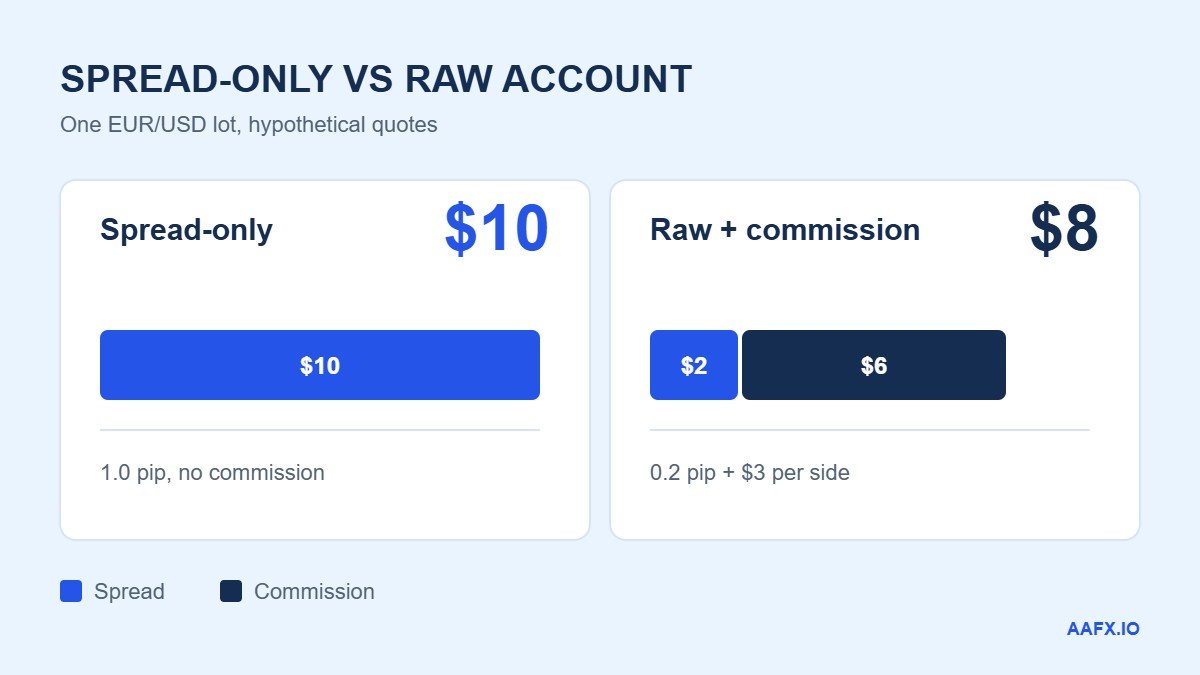
Account A is spread-only at 1.0 pip with no commission, so the trade costs $10. Account B is a raw account quoting 0.2 pip plus $3 per side, so it costs $2 of spread plus $6 of commission, or $8. If B’s spread widens to 0.6 pip, it costs $12 and A becomes cheaper. The break-even point is simple: a $6 round-trip commission equals 0.6 pip, so the raw quote must sit below 0.4 pip to beat a 1.0-pip spread-only account.
| Hypothetical account | Spread cost | Commission (round trip) | Total for one lot |
|---|---|---|---|
| Spread-only, 1.0 pip | $10 | $0 | $10 |
| Raw, 0.2 pip plus $3 per side | $2 | $6 | $8 |
| Raw, 0.4 pip plus $3 per side (break-even) | $4 | $6 | $10 |
| Raw, 0.6 pip plus $3 per side | $6 | $6 | $12 |
The holding period can reverse that result. Suppose a hypothetical position has a constant $10,000 financing base, a 6% annual debit rate and a 360-day year. Each charged night costs about $1.67, so three nights cost $5 and wipe out the $2 saving from the cheaper account. Check each broker’s reference rate, markup, day count and the weekday that carries the weekend charge. Our CFD trading costs guide walks through a full worksheet.
Keep the estimate separate from your profit and loss. If a statement reports profit from your actual entry and exit fills, those fills already include the spread, so do not subtract it again. Start with the fill-to-fill result, then deduct commission and financing shown on their own lines.
Which account protections apply to you
Start with the company name on the agreement. A broker group can run several regulated entities, each with different permissions and complaint routes, and a familiar brand does not tell you which one would hold your money. Open the regulator’s register yourself and match the legal name, website and contact details. The FCA’s guide to checking a firm covers the UK, and our broker licence checklist shows how a real licence number can appear on an unrelated website.
For UK retail accounts, the FCA’s CFD rules cap leverage between 30:1 and 2:1 depending on the underlying asset. Firms must close positions once account funds fall to 50% of the required margin, and negative balance protection stops you losing more than the money in the account. Our leverage and margin guide explains how exposure and collateral interact. If a representative suggests an offshore group company to get higher leverage, repeat every check on the new agreement.
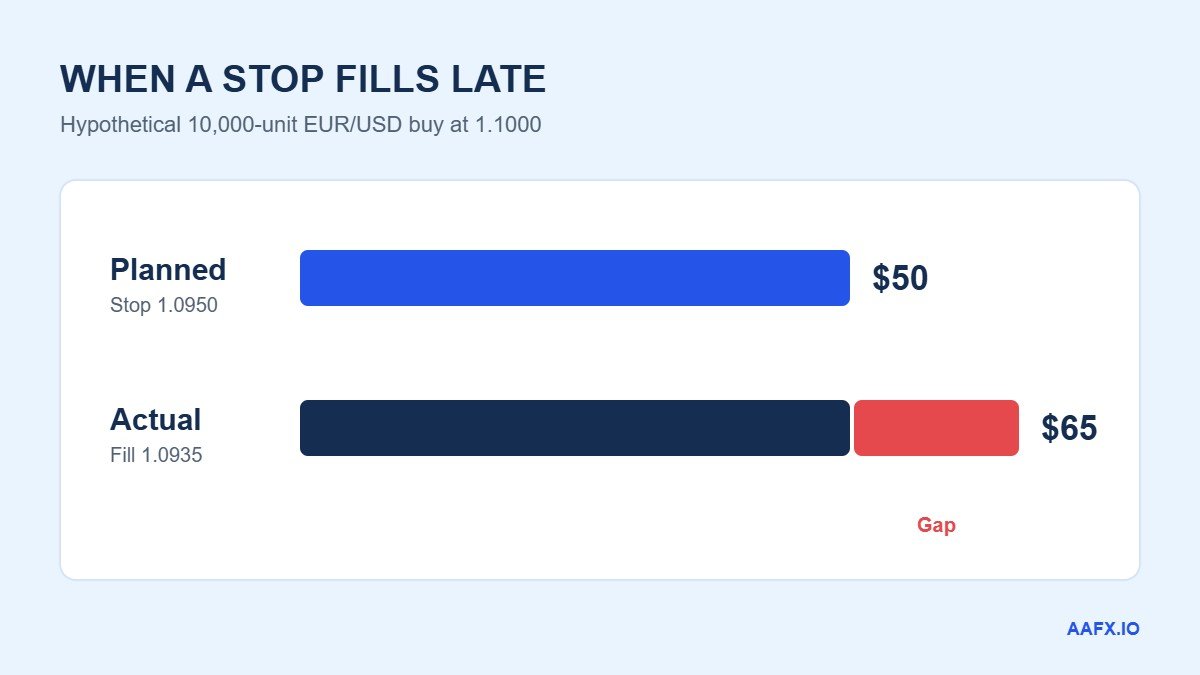
None of these rules sets an exit price for a single trade. A stop-loss is a trigger, not a guaranteed fill. Say you buy 10,000 EUR/USD at 1.1000 with a sell stop at 1.0950, a planned risk of 50 pips or about $50. If the market reopens lower and the stop fills at 1.0935, the loss is $65 before commission. The SEC investor bulletin on order types explains why stop orders behave this way in fast markets.
Ask each broker which side of the quote triggers a stop on your symbol and how orders are handled while the market is closed. Then check the answer against its execution policy. Our guide to trading orders compares stops, limits and guaranteed stops in more detail.
How to test a CFD platform on demo before funding it
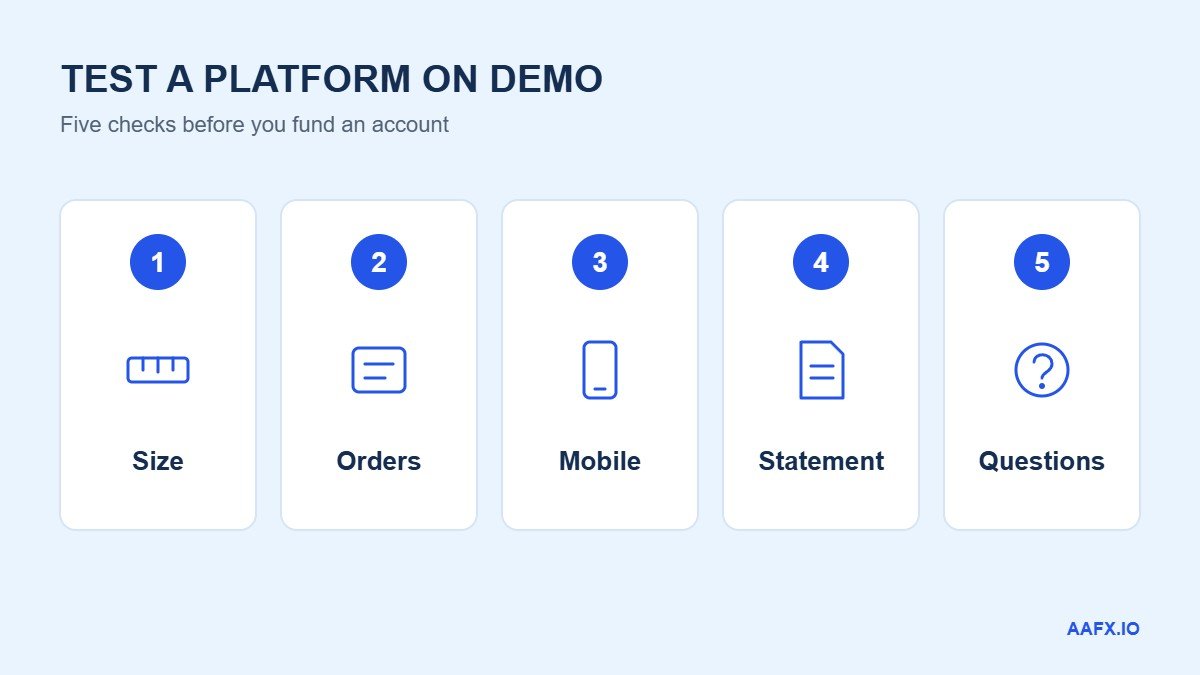
A demo account will not show you live slippage or how a broker handles withdrawals, but it does show whether you can control a trade. Give each platform the same small, repeatable test, using the same market, time window and account currency where possible.
- Size check: open the contract specification, find the unit the ticket uses and work out the loss at your stop before you submit.
- Order control: place a pending limit order, amend it, cancel it, then partly close a second position.
- Mobile check: repeat the steps on your phone and confirm you can tell a pending order from an open position.
- Statement check: export the history and find the fill prices, commission, financing and time zone.
- Open questions: write down what a demo cannot prove, such as withdrawal fees and support response times.
If the ticket’s estimated loss disagrees with your own arithmetic, check the pip or point value and whether the volume box expects units, lots or contracts. That one mismatch causes more oversized trades than any difference in commission.
A trade placed late in your evening may land on the next broker statement date, so note the server time. For withdrawals, ask in writing whether funds must return to the original payment method and whether an intermediary bank can deduct a fee. Put unanswered questions in your comparison rather than giving a platform credit for an assumption.
Who should skip these three CFD platforms
These accounts are built for active, cost-aware traders, and they are not the right tool for everyone. If you want long-term ownership of a company, dividends paid as a shareholder or voting rights, buying the share is a better fit. Our comparison of CFD trading and stock trading sets out the differences.
Skip them too if you live somewhere only an offshore entity will accept you and you cannot confirm who regulates it. The same applies if the smallest tradable size already risks more than you can afford to lose. A new trader who has not yet practised sizing and stops should spend time on a demo account and read our guide to CFD trading risks first.
Finally, if you hold positions for weeks, a raw-spread account may not be the cheapest choice. Overnight financing can outweigh a few tenths of a pip saved on entry, so compare the financing schedule before the spread.
AAFX.IO: match the platform to your trade, not the headline score
IC Markets Raw suits traders comparing two commission models across MetaTrader and cTrader. Pepperstone Razor has a clear use case for UK TradingView users. Tickmill Raw gives active forex traders an easy commission benchmark. Before choosing, identify the company that would open your account, price one realistic trade over its holding period and rehearse the exit on demo. Those answers matter more than a two-tenths gap in a published rating.
For more options, browse our forex broker reviews, read the full Tickmill review or work through the CFD trading costs guide. For short market explainers, follow @arslaninsights on TikTok and AAFX.IO on Instagram.
Affiliate disclosure: AAFX.IO may earn a commission if you open an account through some links on this page. Commercial relationships do not affect our scores, rankings or analysis. Always verify a provider independently before depositing.
Educational information only, not personalised investment, legal or tax advice. Broker terms change, so check the current documents for the entity offering your account. Worked examples are hypothetical and do not represent tested performance or live quotes.
Written and reviewed by Arslan Ali Butt, MPhil Behavioural Finance, MBA Finance, with more than 10 years in forex dealing and market analysis. Last reviewed: 18 November 2026.
How we reviewed this guide: Broker scores come from AAFX.IO’s published Tickmill review and its peer comparison, updated on 9 August 2026. Commissions, platform access, entities and FCA rules were checked against the linked provider and regulator documents on 18 November 2026. Calculations use stated hypothetical inputs. No new live trades, deposits or withdrawals were made for this comparison.
Frequently Asked Questions
Is a zero-spread CFD account free to use?
No. A spread advertised from zero describes a possible minimum, not the price you will always get. Raw accounts add a fixed commission on entry and exit, and the spread widens in quiet or volatile periods. Holding past the daily rollover can also add financing. To estimate the real cost, multiply the expected spread by the pip value, add both sides of commission, then add any holding or currency conversion charges.
Which is cheaper, IC Markets Raw or Tickmill Raw?
On published forex commission alone, Tickmill UK’s $3 per side beats IC Markets EU’s $3.50 per side on MetaTrader, a $1 difference per round-trip lot. The spread you actually receive can easily outweigh that gap, and the two figures come from different regulated entities. Compare both accounts on the same pair, lot size and trading session, and include financing if you hold overnight.
Can I use TradingView with a Pepperstone Standard account?
Not for CFD trading in the UK. Pepperstone’s UK TradingView page lists CFD Razor as the compatible CFD account and states that TradingView is not available on the Standard CFD account. A UK spread betting account can also connect, but it is a separate product. If trading from TradingView charts is your main reason for choosing Pepperstone, check the account type before you apply.
Is cTrader commission the same as MetaTrader commission at IC Markets?
No. IC Markets EU charges $3.50 per standard lot per side on MetaTrader but $3 per $100,000 of US dollars traded per side on cTrader. Because cTrader commission follows dollar turnover, a EUR/USD lot at 1.10 costs about $3.30 per side. The bill therefore moves with the exchange rate. Price the same trade on both platforms in your account currency before deciding which one suits you.
Are these CFD brokers regulated?
Each broker operates regulated entities, but regulation applies to the company that opens your account, not the brand. The examples here come from IC Markets (EU) Ltd, regulated by CySEC, and from UK entities of Pepperstone and Tickmill authorised by the FCA. Groups also run offshore companies with lighter rules. Check the legal name on your agreement against the regulator’s own register before you deposit.
What leverage can UK retail CFD traders use?
Under the FCA’s retail CFD rules, leverage is capped between 30:1 and 2:1, depending on the underlying asset. Major currency pairs sit at the top of that range, while individual share CFDs are capped at 5:1. Professional clients can be offered more, but they give up some retail protections. Higher leverage increases how fast losses build, so size positions from the money at risk.
Does negative balance protection guarantee my stop-loss price?
No. Negative balance protection limits your total loss on a covered retail account to the money in that account. It does not control the price at which an individual stop order fills. An ordinary stop becomes a market order once triggered, so a gap can fill it well beyond your level. Only a guaranteed stop, where offered, fixes the exit price, usually for a fee.
Can I compare a forex lot with an index CFD lot?
Only after converting both into money at risk. A standard forex lot usually represents 100,000 units of the base currency, while an index CFD’s value per point comes from the broker’s contract specification. A volume of 1.00 on two different tickets can therefore carry very different exposure. Compare the cash effect of the same price move before looking at commission or the margin each trade needs.
What if I want a swap-free CFD account?
Read the eligibility rules, the instruments covered, any grace period and the administration fee charged on longer holdings. Some brokers replace overnight financing with a flat fee after a set number of nights, which can cost more on a long trade. Ask the broker for a written example using your symbol and expected holding period, then compare it with the standard financing schedule.
Should beginners trade CFDs on a raw-spread account?
A beginner’s first priority is controlling risk, not saving a fraction of a pip. Raw accounts can be cheaper for active traders, but they add a commission line that is easy to misread when sizing trades. Start on a demo account, learn how the ticket measures volume and practise placing stops. Only move to a funded account once you can predict the loss at your exit.
Sources & Methodology
Primary-source standard: Market-moving facts should link to original data releases, regulator notices, company filings or official project announcements whenever available. Secondary reporting is used for additional context, not as a substitute for original evidence.
Page last reviewed: